A board member who runs a childcare center cannot make a 6 p.m. meeting without paying a sitter. You could pay her. The question is what that costs, and the sitter is the harder half.
The Short Answer Is Yes
Nothing in federal tax law forbids it. The norm runs the other way: BoardSource describes volunteer boards as the model most US nonprofits use, and treats pay as conditional. State law mostly enables rather than forbids, but your own bylaws may forbid it outright. Outcomes turn on your facts and state law, and this is not legal advice for your situation.
Catch One: The IRS Already Treats Your Directors as Insiders
A voting member of your governing body is a disqualified person under section 4958, the intermediate sanctions rules. The status comes with the seat. A non-voting advisory seat sits outside that automatic category, though real influence over budgets or pay can still make someone disqualified on the facts.
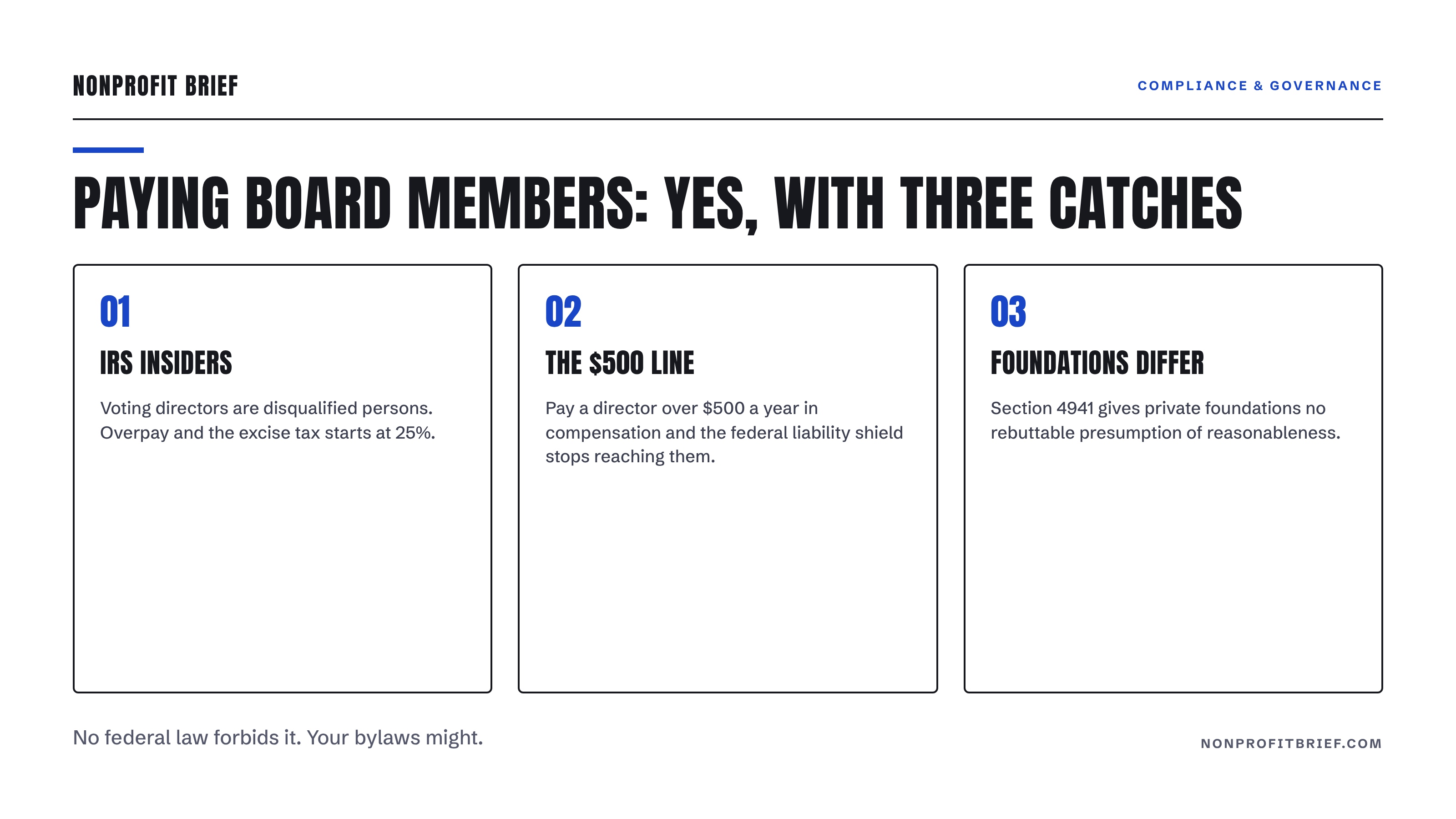
Pay one more than what you get back and that is an excess benefit transaction. The tax is 25% of the excess, owed by the recipient, plus a further 200% if it is not corrected within the taxable period. Directors who knowingly approved it can owe 10% personally, up to $20,000 per transaction, unless their participation was neither willful nor unreasonable.
The way out is cheap. The regulations give you a rebuttable presumption of reasonableness for three steps. Obtain and rely on comparability data before deciding; under $1 million in gross receipts, three comparables in similar communities suffices. Approve the arrangement in advance, through a body with no conflict in it. Then document the basis concurrently, defined generously: records prepared by the later of your next meeting or 60 days after the vote, then approved as accurate and complete.
One step comes before those three, and small charities miss it. Unless you indicate in writing that the payment is compensation, on a 1099, the 990, or in the approving minutes, the regulations do not treat it as paid for services at all, and the whole amount is excess.
Rebuttable means the IRS can still rebut it. The member being paid leaves the room and does not vote, so write a conflict of interest policy that handles recusal first. The same analysis governs paying a founder.
Catch Two: A Stipend Over $500 Can Cost a Liability Shield
The federal Volunteer Protection Act of 1997 shields a nonprofit volunteer from personal liability, and the statute says the term volunteer includes a director, officer or trustee. But it defines a volunteer as someone receiving no compensation, and nothing of value in lieu of it, above $500 a year. Reasonable reimbursement for expenses actually incurred does not count. A stipend does. Pay $600 and the definition no longer reaches that director.
It requires the volunteer to be acting within scope and, where the state demands it, properly licensed. It drops away for gross negligence, reckless or criminal misconduct, and vehicle accidents, and never applies to civil rights violations or acts under the influence. It protects the individual, not your organization, and not when the nonprofit is suing. States can elect out of it for in-state suits in their own courts.
The shield is narrower than its reputation. Most states have their own volunteer immunity statutes with their own compensation rules, so check yours and call your broker before the vote about your directors and officers coverage.
Catch Three: Private Foundations Play a Different Game
If you are a private foundation, section 4958 is not your rule. Section 4941 is, and it starts from the opposite presumption: paying a disqualified person is self-dealing unless an exception applies.
The exception covers compensation, and expense reimbursement, for personal services reasonable and necessary to the exempt purpose, where the amount is not excessive. Government officials are excluded. Foundation board fees are common and legitimate, but there is no rebuttable presumption under 4941, so comparables and minutes do not create one. The tax is 10% of the amount involved on the self-dealer for each year in the taxable period, with no knowledge requirement, plus 5% on a knowing manager, 200% more if uncorrected, and 50% on one who refuses to fix it.
Your determination letter says which you are, as does whether you file Form 990 or 990-PF.
What Is Not Compensation, and What Only Looks Like It
Mileage, airfare and out-of-pocket program costs are reimbursable tax-free. Directors are usually not employees, but an accountable plan is the standard for documenting their reimbursements: a business connection, substantiation to you, and any excess advance returned within a reasonable time. Miss one and every dollar paid becomes taxable.
The sitter is different, where the warm instinct goes wrong. Childcare is a personal expense, not a deductible business one, so an accountable plan cannot carry it. Reimbursing it is taxable income to your director and counts as compensation for 4958. It may well count against the $500 threshold too: the statute excludes reimbursement for expenses actually incurred, without saying whether that means business expenses, so assume the conservative reading. To solve her childcare problem, you are paying a stipend. Price and document it as one.
One Thing You Probably Heard Wrong
A common warning says paying directors wrecks your Form 990 independence count. Reasonable director fees do not. The Form 990 instructions, in the glossary entry for independent voting members, exclude reasonable compensation for board service from the $10,000 independent contractor test, and director fees are not compensation as an officer or employee. Being paid as staff breaks independence; a reasonable director fee does not. It can still break if the director takes over $10,000 as a contractor for non-board work, or if the director or a family member is in a Schedule L transaction. Recheck your minimum board size. The three legal duties do not change when a stipend appears.
The takeaway
Confirm your bylaws allow it. Write down that the payment is compensation. If you are a public charity, build the 4958 record: comparables first, advance approval by a conflict-free body, minutes within 60 days. If you are a foundation, get the 4941 personal-services analysis right instead, because no safe harbor is waiting. Call your broker about the $500 threshold. And tell the recipient that director fees are self-employment income, reportable on Form 1099-NEC at $2,000 or more and taxed as self-employment once net earnings reach $400, so $600 nets closer to $515.
Then ask whether a different meeting time, honest mileage reimbursement, or a non-voting advisory seat gets her to the table for less.