The determination letter arrives, you send your first email appeal, and somewhere in that happy blur a compliance obligation quietly attaches: in most states, you were supposed to register with a state agency before you asked anyone for money. Charitable solicitation registration is one of the most commonly missed legal requirements in the sector, mostly because nothing in the federal exemption process mentions it. Your 501(c)(3) status comes from the IRS; permission to ask for donations comes from the states, one at a time.
The Ask Triggers the Rule, Not the Gift
State registration statutes regulate solicitation — the request itself — rather than the receipt of money. Sending an appeal letter, posting a fundraising campaign, texting a donate link, or putting a QR code on an event flyer all count, whether or not anyone gives. The National Council of Nonprofits notes that solicitation today includes websites, social media, text messages, and QR codes, even where state statutes were written for direct mail and phone banks. Registration is generally required before the first ask, and most states then require annual or biennial renewals, with late fees when you miss them.
Where You Have to Register
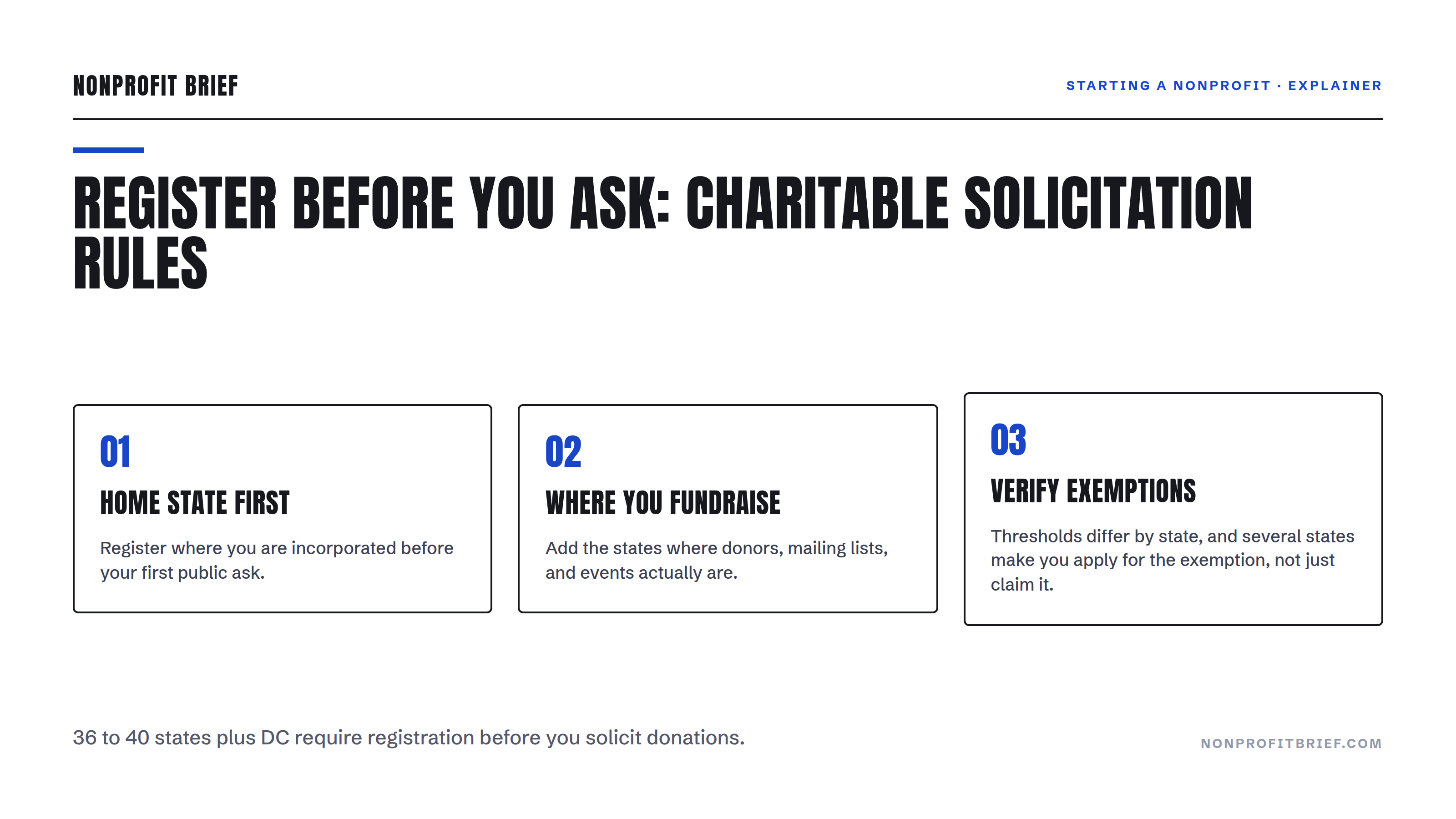
The IRS puts the count at approximately 40 states with charitable solicitation statutes on the books. In practice, as of mid-2026, compliance firm tallies put broad registration requirements at 36 to 40 states plus Washington, DC, depending on how the edge cases are counted. Roughly ten states impose no general charitable registration: Delaware, Idaho, Indiana, Iowa, Montana, Nebraska, South Dakota, Utah (which dropped its general requirement effective 2025), Vermont, and Wyoming. A few others regulate only narrow cases: Texas limits its requirements to law enforcement, public safety, and veterans organizations, and Louisiana registers charities only when they use paid professional solicitors or fundraising counsel. These lists drift as legislatures act, so check the current rule in any state you care about rather than relying on a chart you saved two years ago.
Start with your home state, since operating and soliciting where you are incorporated almost always triggers registration there first. Then add states where you actively raise money: mailing lists, event invitations, grant applications to out-of-state foundations in some states, and paid fundraising campaigns all create contacts regulators look at.
Your Donate Page Is the Complicated Part
A website reaches all fifty states, which raises an uncomfortable question: does a donate button mean you must register everywhere? The closest thing to an answer is the Charleston Principles, advisory guidelines the National Association of State Charity Officials approved in 2001. Under that framework, a passive donation page alone generally does not require registering in a state, but registration is expected where you target residents of that state or receive repeated and ongoing or substantial contributions from it. The catch: the principles are guidance, not law, states apply them unevenly, and the trend among regulators runs toward stricter readings: a growing number treat even a passive donate page as enough to require registration. Florida, for one, applies its own broad statutory definition of solicitation instead of the principles: an ask made in or from the state counts, whether or not any contribution results. Email is simpler and stricter: appeals sent into a state are solicitation in that state under the same framework.
Exemptions Exist. Verify, Don't Assume
Most states exempt certain organizations: religious congregations are the most common carve-out, and many states exempt accredited educational institutions, some hospitals, membership organizations that solicit only their own members, and small organizations under a revenue threshold. The IRS's Pennsylvania example illustrates the pattern: organizations raising $25,000 or less annually may be exempt there if no one is paid to solicit. Two cautions. Thresholds and definitions differ by state, and several states require you to apply for the exemption and receive confirmation rather than simply claiming it. An exemption in your home state says nothing about the next state over.
A Sane Order of Operations for a New Nonprofit
Register in your home state before your first public ask, ideally while you are waiting on the IRS, the same season you are choosing between Form 1023 and 1023-EZ. Once real fundraising starts, list the states where donors, mailing lists, and events actually are, and register there next, prioritizing states where you solicit deliberately over states where a stray online gift arrived. Budget for it: filing fees are modest individually but add up across states, which is why many small organizations register in a handful of states and geofence the rest of their paid campaigns. If you are a sponsored project rather than your own entity, this burden mostly is not yours: fundraising typically runs under your fiscal sponsor's registrations, which is one of the model's quieter advantages. And if you hire outside fundraising help, know that professional solicitors and fundraising counsel carry their own registration and contract-filing requirements in many states.
The takeaway
Charitable solicitation registration is unglamorous, fragmented, and real. The rule of thumb: register at home before you ask, add states where you genuinely fundraise, treat your donate page under the Charleston Principles rather than folklore, and confirm exemptions in writing. An afternoon of filings now is cheaper than explaining an enforcement letter to your board later.