The press release says corporate giving went up last year. The same dataset says most companies cut. Both statements are true, and the distance between them is the most useful thing a development director can learn about corporate money this year.
The numbers come from Giving in Numbers, the long-running corporate giving survey from Chief Executives for Corporate Purpose (CECP), which released topline findings in July and whose research director unpacked them in an analysis for Candid published August 11. The survey is in its 25th year and draws on more than 650 multibillion-dollar companies over that history. The full 2026 report lands in October.
The Median Rose While the Majority Cut
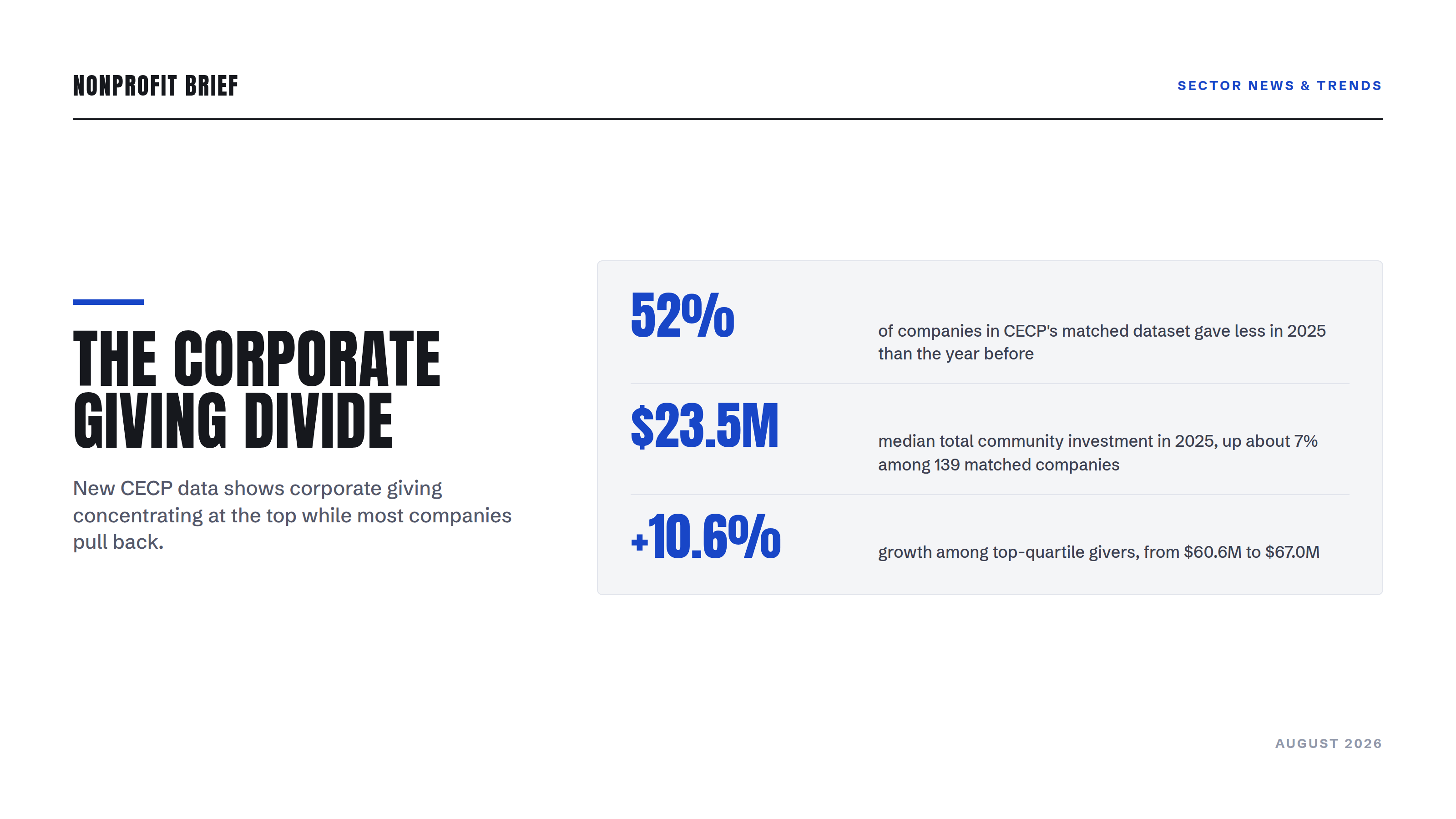
Among the 139 companies that reported total community investments for both years, the median rose about 7 percent, reaching $23.5 million in 2025. Read that line alone and corporate philanthropy looks healthy. Then read the next one: 52 percent of those same companies gave less in 2025 than the year before, and giving across all participants was essentially flat, down 0.2 percent.
Both lines fit together because the growth is concentrated at the top. Companies in the top quartile of givers raised their community investments 10.6 percent, from $60.6 million to $67.0 million. "The headline number tells you giving went up, but that's not really the story," CECP's Kate Stobbe said in the release. A smaller group of companies increased enough to pull the totals up while, as the release puts it, "pullbacks were the more common story on the ground."
This is the decomposition that headline growth rates hide, and it matches the wider picture. Corporate giving reached $43.7 billion in 2025, about 7 percent of all U.S. charitable giving, but was flat once inflation is counted. The pool is not draining. It is pooling in fewer places.
Direct-Service Missions Are Feeling It First
The Candid analysis adds a cause-level detail worth sitting with. Median corporate spending on health and social services fell from $4.95 million in 2023 to $3.55 million in 2025. If your organization feeds people, houses them, or gets them to a clinic, the concentration story is not abstract sector news. It is a line moving in your revenue forecast.
A New Tax Floor Arrives at This Exact Moment
The divide is opening just as the tax math changes underneath it. For tax years beginning after December 31, 2025, a corporation can deduct charitable contributions only above a floor of 1 percent of its taxable income, with the existing 10 percent ceiling still in place. Amounts stuck below the floor generally cannot be carried forward unless the company also exceeded the ceiling that year, and even then the carryforward runs out after five years and faces the same floor again when used. The same law changed the individual side too; our guide to the 2026 deduction rules covers that half.
Here is why the floor lands on the wrong side of the divide. CECP's data puts median corporate charitable contributions at 0.39 percent of pre-tax profit. That is a book measure rather than the taxable-income base the floor uses, but it sits far below the 1 percent threshold on any footing. A company giving at typical levels gets no deduction for its first charitable dollars in 2026, which is a new reason for a finance chief to ask why those dollars are going out at all. The companies with the least slack are the small and midsize firms that sponsor your gala and match their employees' gifts, not the top-quartile giants already scaling up.
What This Means for Your Corporate Pipeline
- Sort your corporate partners by which side of the divide they are on. A top-quartile national funder that grew its giving 10 percent is a candidate for a bigger, longer ask. A regional company that trimmed 15 percent needs a retention call, not a stretch proposal.
- Stop leading with the deduction. For a midsize partner below the floor, the tax argument for a straight charitable gift just weakened. A sponsorship with real marketing value is typically an ordinary business expense for the company rather than a charitable contribution, so the floor does not enter that conversation. How a given company books it is a question for its own tax advisers, but the ask you bring can be built either way.
- Diversify what you accept. The Candid piece urges nonprofits to widen corporate engagement beyond the grant check: sponsorships, skilled volunteering, and in-kind infrastructure support. That advice reads differently once you know most companies are cutting cash.
- Re-qualify before you renew. Corporate funders rewrote their criteria earlier this year. Treat every 2026 renewal as a fresh qualification, and ask your contact directly whether the budget behind your grant grew or shrank.
The takeaway
Corporate giving is not collapsing. It is concentrating, and 52 percent of companies in CECP's matched data cut giving even as the median rose to $23.5 million. A new 1 percent deduction floor adds pressure on exactly the smaller partners most likely to be cutting. Budget corporate revenue for 2027 by partner, not by sector headline, and build asks that work with or without the deduction.