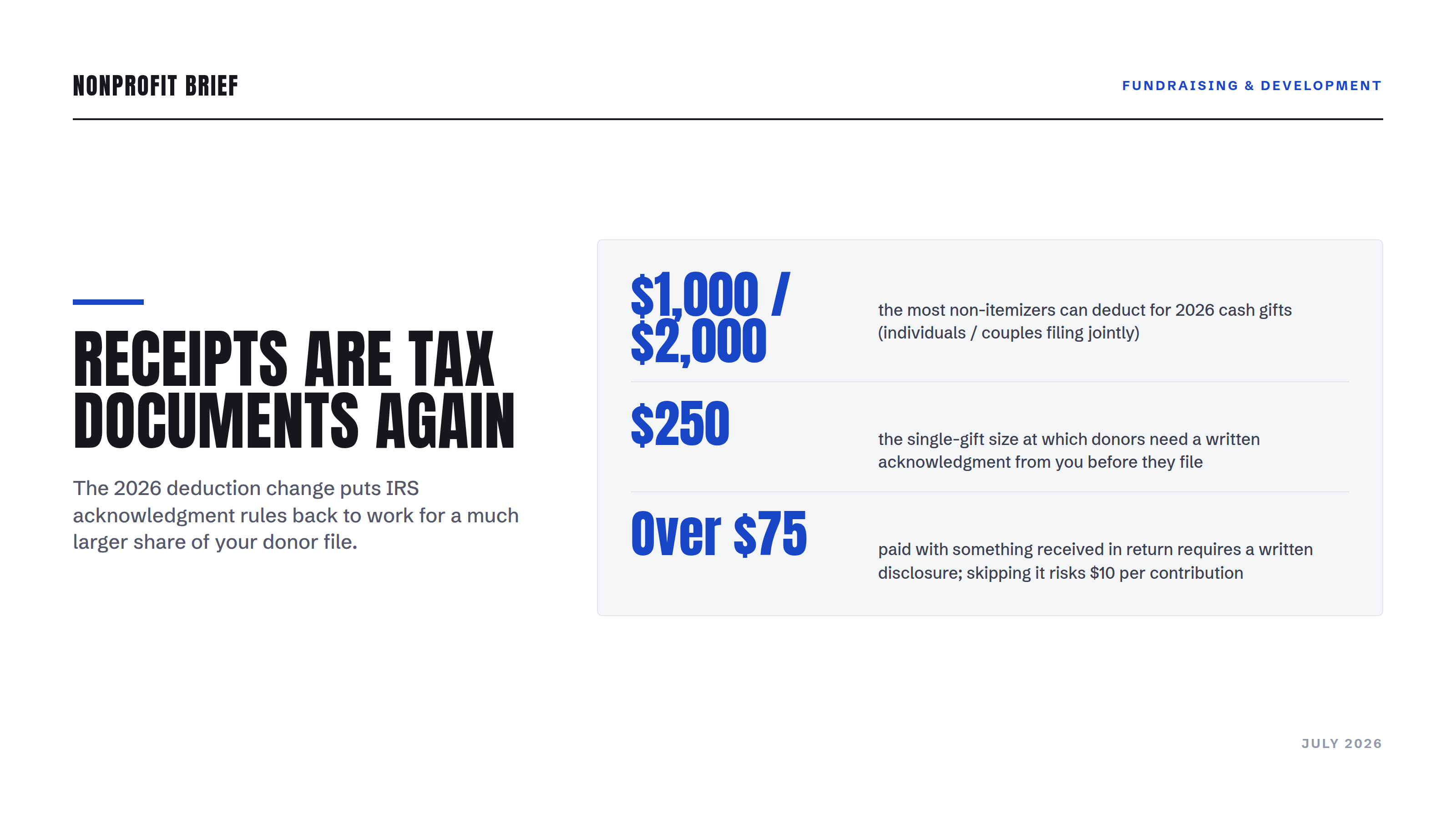
For most of the past eight years, the typical donor got no tax benefit from giving, because the 2017 standard deduction increase moved the large majority of households off the itemizing track. That changes with gifts made this year. Under the tax law passed last summer, non-itemizers can deduct qualifying cash contributions again starting with tax year 2026, up to $1,000 for individuals and $2,000 for couples filing jointly. Not every cash gift counts: the deduction only covers gifts made directly to public charities, so contributions to donor-advised funds, supporting organizations, and most private foundations do not qualify. When a comparable deduction existed in 2020 and 2021, about 90 million taxpayers claimed it, according to Fidelity Charitable. The practical consequence for your shop: acknowledgment letters that have been a stewardship courtesy since 2018 are about to become tax documents again, for a much larger share of your file. It is worth checking that yours actually meet the IRS requirements, which are specific and older than most fundraising software.
We covered what the new deduction means for your appeals when the law changed. This piece is about the paperwork on your side.
The $250 Rule Is the One That Bites
For any single contribution of $250 or more, the donor needs a contemporaneous written acknowledgment from you to claim the deduction. A canceled check is not enough at that level. "Contemporaneous" has a hard edge: the donor must have the acknowledgment in hand by the date they file their return for the year of the gift, or the return's due date if that comes first. A receipt you issue in April after a donor filed in February does not fix anything.
Note where the penalty lands. The IRS does not fine your organization for skipping the acknowledgment; it disallows your donor's deduction. The donor who loses a write-off because your letter never came, or came without the required language, is a donor you will not keep. Receipts are retention work as much as compliance work, and the retention math says you cannot afford the loss.
What Every Acknowledgment Must Say
The required contents are short but exact. The letter or email must include your organization's name, the amount of any cash contribution, and a description (not a value) of any non-cash gift. Valuing donated property is the donor's job, not yours, and putting a number on it can create problems for both sides.
Then comes the sentence most homemade templates miss: a statement about whether you provided any goods or services in return. If you did not, say so explicitly. The standard "no goods or services were provided in exchange for this contribution" line exists because the IRS requires the statement, and acknowledgments that omit it have cost donors deductions. If you did provide something, the acknowledgment needs a description and a good-faith estimate of its fair market value, and if the benefit was entirely intangible and religious, it must say that instead.
The $75 Event Rule Comes With an Actual Fine
Separate rule, and this one does carry an organizational penalty. When a donor pays more than $75 and receives something in return, a gala seat, a dinner, an auction win above the item's fair market value, that is a quid pro quo contribution, and you must give the donor a written disclosure. It has to tell them their deduction is limited to the amount paid above the fair market value of what they received, and it has to include your good-faith estimate of that value. A $200 ticket to a dinner worth $80 buys a $120 deduction, and your paperwork has to make that arithmetic possible.
Skipping the disclosure costs $10 per contribution, up to $5,000 per event or mailing, unless you can show reasonable cause. Small exceptions exist for token thank-you items of insubstantial value and for memberships of $75 or less; the IRS page above links the details.
Small Gifts Still Need a Paper Trail
Below $250, your donor can substantiate a cash gift with a bank record or a written communication from you showing your name, the date, and the amount. Their credit card statement technically covers it. But with the new deduction, a January summary letter totaling the year's gifts is the difference between a donor hunting through statements and a donor who deducts painlessly, remembers why, and gives again. Payroll-deduction donors need a pay stub or W-2 showing the amount withheld, plus a pledge card prepared by or for your organization. For payroll gifts of $250 or more, that pledge card must also state that you do not provide goods or services in exchange for payroll contributions; your name alone on the card is not enough. Worth checking if you run workplace giving.
What to Do Before December
Pull your receipt templates this quarter, the email autoresponder included, and check them against the list above; the missing goods-or-services statement is the most common defect. Make sure event registrations above $75 generate the quid pro quo disclosure with a real fair market value estimate, decided before the invitation goes out. And plan a January summary mailing that totals each donor's 2026 cash gifts, with a line noting that non-itemizers may now deduct up to $1,000 or $2,000 and that donors should ask their own tax advisers what applies to them. You are not in the tax advice business, but you are in the business of making generosity easy to complete.
The takeaway
The 2026 deduction quietly reactivates the tax paperwork for the bulk of your donor file, and the substantiation rules it plugs into are old, specific, and unforgiving of casual templates. Fix the acknowledgment language now, automate the $250 and $75 triggers, and treat the January summary letter as both a compliance document and the cheapest retention touch you will send all year. The organizations that get this right will not win points for it; the ones that get it wrong will hear about it from a donor's accountant.