When New York's Tenement Museum needed relief from the mortgage that was eating its post-pandemic budget, the help came from a charity, but it did not come as a grant. FJC, a New York public charity whose loan fund has advanced more than $364 million to nonprofits, helped restructure the museum's debt, a move the Chronicle of Philanthropy reports cut its interest rate to 1% and will save it $2.5 million in debt payments over five years. The Chronicle's July 24 reporting describes a widening trend: foundations are increasingly pairing grants with loans, loan guarantees, and equity investments, and treating the nonprofits they fund as enterprises that need capital, not just annual budgets.
If a funder floats one of these structures at you, the vocabulary matters, because a loan is a different animal from a grant no matter how mission-driven the lender is.
A PRI Is a Loan With a Charitable Job
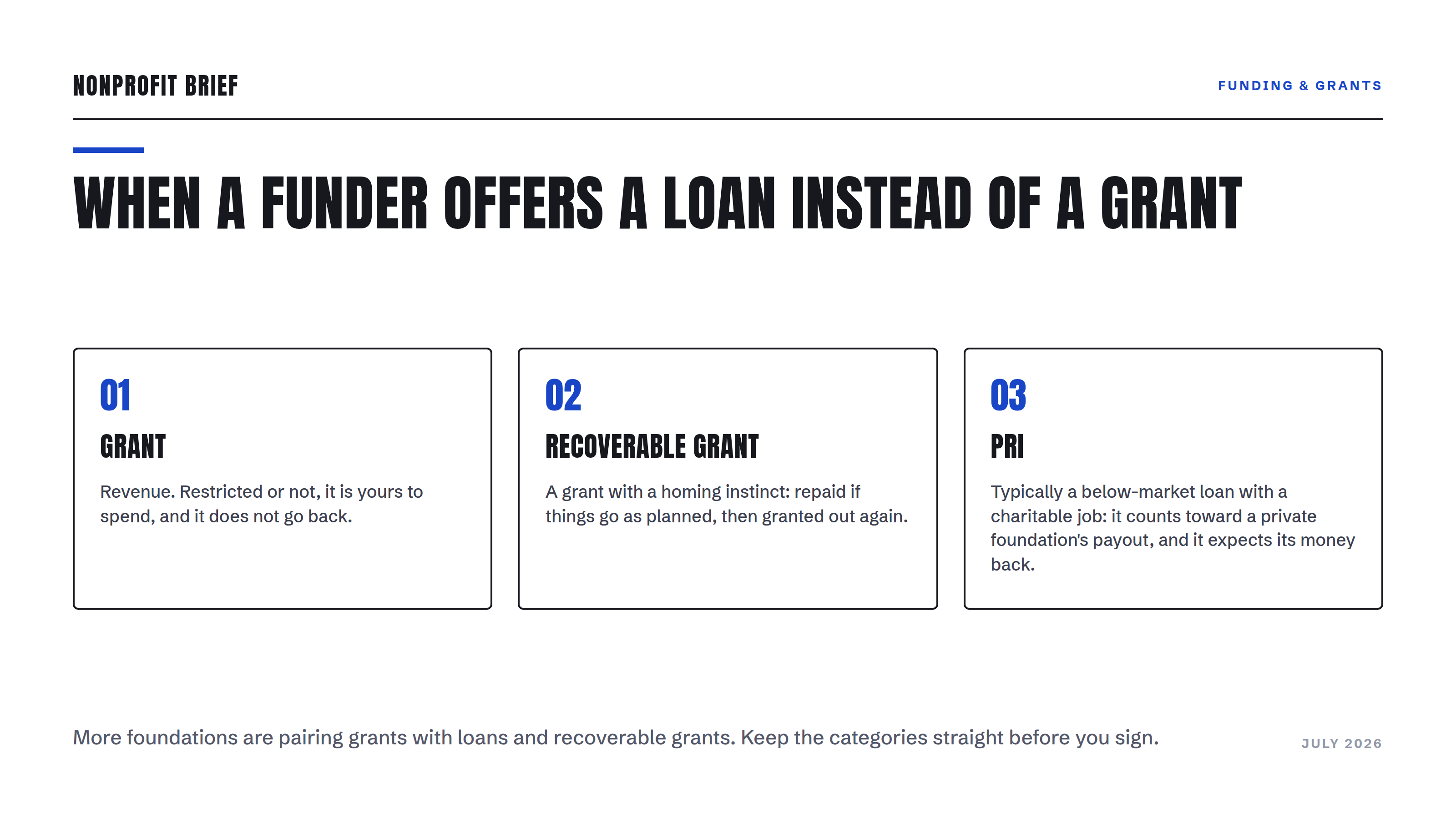
The workhorse structure is the program-related investment, or PRI. Under IRS rules, a private foundation's investment qualifies as a PRI when its primary purpose is accomplishing the foundation's exempt purposes, producing income is not a significant purpose, and lobbying or campaign activity is not a purpose at all. In practice that usually means below-market money: the IRS's own examples include low-interest and interest-free loans and high-risk investments in low-income housing.
Two cousins show up in the same conversations. A recoverable grant behaves like a grant with a homing instinct: as the Seattle Foundation describes it, the nonprofit repays the money after a set period if things go as planned, and the capital flows back to be granted again. Mission-related investments sit at the other end, market-rate positions held in a foundation's endowment. The Chronicle reports the Bush Foundation holds about $70 million in below-market loans and investments, plus a roughly $200 million pool inside its endowment used for market-rate impact investing.
Why Funders Like This Math
PRIs are not charity-flavored banking for its own sake. They count toward the annual payout requirement, the roughly 5% of investment assets that a private non-operating foundation must distribute each year, because the IRS treats them as qualifying distributions. And unlike a grant, the money usually comes back; repayments get added to what the foundation must pay out in future years, so the same dollar can be lent out three times in a decade. The Chronicle notes that Mission Investors Exchange, the network for foundations doing this work, has grown to more than 300 members, including the Ford, Gates, and Rockefeller foundations. Momentum, though, is not ubiquity: most foundations surveyed in the research the Chronicle cites still use no non-grant capital at all, so a loan offer remains the exception, not the default.
A Loan Is Not a Grant on Your Books
For your organization, the difference is structural. A grant, even a restricted one, is revenue. A loan is a liability that sits on your balance sheet until you pay it back, with interest, on a schedule that does not care whether your gala underperformed.
That makes debt a fit for some problems and a trap for others. It works when there is a defined gap between money you are owed and money in hand: bridging slow government reimbursements, financing a building, smoothing a capital campaign's pledge schedule, or refinancing expensive debt, as the Tenement Museum did. It fails when it papers over a structural deficit. If your budget does not balance without borrowed money, a 1% loan does not fix the model; it postpones the reckoning and adds a creditor to it.
What to Ask Before You Sign
Treat a mission lender like a lender. Ask the interest rate and whether it is fixed. Ask the term, the repayment schedule, and whether payments start immediately or after a grace period. Ask what secures the loan: a lien on your building is a bigger commitment than an unsecured note. Ask what happens if you cannot pay, because "we would work with you" is not a contract term. Ask whether the loan displaces grant money you would otherwise have received from the same funder, which the Chronicle notes is a live worry inside foundations themselves. And put it in front of your board and your accountant before you commit, because whether debt strengthens or strains your balance sheet turns on your specific facts, and this is not financial or legal advice for your situation.
The Takeaway
More funders want to be your lender as well as your grantmaker, and that is mostly good news: cheap, patient capital from someone who wants you to succeed beats a bank line you cannot get. Just keep the categories straight. A PRI advances a mission and still expects its money back. Say yes when the loan finances something with a repayment path built in, and say no, politely, when what you actually need is a grant.