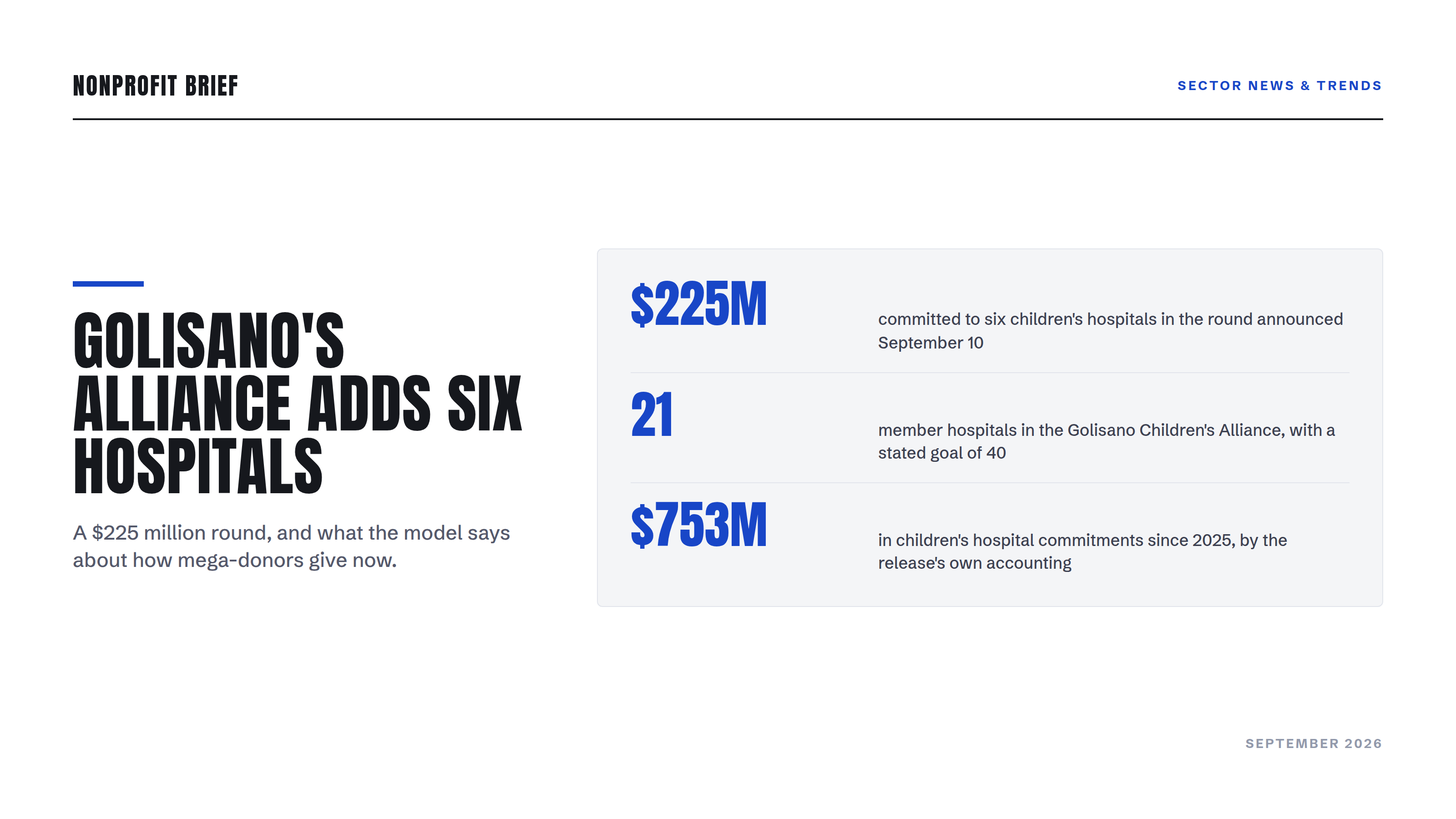
Tom Golisano, the Paychex founder who has spent the past year systematically funding pediatric care, committed another $225 million to six children's hospitals on September 10, expanding his Golisano Children's Alliance to 21 member institutions. The announcement puts his children's hospital commitments since 2025 at $753 million by his team's accounting, with a stated goal of reaching 40 member hospitals nationwide. For fundraisers, the story is less about one donor's generosity than about the model: a living example of how some of the largest individual givers now structure their philanthropy as branded, multi-round networks rather than one-off gifts.
Where the $225 million goes
The six new commitments, as listed in the announcement: $40 million each to Johns Hopkins All Children's Hospital for its Wesley Chapel, Fla., campus now under construction, Renown Health in Reno, Nev., Children's Hospital Colorado for its Colorado Springs campus, and Monroe Carell Jr. Children's Hospital at Vanderbilt in Nashville, Tenn.; $35 million to Children's Minnesota in Minneapolis; and $30 million to Dartmouth Health Children's in Lebanon, N.H. Independent coverage from the Rochester Business Journal confirms the amounts and the alliance's 21-member count.
The alliance launched in October 2025 with $253 million to six hospitals, folding in four hospitals that already carried the Golisano name for a 10-member start. A $100 million round followed in December 2025, then $125 million in April 2026, and now this one. The $753 million cumulative figure is the release's own accounting of his children's hospital commitments since 2025, and it includes a $50 million Buffalo gift made shortly before the alliance existed. The through line, in Golisano's words: "My hope is that no family, no matter where they live or what they can afford, has to travel far or wonder if their child will get the best care available." Member hospitals carry the Golisano name, and the network's stated focus is pediatric care delivery, innovation, and access to treatment closer to home. The release does not detail designated uses for each gift, though recipient statements tie some of them, like the Wesley Chapel campus, to specific projects.
The alliance model is becoming a mega-donor pattern
Golisano's approach rhymes with a broader shift among the biggest individual givers: move fast, give in repeated rounds, and organize recipients into a network with a shared identity. The Chronicle of Philanthropy reports that these are direct personal gifts rather than foundation grants, that Golisano has given more than $1.2 billion over his lifetime, and that he has appeared on the Chronicle's Philanthropy 50 list five times. Where MacKenzie Scott built a model around unrestricted gifts with no strings and no reporting requirements, Golisano is building something different: a named, growing federation with follow-on investment. Both depart from the traditional endowment-and-wing playbook, and both reward organizations that were visible and credible before the donor ever called. We have written about how concentrated the top of the giving market has become in our coverage of the Buffett and Gates giving shifts and the Giving USA 2026 numbers, where growth increasingly rides on a small number of very large decisions.
What development teams can actually take from this
Most nonprofits will never receive a Golisano-scale gift, and chasing one is not a strategy. But three features of this alliance are worth internalizing. First, repeat rounds are the norm at this level: four alliance rounds arrived in under a year, which means a donor's first gift is increasingly an entry point, not a ceiling, and stewardship after a major gift matters more than the proposal before it. Second, mega-donors are picking institutions that anchor a region and can absorb eight figures without drama; audited financials, board depth, and a concrete capital plan are the admission ticket. Third, naming still matters. The sector debates recognition culture, but the largest checks in 2026 continue to come with names attached, and boards should decide their naming policies before the offer arrives, not during it.
It is also a useful data point for anyone building a case that individual giving is healthy at the top even as broad-based donor counts erode. The pattern shows up across this year's reporting: fewer donors, bigger decisions, and more of the total flowing through a handful of hands. That cuts both ways for a small organization, and the honest reading is that pipeline concentration makes retention of ordinary donors more valuable, not less.
The takeaway
Golisano's $225 million round is real money for six hospitals, and it is also a signal. The most active individual mega-donors are giving faster, in repeat rounds, through structures they control and brand. If your organization is in health care, the alliance's march toward 40 members is worth tracking directly. For everyone else, the lesson is about readiness: the organizations receiving these calls had their financials, governance, and regional story in order long before the phone rang. Steward every major donor as if the second gift is the real one, because at the top of the market in 2026, it usually is.