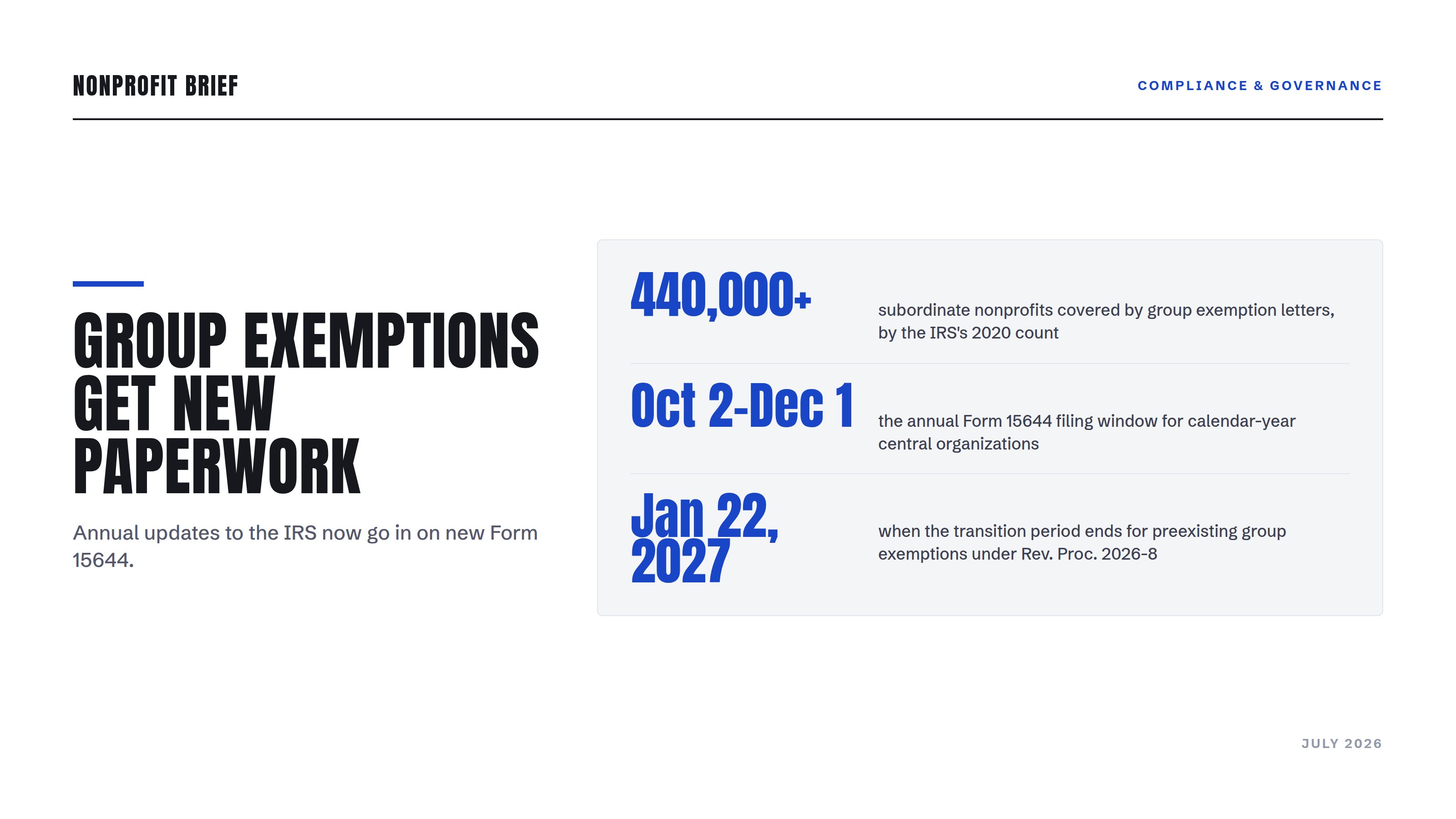
More than 440,000 nonprofits do not hold their own IRS exemption. They borrow one. A national charity, church body, or veterans organization holds a group exemption letter, and its chapters ride along as subordinates, by the IRS's own count as of 2020. The machinery behind that arrangement just got its biggest overhaul since 1980, and as of this month it comes with a new required form.
Annual Updates Now Go on Form 15644
In its July 14 Exempt Organizations Update, the IRS told central organizations, the parents that hold group exemption letters, to use the new Form 15644, Supplemental Group Ruling Information, for the annual updates they owe the agency. The form was created in April and replaces the letter-format submissions centrals have cobbled together for decades. For now, completed forms go in by fax, to 833-312-5228. The new procedure calls for electronic submission once the IRS publishes a process for it; until then, fax is the only live instruction.
The timing rules sit in Revenue Procedure 2026-8: the annual submission is due at least 30 days, and no more than 90 days, before the close of the central organization's annual accounting period. For a calendar-year organization, that works out to a window from October 2 to December 1. Centrals can also send interim updates at any time, and the form has a checkbox for exactly that.
The form itself is short. It asks whether any subordinate has changed its purpose, character, or method of operation; whether any subordinate has been automatically revoked for missing its required annual filings three years running; whether each subordinate remains affiliated with the central and under its general supervision or control; and which organizations are being added to or dropped from the roster.
One carve-out: a 501(c)(3) central organization that is a church or a convention or association of churches may submit the form, but is not required to.
The Rules Behind the Form Changed in January
Form 15644 is the paperwork face of a much bigger shift. Revenue Procedure 2026-8, effective January 20, 2026, superseded Rev. Proc. 80-27, the 1980 guidance that, with one light amendment in 1996, governed group exemptions for 45 years. It also reopened the program: the IRS had stopped accepting new group exemption applications in June 2020 under Notice 2020-36, and the freeze held for almost six years.
The new procedure tightens the rules, as early law firm analysis laid out. A central organization now needs at least five subordinates to obtain a group letter, and at least one to keep it. Each central may hold only one letter. All subordinates under a letter must be described in the same paragraph of section 501(c), though they do not have to match the central's own paragraph. And the procedure finally defines the terms that used to cause arguments: what counts as affiliation, and what a central must actually do to exercise general supervision or control. General supervision is a two-part job: each year the central must obtain, review, and retain information on every subordinate's finances, activities, and filing compliance, and it must also send each subordinate written material (or otherwise educate it) about what keeping tax-exempt status requires.
Groups that already existed get room to adjust. The minimum-count, one-letter, matching, and affiliation-and-supervision requirements do not apply to preexisting group letters and their preexisting subordinates until a transition period ends on January 22, 2027, and any cleanup a group needs has to reach the IRS through its SGRI submissions before that date. A few requirements, including the uniform purpose statement rule for subordinates that share a purpose, never apply to preexisting subordinates at all.
Chapters File Nothing Here, but Should Confirm Plenty
If you run a chapter, post, or affiliate covered by a parent's group letter, this filing is not yours. Your national office files it. But your exemption depends on it being done, so it is worth asking your central three questions: who is handling Form 15644 this year, when does our window close, and is our chapter's information current on the roster. If the answer to the first question is a blank stare, you have learned something important early.
Two boundaries of the group arrangement are worth restating, because they trip people up. First, group coverage does not cover your annual return: unless your central files a group return that includes you, or your chapter qualifies for a filing exception (churches and certain church-affiliated organizations are the big one), your chapter files its own Form 990, 990-EZ, or 990-N every year, and three missed years means automatic revocation regardless of the group letter. Second, if a group letter is terminated, the IRS will not simply keep recognizing former subordinates. Church subordinates keep their status either way, but everyone else needs a new home: joining another central's group letter, or applying for recognition independently. A one-line email to your national office is cheap insurance against both.
Founders Get a Reopened Door
For nearly six years, building a chapter network on a single exemption was simply unavailable, since no new group applications were accepted. That door is open again: new group applications are filed electronically on Form 8940 through Pay.gov, with a user fee, and some entities cannot ride along as subordinates at all, foreign organizations and private foundations among them. A standalone startup still takes the ordinary route, Form 1023 or 1023-EZ, and for a single organization that remains the path. But if your plan involves many local units under one national umbrella, the group exemption is back on the menu, now with clearer rules and stricter homework. Whether it fits turns on your structure's specific facts, and this is not legal advice for your situation.
The takeaway
If you hold a group exemption letter, put the Form 15644 window on the calendar now: at least 30 days, no more than 90 days, before your year closes, which for calendar-year organizations means October 2 to December 1. Check that your subordinate roster is accurate before the window opens, and start documenting the supervision-or-control work the new rules expect, because the transition period ends January 22, 2027. If you are a subordinate, confirm your parent has this handled and keep filing your own 990-series return. The group exemption program survived its overhaul. The organizations that do well under it will be the ones that treat the annual update as a routine, not a scramble.