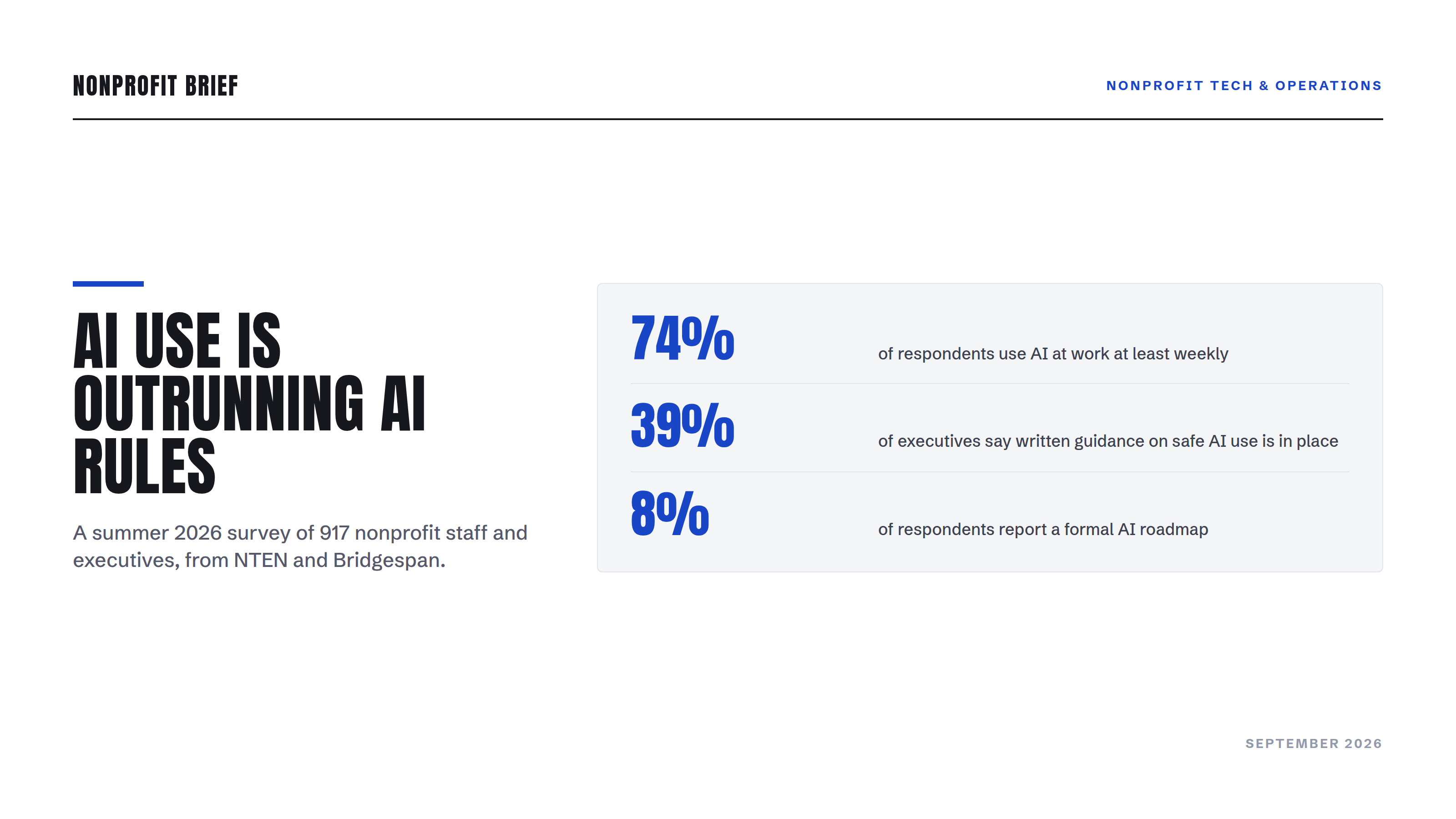
NTEN and the Bridgespan Group surveyed 917 nonprofit staff and executives this summer, and the findings, released September 10, describe a sector that adopted a tool before it wrote the rules for it. Of the 723 respondents who answered how often they use AI in their day-to-day work, 45% said daily or more, and about 74% said at least weekly. Yet only 39% of the 404 executives surveyed said their organization has written guidance on safe AI use in place.
That is the story in two numbers. The people are ahead of the paperwork.
Adoption Happened Person by Person, Not by Plan
The survey, which NTEN fielded with Bridgespan in summer 2026, is one of the larger recent looks at how nonprofits actually use AI, as opposed to how they feel about it. The usage numbers are striking precisely because almost nothing organizational sits underneath them. In Bridgespan's companion report, "Choosing Your AI Path," 70% of respondents agreed their organizations are not taking advantage of meaningful AI opportunities, and only 8% reported having a formal AI roadmap. Money follows the same pattern: 69% said their organization has received no AI-related funding at all.
In other words, the typical setup right now is individual staff experimenting on their own, with no budget, no plan, and no funder support behind them. Anyone who has watched a new tool spread through a small shop will recognize the shape.
The Governance Checklist Is Mostly Unchecked
Governance here just means the boring infrastructure: who owns the question, what the rules are, and what money and training support it. The NTEN report asked executives what is actually in place today, and the answers run well behind the usage data. Written guidance on safe AI use: 39%. A named owner or group responsible for AI oversight: 42%. A budget designated for AI: 17%. Staff training on using the tools well: 18%. Data organized enough to support AI use: 24%.
None of those items is exotic. They are the same things an organization would put in place for any system that touches donor records, client information, or program data. The risk in skipping them is not abstract: without a stated line, nothing stops staff from pasting real constituent information into consumer AI tools, because nobody has told them where the line is.
Executives and Staff Are Not Reading the Same Room
The Chronicle of Philanthropy's write-up of the data points at a second gap, this one inside the building. Executives were roughly twice as likely as staff to strongly agree that their organization has untapped AI opportunities, 44% to 23%. The two groups worry about different things, too: more than half of executives cited data, privacy, and security concerns as the biggest barrier, while staff were most worried about the technology's environmental impact. Only about a third of staff said they were significantly concerned about losing their job or being pushed into a different role.
For a leadership team, that split matters more than any single adoption number. If the boss sees promise and the staff see risk, an AI push announced from the top will land badly, and quiet individual use will continue either way, just without guardrails.
Start With Guidance, an Owner, and a Budget Line
The fix is smaller than it sounds, and most of it is handled with decisions rather than dollars. Bridgespan's data suggests staff would welcome it: 62% of respondents said clear organizational guidelines or policies would significantly help them use AI more confidently and responsibly. A one-page policy that names approved tools, bans constituent data in unapproved ones, and tells staff who to ask beats a perfect policy that ships next year. Naming an owner, one person or a small group who tracks tools and fields questions, costs nothing. A small dedicated budget line, even a few hundred dollars for paid tiers and training, turns scattered experiments into something you can direct. On the training side, free options built for nonprofits already exist, so the gap between 18% and the rest is mostly a scheduling problem.
What this survey should not produce is an AI strategy retreat. The data says your staff are already past the "whether" question. The remaining work is the ordinary kind: rules, roles, and money.
The Takeaway
New NTEN and Bridgespan data out this week puts numbers on something many EDs already sense: AI use in nonprofits is routine, and AI governance is rare. About 74% of respondents use AI at least weekly, but the executives surveyed report written guidance at only 39% of organizations, a named owner at 42%, and an AI budget at 17%, and across all respondents just 8% report a formal roadmap. The gap between those numbers is now a management problem, and it closes with a one-page policy, a named owner, staff training, and a modest budget line, in that order.