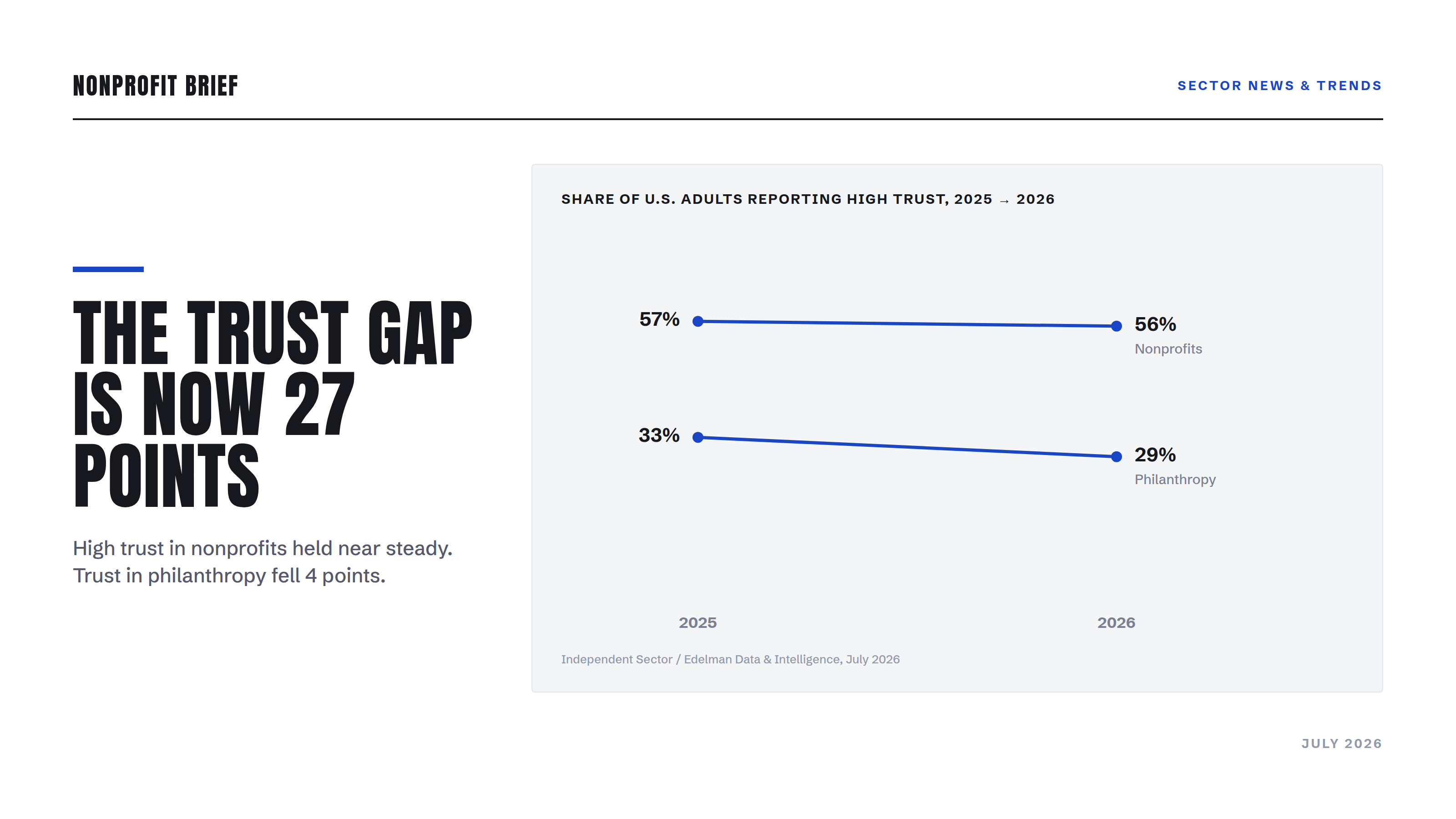
On July 22, Independent Sector released the seventh edition of its annual survey on public trust in the sector, conducted with Edelman Data & Intelligence. The headline number barely moved: 56% of Americans say they place high trust in nonprofits, a point below last year's 57%. The number worth your attention is the other one. High trust in philanthropy fell 4 points to 29%, leaving a 27-point gap between how the public sees nonprofits and how it sees the institutions that fund them.
Nonprofits Are Still the Most-Trusted Institutions in the Survey
The study, based on a survey of 3,000 U.S. adults with a 2% margin of error, plus politically balanced focus groups run in April, again found nonprofits ahead of government, corporations, and the media on trust. The advantage is specific, not vague goodwill. Respondents trusted nonprofits over corporations to follow laws and regulations (51% versus 35%), to stay accountable to the communities they serve (49% versus 34%), and to use their funds responsibly (47% versus 31%).
Trust also held across party lines: 64% of Democrats and 58% of Republicans report high trust in nonprofits. In a year when most institutions split the electorate, a 6-point partisan gap is remarkably narrow. The comparison institutions did not come close. Among the 10 comparison sectors the survey tested, the military ranked highest and still trailed nonprofits by 12 points.
Under the stable topline, the subsector picture softened slightly. Seven of nine nonprofit subsectors ticked down, though only one decline was statistically significant: civic organizations, which fell 4 points. The rest moved within the survey's 2% margin of error, which Independent Sector's research team reads as stability. Human services organizations remain the most trusted at 67%, followed by animal and wildlife groups at 61%. One cause area moved sharply the other way: support for nonprofits providing community services for legal immigrants rose 7 points, the largest gain in the survey.
Philanthropy's Slide Is Your Problem Too
The 29% trust figure for philanthropy is the report's sharpest warning. Total giving hit a record in 2025, driven more by bequests and foundations than by everyday donors, yet confidence in foundations and major donors as institutions keeps eroding. For an executive director, that gap has practical consequences. Public skepticism of large funders feeds directly into policy debates over foundation payout requirements and donor-advised funds, and it colors how your community reads a major gift announcement.
The report's advice runs through visibility into money. "This new research shows that connection is an essential part of trust. Americans want to see how organizations use their funds and feel the impact of an organization in their communities," said Independent Sector president and CEO Dr. Akilah Watkins in the survey announcement. Organizations that treat financial transparency as a compliance chore are leaving trust on the table.
Engagement Builds Trust. Undisclosed AI Can Burn It.
Two findings point to concrete moves. First, direct contact works: 60% of respondents who interacted with a nonprofit in the past year said the experience increased their trust, and the interactions that moved trust most were advocating for a cause with a nonprofit's help, joining a rally or demonstration one organized, and volunteering. Familiarity is doing real work here, and it is work a communications budget cannot buy. It is the same logic that makes retention cheaper than acquisition: the people already inside your building are the easiest ones to convince.
Second, the survey asked about artificial intelligence for the first time, and the public's terms are clear: 76% of Americans agree nonprofits should disclose when and how they use AI. Asked how they would react if a nonprofit they support used generative AI in many of its operations, 37% said they would be less likely to trust it, against 22% who said more likely. That is not a reason to avoid the technology, which is already reshaping nonprofit operations, but it is a reason to have a written answer ready when a donor asks how you use it.
The takeaway
Trust is an operating asset, and this year's data says it compounds through contact and candor. Budget staff time for the things that put people inside your work: volunteer shifts, open houses, and program tours. Publish plain-language financials before anyone asks. If AI touches your donor communications or service delivery, say so in a sentence on your website rather than waiting for the question. And keep your organization's story distinct from your funders'. The public trusts you more than it trusts the money behind you, and that difference is yours to protect.