A first-time $250,000 gift should be pure good news. For a small public charity, it can also start a clock. Every year, Schedule A of Form 990 makes you recompute one fraction: public support divided by total support. Let a single donor grow too large inside that fraction for too long and your organization can slide, automatically, into private foundation status, with the excise taxes and extra paperwork that come with it.
Public Charity Status Is Earned Every Year, Not Granted Once
Most founders think public charity status was settled when the determination letter arrived. It was only proposed there. The classification you picked on your Form 1023 application has to be defended annually on Schedule A, and the IRS gives you two public support tests to do it. Both are measured over a 5-year window: the current tax year plus the 4 prior years. That rolling math is forgiving in one way, since no single bad year decides anything, and unforgiving in another, since a huge gift stays in the denominator for 5 years.
The Default Test Counts Big Donors Only Up to 2 Percent
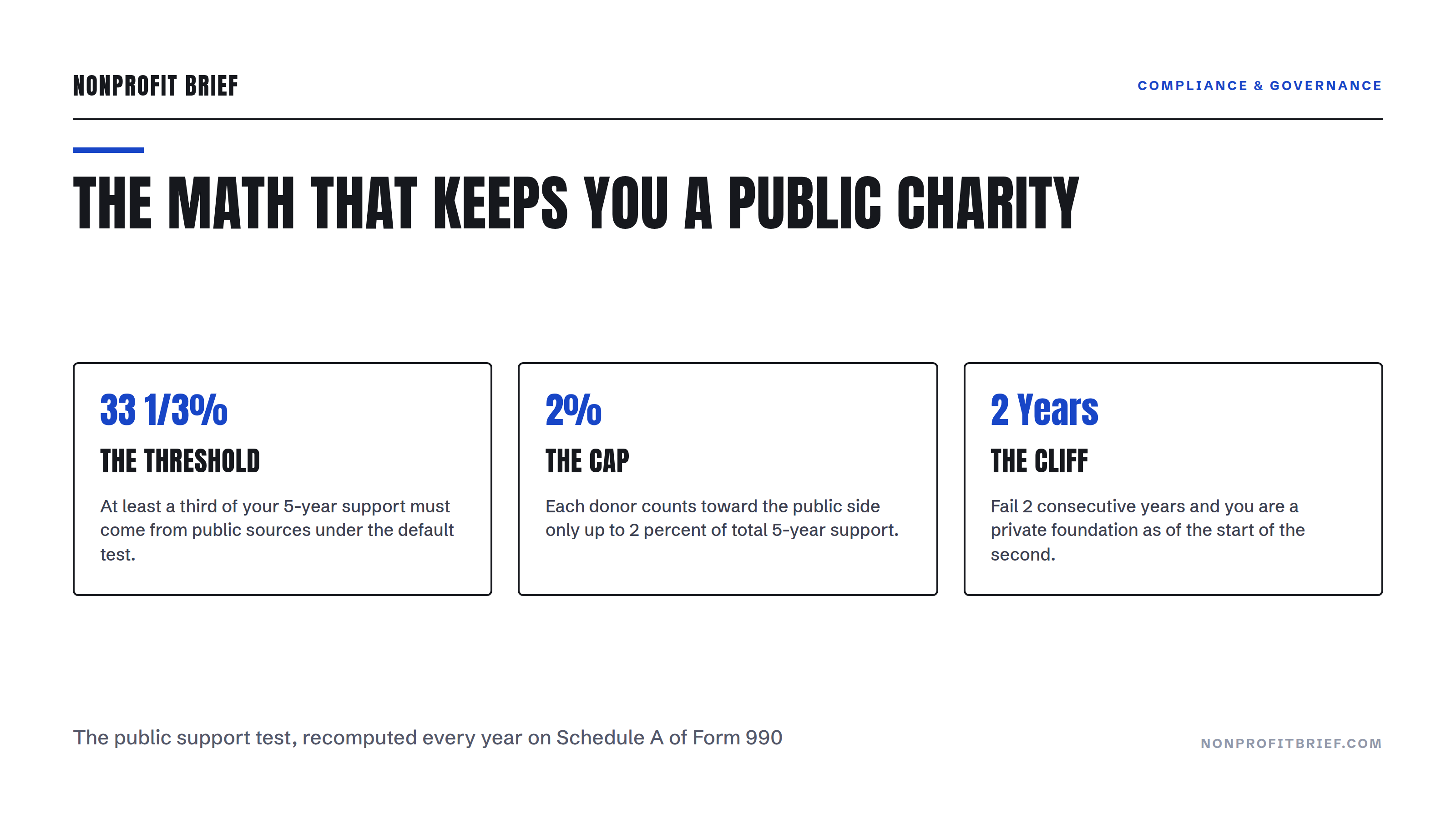
The first test, for organizations classified under sections 509(a)(1) and 170(b)(1)(A)(vi), asks whether at least 33 1/3 percent of your total support came from public sources over the 5-year period. The catch is the 2 percent cap: contributions from any one individual, trust, or corporation count as public support only up to 2 percent of your total 5-year support. This is where boards get surprised. If your total support over 5 years is $2 million, each donor counts toward the public side only up to $40,000. A loyal donor who gave $300,000 still contributes just $40,000 of public support, while the full $300,000 sits in the denominator. The cap is also shared: gifts from a donor's spouse, certain family members, and entities the donor controls are aggregated and treated as one person, so a founder plus the founder's company cannot multiply it. Two sources escape the cap entirely: governmental units and charities that are themselves publicly supported under this same donation-based test. A state grant or a community foundation grant generally counts in full, though a grant that simply passes through money a donor earmarked for you is capped like the donor's own gift, and payments under a government fee-for-service contract are treated as program revenue rather than contributions and stay out of this test entirely. Funder mix matters as much as funder generosity.
Fee-for-Service Charities Use the 509(a)(2) Version
Organizations that earn most of their budget from program fees, admissions, or sales related to their mission usually test under section 509(a)(2) instead. (Schools, hospitals, and churches are their own categories and face no support test at all.) That version requires more than one third of support to come from gifts, grants, membership fees, and gross receipts from activities related to your exempt purpose, with its own concentration limit: receipts from any one payer count only up to the greater of $5,000 or 1 percent of total support for the year, and support from disqualified persons (board members, officers, substantial contributors, their families, and entities those people control) does not count as public support at all. It also adds a ceiling: no more than one third of support may come from investment income and after-tax unrelated business income. Schedule A runs both tests, so an organization that fails one can still pass the other.
Failing Once Costs Nothing. Failing Twice Costs the Status.
New organizations get a grace period: for their first 5 years as a 501(c)(3), they are treated as public charities regardless of the math, and the test first bites in year 6. After that, one failed year changes nothing by itself. Fail 2 consecutive years, though, and the organization is reclassified as a private foundation as of the beginning of the second failed year. For that year, the consequence is filing Form 990-PF and paying the excise tax on net investment income; from the following year, the full private foundation rulebook applies, including the annual minimum payout requirement. The IRS has said it will not assert the tax or penalties for that first reclassified year where the failure was unexpected and the result would be unfair, but relief must be requested and shown: a cushion, not a plan. There is also a middle path, available only under the donation-based 509(a)(1) test: an organization that keeps public support at 10 percent or more can claim the facts and circumstances test by showing, in a written narrative on Schedule A, that it is organized and operated to attract public support, at a minimum; the IRS also weighs factors like how representative the board is and how broadly programs serve the public. That test is judgment-based rather than mechanical; outcomes here turn on your specific facts, and this is not legal advice for your situation.
What to Do When a Gift Is Big Enough to Tip You
Grantmakers call this problem tipping: a grant so large it pushes the grantee below the public support threshold. You have more options than declining the money. First, run the Schedule A math before you accept, not at filing time; your accountant can model the gift's 5-year effect in an afternoon. Second, ask whether the gift qualifies as an unusual grant, which Schedule A generally excludes from the calculation entirely when a contribution from a disinterested party is attracted by your publicly supported nature, unusual and unexpected in its amount, and large enough to endanger your status. Third, talk to the funder; many large foundations will spread a commitment over several years precisely because they watch tipping too. And keep building the base underneath it all: a wide pool of small gifts is what makes the ratio resilient. The same discipline behind donor retention math protects your status as well as your revenue.
The takeaway
The public support test is a 5-year fraction, recomputed every year on Schedule A: at least 33 1/3 percent public support under the default test, with each donor capped at 2 percent of the total, or the 509(a)(2) version for fee-driven organizations. One bad year is survivable. Two in a row makes you a private foundation as of the start of the second. So treat the ratio as a board-level number: have someone report it annually alongside the budget, model any gift that exceeds a few percent of your 5-year support before accepting it, and remember the escape hatches, from the unusual grant exclusion to the 10 percent facts and circumstances test under the donation-based version. The organizations that get tipped are almost never the ones watching the math.