Pull the report from last December's appeal and count the pieces that came back marked undeliverable. For most small nonprofits the number sits somewhere between annoying and alarming, and every one of those envelopes was paid for twice: once in postage, once in the gift that never arrived. Late July is the right moment to deal with it. Year-end campaigns get planned in September and printed in October, which makes August the last quiet month your donor database will see this year.
Retention Is a Data Problem Before It Is a Strategy Problem
The sector's topline numbers look healthy until you read the second line. The Fundraising Effectiveness Project's full-year 2025 data shows fundraising revenue up 5.0% over 2024, the strongest growth in five years. The same report shows the number of donors fell 3.6%, with growth concentrated among major and supersize donors, and overall donor retention at 43.3%, essentially flat against the prior year's 43.1%. Fewer than half the people who gave in 2024 gave again in 2025, and holding steady at that level is nothing to celebrate.
Some of that loss is real attrition. A measurable slice of it is mechanical: the thank-you that bounced, the appeal mailed to an address the donor left two years ago, the household that received three copies addressed to three variants of the same couple and concluded nobody was minding the store. Before you commission a new acquisition strategy, ask how many of last year's "lapsed" donors simply stopped hearing from you. The math on keeping a donor versus finding a new one has not changed: retention is the cheaper fight, and retention runs on accurate records.
Stale Addresses Cost More Than They Did in June
Postage went up this month, and the increase lands hardest on loosely sorted mail, which raises the price of every wasted piece. Address accuracy is also a rules question, not just a thrift question. Under USPS's Move Update standard, mailers claiming First-Class presorted or automation prices, or Marketing Mail prices, must demonstrate through an approved method that their mailing list was updated against change-of-address records within 95 days before the mailing date. Approved methods include NCOA processing, USPS's Address Change Service, and ancillary service endorsements such as "Address Service Requested."
If you use a mail house, it likely handles this by running your file through NCOALink, the Postal Service's change-of-address dataset, via a certified processor. That process can only fix what it can match, though. Records with misspelled street names, missing apartment numbers, or a donor's former married name often fail to match and sail through unchanged. The cleanup work below is what makes the automated tools earn their keep.
Five Fields That Pay for Themselves
You do not need a data warehouse project. You need five things to be true about every active donor record before the appeal file is pulled:
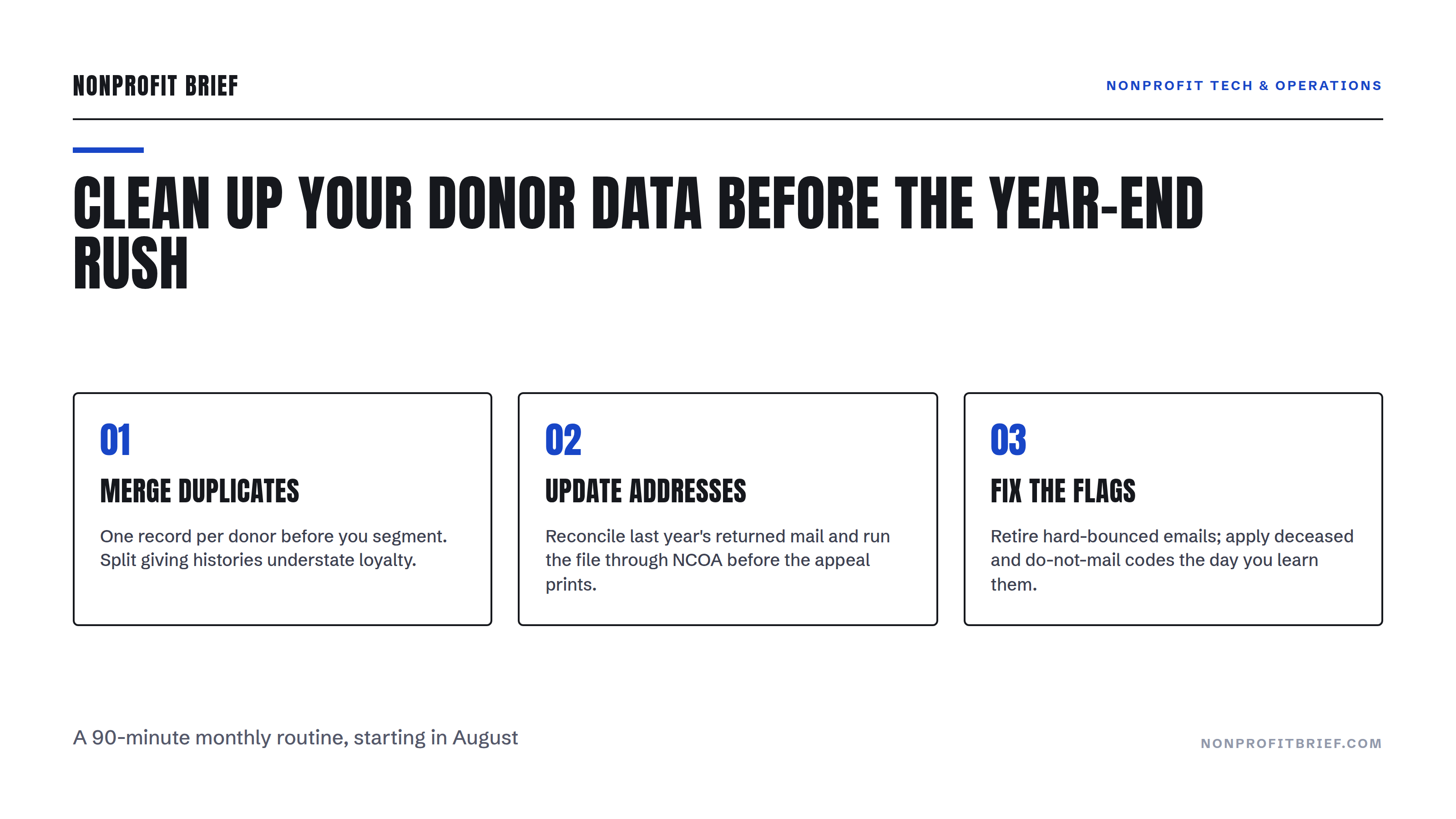
- One record per donor. Merge duplicates before you segment. Duplicate records split giving history, which understates loyalty, which puts your steadiest donors in the wrong appeal tier.
- A current mailing address. Reconcile last year's returned mail now, while the pile is still findable, and let NCOA processing handle the movers you do not know about.
- A working email. Hard bounces should be flagged and re-permissioned or retired, not mailed again. Bounce rates also drag down deliverability for everyone else on your list.
- Accurate gift history. Date, amount, and fund on every gift, because that history drives ask strings, and because it feeds the acknowledgment letters that more of your donors will need for cash-gift deductions in 2026.
- Honest contact flags. Deceased, do-not-mail, and do-not-call codes, applied the day you learn them. Mailing a memorial donor's late spouse is the most expensive kind of cheap mistake.
A 90-Minute Monthly Routine Beats an Annual Rescue
Database cleanup fails as a heroic annual project and works as a boring habit. Ninety minutes a month covers it for most organizations under a few thousand records: run your CRM's duplicate finder and merge what it surfaces, work the bounce and returned-mail lists, apply any flag changes, and spot-check ten random records against source documents. Log what you fixed. In three months the routine gets shorter because the backlog is gone.
Assign it to a named person with a recurring calendar block. Data quality owned by everyone is owned by no one, and the volunteer who "knows the database" is a single point of failure the week before your appeal drops.
The takeaway
Sector-wide, revenue is growing while donor counts shrink, so every donor you already have is worth more defending. A meaningful share of donor loss is mechanical, and the mechanics are fixable for the cost of a few staff hours: merge duplicates, reconcile returned mail, retire dead emails, verify gift history, honor contact flags. Do it in August, before the year-end machine starts, and December's undeliverable pile gets smaller while the thank-yous land where they should.