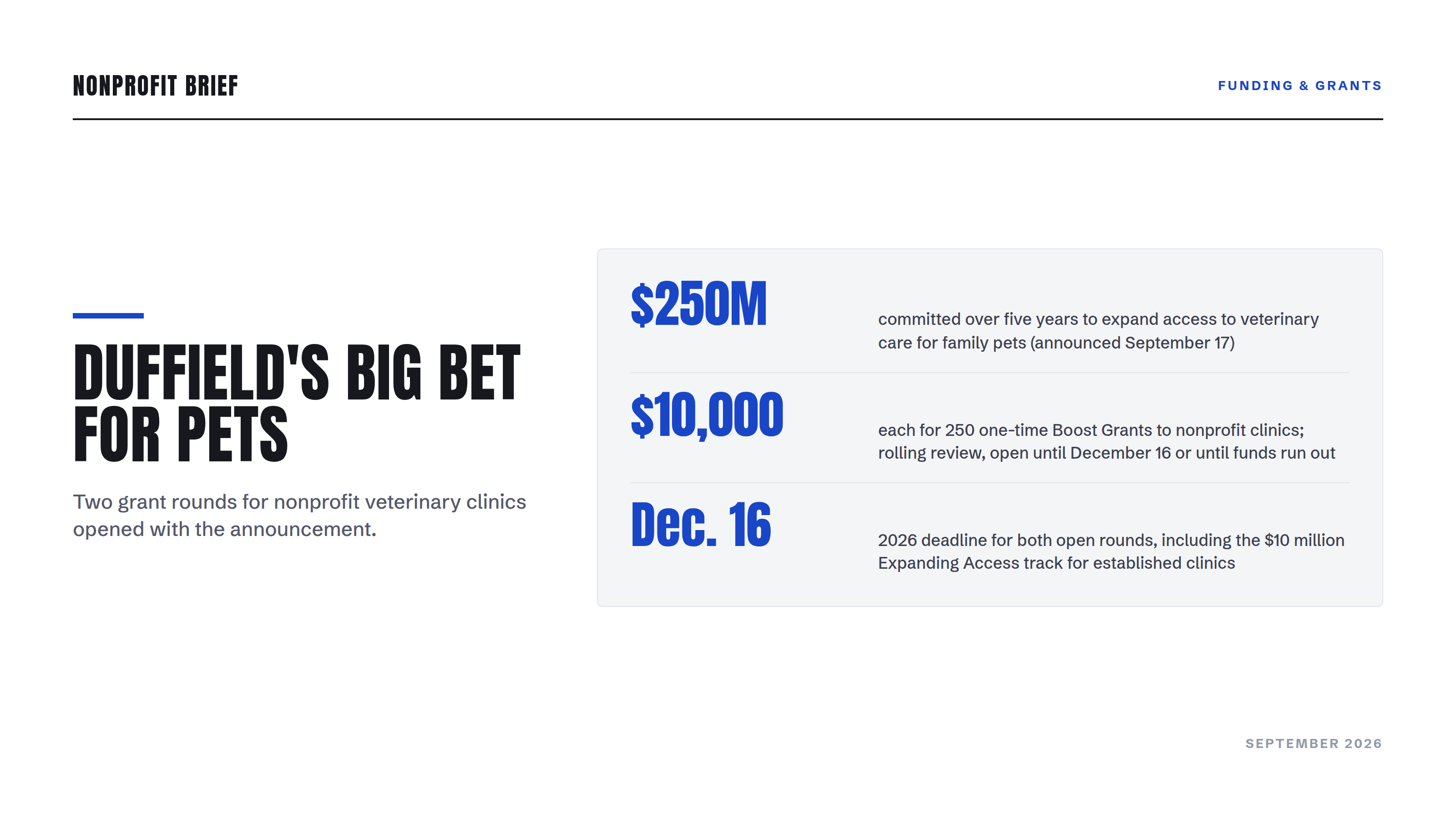
The Dave & Cheryl Duffield Foundation committed $250 million over five years on September 17 to expand access to veterinary care for family pets. The foundation calls the initiative Big Bet for Pets. Most nine-figure pledges arrive as press releases and leave grantseekers waiting. This one arrived with application links: two grant rounds for nonprofit veterinary providers opened with the announcement, and both close December 16, 2026.
Both Open Rounds Close December 16
The Duffield Boost Grants are 250 one-time grants of $10,000 each, a $2.5 million pool for nonprofit and low-cost veterinary care providers nationwide, usable for any project tied to delivering free or low-cost care for family pets. Applications are reviewed on a rolling basis through December 16 or until the funds are spent, whichever comes first, so applying early matters. The foundation's own list of eligible uses is broad for a first-time funder relationship: veterinarian and technician salaries, equipment purchases and repairs, subsidy funds that cover no-cost care, free pop-up clinics, and multilingual marketing and signage. Selection weighs your track record of affordable care and how clearly you describe what the money will do.
The Expanding Access Grants are the larger track: a $10 million pool, per the foundation's announcement, for established nonprofit clinics ready to grow, whether that means new service lines, longer hours, additional locations, or mobile units. The funding is flexible and multi-year, and it can cover salaries, equipment, supplies, renovations, and vehicles. The open call closes December 16, 2026, and the first step is a pre-application describing your expansion plan and the community need behind it, which the foundation asks for in place of a traditional letter of inquiry. The foundation has also scheduled a live question-and-answer session on this round for September 24.
The Direct-Delivery Rule Decides Who Can Apply
Both programs fund organizations that deliver veterinary care themselves, through their own clinic or program. The Boost rules say it outright: organizations that subsidize or cover the cost of care provided by third parties, including voucher programs, are not eligible. The Expanding Access criteria point the same way, since eligibility turns on your organization providing the care. That rule will screen out a meaningful slice of the pet-assistance field, and it is worth absorbing before anyone on your team drafts a word.
The scope is also owned pets, not shelter animals. Both programs fund care for family pets; animals in a shelter's custody do not count toward eligibility, so a shelter qualifies only through work serving owned pets. The two tracks then set different bars. Boost asks for at least one year of providing low-cost or free veterinary services and the intent to keep providing them for the next 12 months. Expanding Access asks for at least three years of track record, at least 2,000 pets served in the last 12 months, and the intent to keep providing low-cost or free care for the next one to three years. Both accept 501(c)(3) organizations, public entities, and projects operating under a 501(c)(3) fiscal sponsor. That last door matters: plenty of community clinics run as fiscally sponsored projects long before they incorporate, and this funder does not make them wait for their own exemption. The service-year minimums still apply either way.
The Money Comes From the Family Behind Maddie's Fund
Dave Duffield, a co-founder of the software companies PeopleSoft and Workday, and Cheryl Duffield have funded companion-animal causes for more than 30 years, most visibly through Maddie's Fund, the foundation the couple created in 1994 and named for their miniature schnauzer. The through line in the new commitment is affordability rather than sheltering. "Pets are members of our families, and they need veterinary care to live long, healthy lives," Dave Duffield said in the announcement. "For too many families, that care is not easy to find or afford."
The scale claim behind the program is the foundation's own estimate: at least 50 million dogs and cats in the United States live in families without access to affordable veterinary care, largely because of financial barriers. The commitment also builds on a precedent, PetSmart Charities' $100 million pledge for veterinary access in 2023, which the Duffield bet now more than doubles. For animal-welfare organizations, the signal is that access to care, not adoption, is where some of the biggest private money in the field is heading. The foundation says more programs will follow across the five years, including a veterinary research fund with open calls expected later this year.
The Takeaway
If you run a nonprofit veterinary clinic, or a fiscally sponsored program that delivers care directly to owned pets, put December 16 on the calendar and start the Boost application soon, because review is rolling and the pool is finite. If you are an established clinic that served 2,000 or more pets in the past year, the Expanding Access pre-application is the bigger prize, and the flexible multi-year structure is rare in this field. If your organization helps families with vet bills through vouchers or third-party payments, this round is not built for you, though the research fund and later program launches are worth watching. And whichever track fits, the usual discipline applies: read the eligibility pages yourself before you write, and if you are newer to institutional funders, our guide to finding grants that fit covers how to qualify a funder before you spend a week on its application.