Type "grants for nonprofits" into a search engine and you get listicles, lead-generation forms, and a few companies happy to sell you a database subscription. None of that is the process. Finding grants is research work: figuring out who already funds organizations like yours, confirming they would consider you, and getting registered in the right systems before a deadline forces you to do it badly. This piece walks that process end to end.
Grants Are a Fifth of the Money, Not Most of It
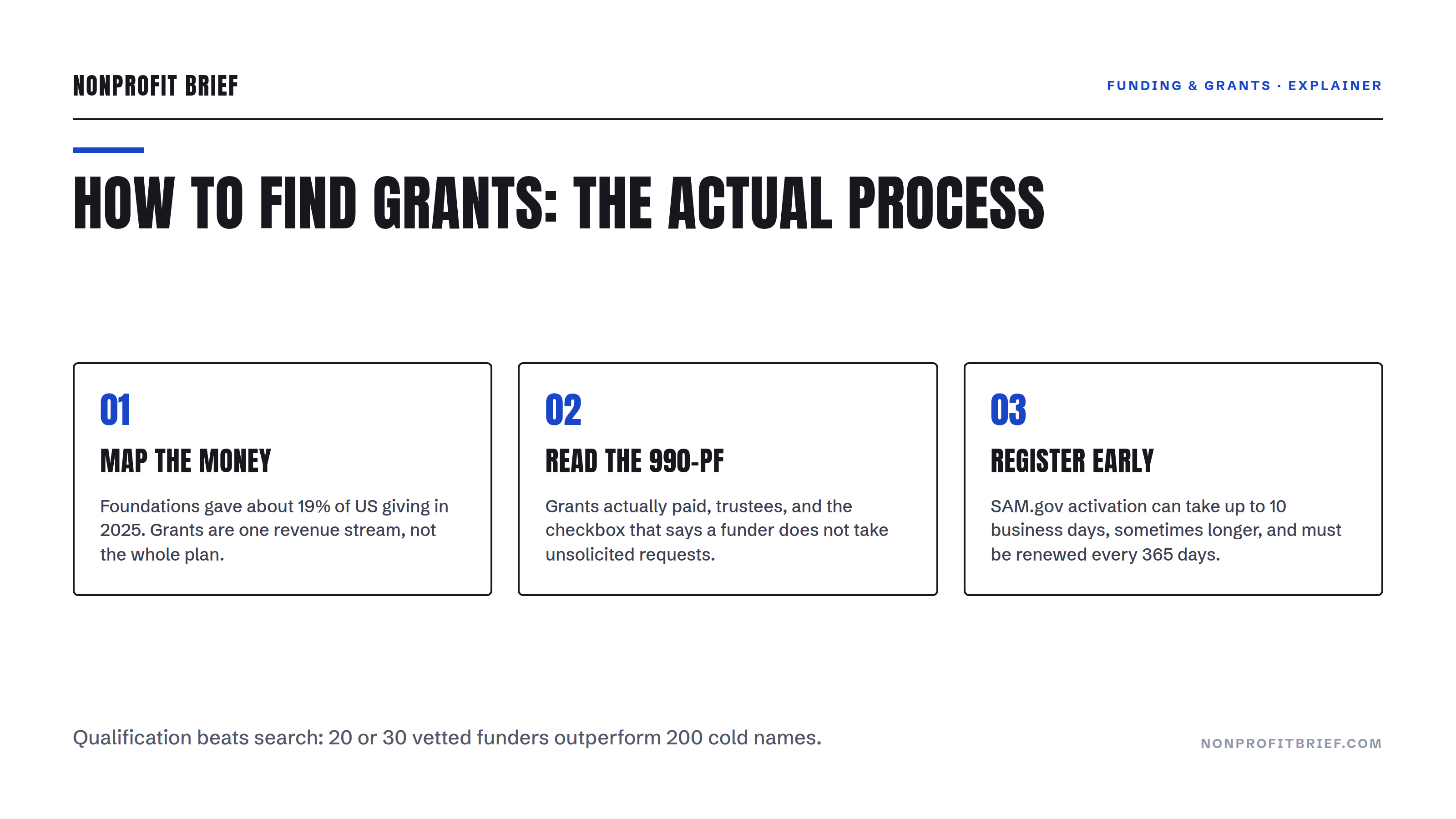
Start with the map. Americans gave $617.20 billion to charity in 2025, per Giving USA 2026. Foundations supplied $117.15 billion of that, about 19%. Individuals gave $394.2 billion, roughly 64%. We covered the full breakdown when the record-year numbers came out. The point for your planning: grants are a strong minority stream, not the main event, and organizations that fund themselves durably usually pair grant revenue with individual giving. The math on donor retention is where that second stream starts.
Start With Who Already Funds Work Like Yours
Foundation prospecting runs on two tools, one paid and one free.
The paid one is Candid's Foundation Directory, the sector's standard database, which as of September 2026 covers more than 140,000 foundations and corporate donors and 3.8 million recent grants. Subscriptions are real money for a small shop, but you can get free, in-person access at Candid's partner locations, which include public and university libraries across the country. An afternoon at one of them can produce a workable prospect list.
The free one is the Form 990-PF. Every private foundation files this annual return, and it is public record. ProPublica's Nonprofit Explorer lets you pull any foundation's filings at no cost. Read three things: the list of grants actually paid, with recipients and amounts, which tells you real award sizes and geography better than any guidelines page; the officers and trustees, which tells you whose relationships matter; and the checkbox a foundation marks when it gives only to preselected organizations and does not accept unsolicited requests.
Most Foundation Doors Are Closed, Which Is Useful to Know Early
That last checkbox deserves its own paragraph. In Candid's analysis of fiscal year 2023 filings, 71% of private foundations marked it, which on Candid's reading leaves at most 29% open to considering new grantees. Candid's 2025 survey of 522 private and community foundations found 55% willing to take unsolicited proposals. The gap reflects who was measured: the survey included community foundations, skewed toward larger and more active grantmakers, and survey-takers may read "unsolicited proposals" more narrowly than the IRS checkbox term. Either way, a majority of doors are closed to cold approaches. That is not bad news; it is targeting information. Every closed-door funder you strike from your list early is time you spend on the minority who will actually read you, or on the warm-introduction work that opens invitation-only doors.
Federal Grants Run Through Two Registrations, So Register Before You Need To
Government funding is its own track. Federal opportunities post to Grants.gov, which is free to search and free to use, but you cannot apply until your organization completes Grants.gov's registration steps. Those start with SAM.gov, the government's entity system, which assigns your Unique Entity ID, and they do not end there: your E-Business Point of Contact must then create a Grants.gov account, add your organization's profile with that ID, and assign submission roles to whoever will actually file. Both registrations are free, so decline the third-party services that charge nonprofits for "help" with them. SAM.gov says to allow up to 10 business days for a registration to become active, it can stretch to weeks if your documentation needs verification, and the registration must be renewed every 365 days. The failure mode is predictable: an organization finds a perfect opportunity three weeks before deadline and burns the writing window on paperwork. Register now, calendar the renewal, and the track stays open. Be clear-eyed about the climate too: federal grantmaking has contracted sharply this cycle, which makes state pass-through dollars and the non-federal tracks below relatively more important.
The Money Close to Home Is Easier to Reach
National foundations get the attention, but for most small organizations the likeliest first grants are local: your community foundation, your United Way, corporate giving programs at employers in your county, and city or county human services funds. These funders publish shorter applications, meet applicants at real events, and fund general operating more often than national funders do. They are also findable without a database; a list of the community foundations and major employers within an hour's drive is a prospect list.
Wherever a prospect comes from, qualify it before you write: confirm program fit, geography, typical award size, and whether they fund organizations at your budget level. When a live opportunity does surface, read the RFP the way reviewers will before you commit the hours.
The Takeaway
Finding grants is not a search problem; it is a qualification problem. Map the money, use the 990-PF and the Foundation Directory to find funders with a demonstrated pattern of funding work like yours, strike the closed doors early, get your SAM.gov registration active before any deadline exists, and work the local funders first. A pipeline of 20 or 30 qualified prospects you slowly cultivate will outperform 200 names you mail-merge, and it will do it with less of your time.