The determination letter arrives, someone on your board says the word "grants," and the fundraising plan starts to write itself: apply to 50 foundations, win a few, fund the budget. Here is the honest version before you spend a year on it. Foundations mostly fund organizations with a track record, which a brand-new nonprofit by definition does not have. Grants can be part of your story early. They are almost never the opening chapter.
Most Grant Doors Are Closed to You, and Not Personally
Funders screen for the same four things before they read a word of your proposal. Candid's grant-readiness guidance lists them: 501(c)(3) status, an established track record of results, capable leadership and a governing board with sound financial practices, and revenue beyond grants alone. A new organization typically has the first and is still building the other three. The same guidance says it plainly: it is difficult, though not impossible, for a brand-new organization to get a grant.
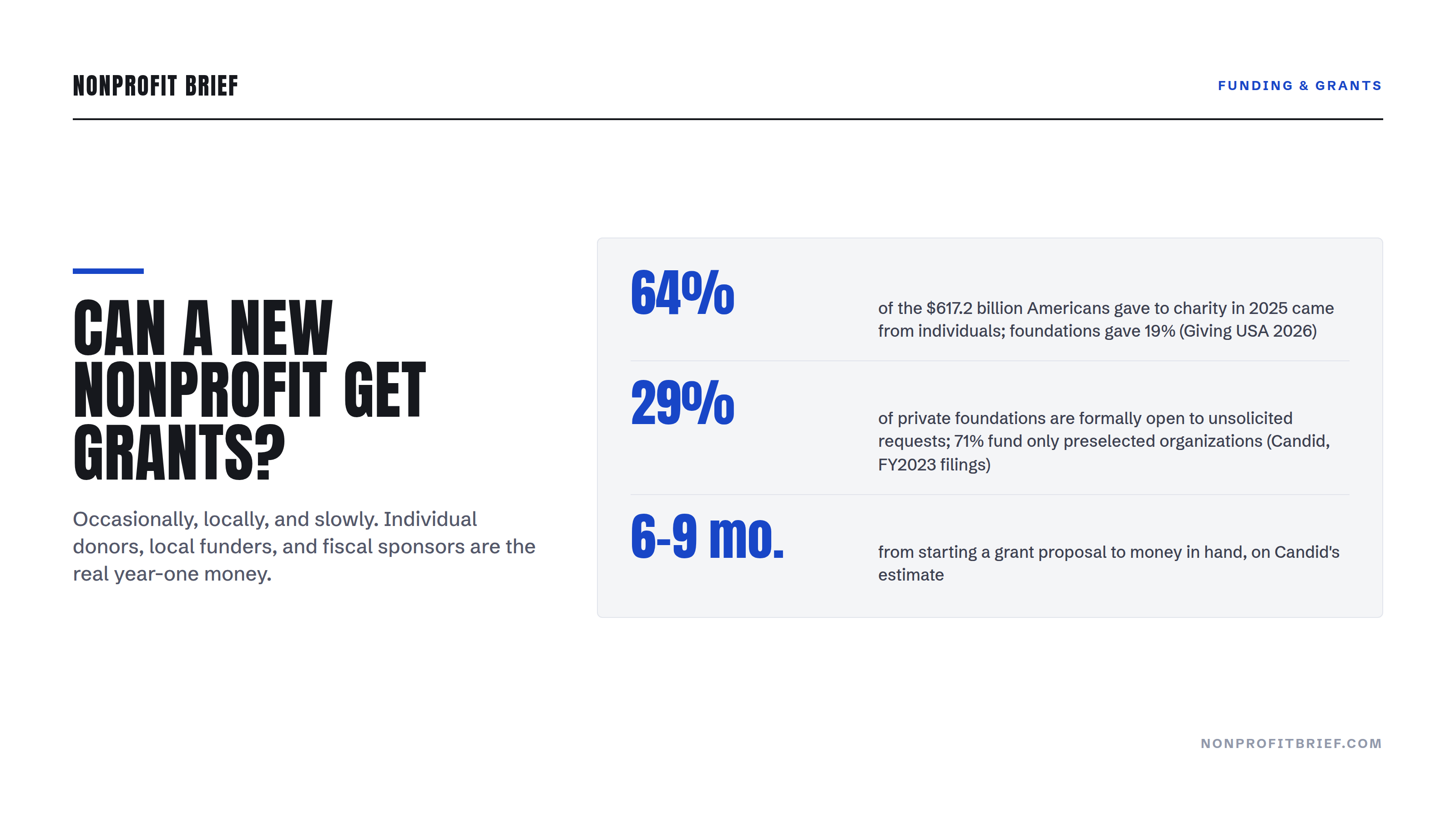
The structural math makes it harder. In Candid's analysis of fiscal year 2023 filings, 71% of private foundations told the IRS they give only to preselected organizations, leaving roughly 29% formally open to unsolicited requests from anyone, let alone newcomers. Candid itself cautions that this is the narrow reading, since many box-checking funders still take letters of inquiry or fund through relationships, but a cold proposal from an unknown organization is exactly the approach the checkbox screens out. Even a yes moves slowly: Candid pegs the distance from starting a proposal to money in hand at six to nine months. A first-year budget built on grant revenue is a plan to be underfunded for a year.
Individuals Fund Beginnings; Foundations Fund Track Records
Look at where the money actually comes from. Americans gave $617.20 billion to charity in 2025, per Giving USA 2026. Individuals supplied $394.2 billion of it, about 64%. Foundations gave $117.15 billion, about 19%. Individual donors also behave differently: they give because they know you, believe you, or were asked by someone they trust, none of which requires three years of financial statements. Your founding board, your first volunteers, and the people who already care about the problem are a funding base no foundation program officer can be. Learn the retention math early, because the donors you keep from year one are worth far more than the ones you replace.
The Doors That Do Open for New Organizations
Some grantmakers do fund young organizations, and they cluster close to home. Community foundations, local United Ways, corporate giving programs at nearby employers, and giving circles make smaller awards, publish shorter applications, and meet applicants at real events, which suits an organization whose strongest asset is its people. Two more openings are worth knowing. First, reviewers will weigh your leadership's history even when the organization has none; Candid's guidance advises highlighting your leaders' track record at previous organizations, so a founder who ran programs elsewhere should say so, with numbers. Second, fiscal sponsorship lets a project operate under an established charity's exemption. As Candid notes, grantmakers typically fund nonprofit organizations rather than individuals or unincorporated projects, so a fiscal sponsor can open funding doors years before your own track record would. The sponsor charges an administrative fee and legally oversees the money, which is the price of borrowing its standing. Expect whatever money does come to arrive with strings: most first grants are restricted to program expenses, not overhead or salaries in general.
Spend Year One Building the Record, Not Mailing Proposals
Treat your first year as the evidence-gathering phase funders will eventually ask about. Count everything from day one: people served, outcomes, testimonials, and dollars raised from individuals. Build the prospect list now, the slow way, using the process in our guide to finding grants: read 990-PFs to see which funders actually give to small or young organizations in your area, and strike the closed doors from your list early. When a genuinely fitting opportunity appears, read the RFP like a reviewer before committing hours you could spend with donors. And favor the local funders where a coffee is possible, because for a new organization the meeting is the application.
The Takeaway
Can a brand-new nonprofit get grants? Occasionally, locally, and slowly. Most foundation money stays out of reach until you have results to show, so put individual donors at the center of year one, use a fiscal sponsor or your leaders' prior track records where they genuinely apply, and work the community funders within driving distance. Build the record now. The grants conversation gets much easier in year two or three, and everything you did in the meantime is exactly what the proposals will ask for.