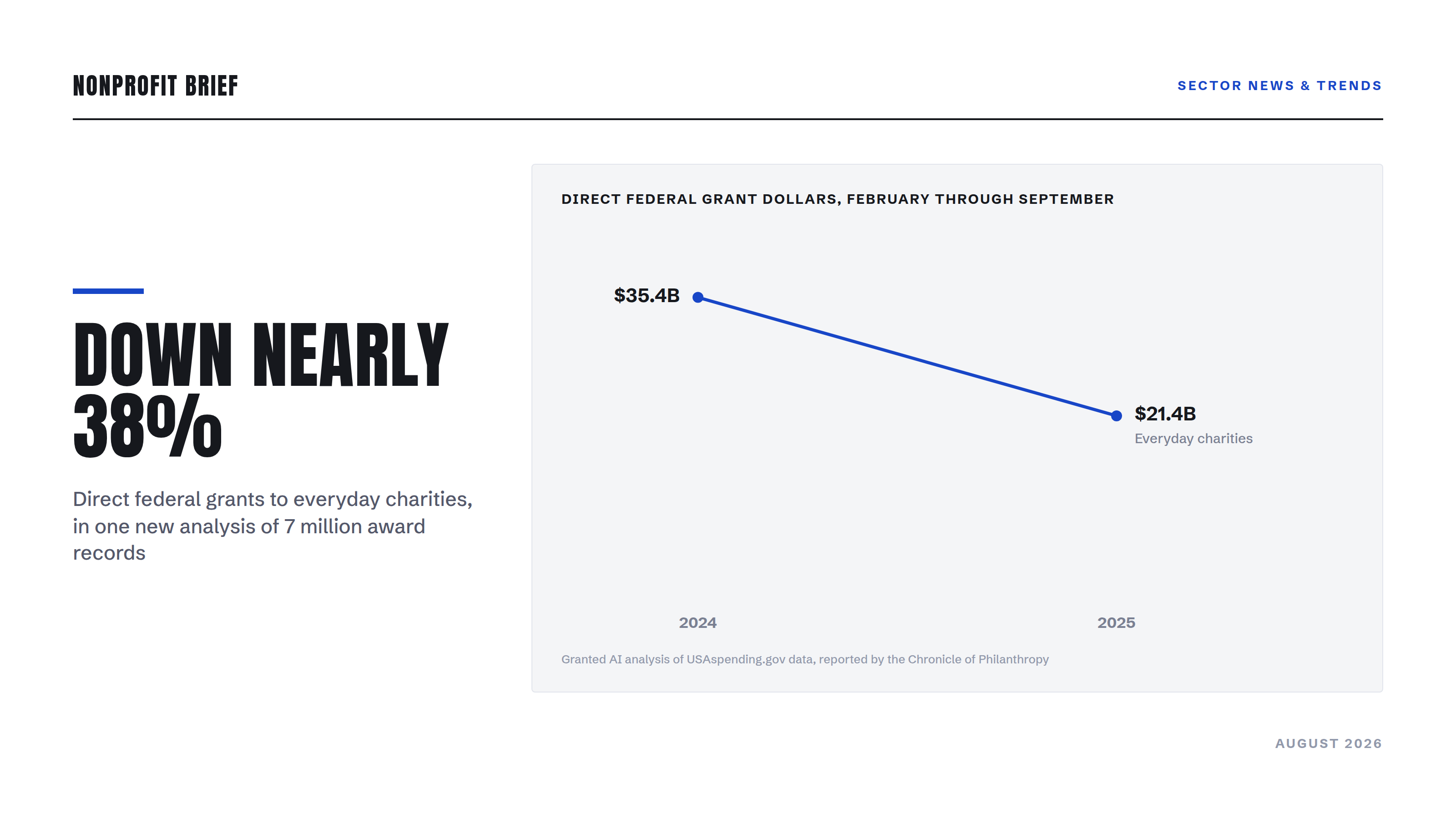
Federal grants to everyday charities fell by nearly 38% in eight months. That is the headline finding of a new analysis reported by the Chronicle of Philanthropy on July 30. The dollars dropped from $35.4 billion to $21.4 billion.
The number deserves attention. It also deserves a close read, because what it measures is narrower than the headline suggests, and what it leaves out may matter more to your budget than what it counts.
What the Analysis Counted, and What It Deliberately Cut
The analysis comes from Granted AI, a company that builds a grants database for nonprofits. It processed roughly 7 million award transactions from USAspending.gov, the federal government's public database of spending, and compared February through September 2025 against the same months a year earlier.
It then excluded hospitals, universities, rural electric cooperatives, and clean-energy projects. The point of the exclusions was to isolate what most people picture when they hear the word nonprofit: food banks, human services agencies, arts groups, international aid organizations. For that slice of the sector, direct federal grant dollars fell from $35.4 billion to $21.4 billion, a drop of nearly 38%.
The months in question were not quiet ones. The period covers the dismantling of USAID, the canceled Justice Department grants that hit more than 550 organizations, and cuts to arts, humanities, and public broadcasting funding. Grantees in other terminated programs are already in court, where terminated grantees are suing on breach-of-contract theories.
The 38% Is a Slice, Not the Whole Pie
The analysis measures direct federal awards: money a federal agency granted straight to a nonprofit. A large share of government support reaches nonprofits a different way, as pass-through funding, where a federal agency grants to a state agency and the state subgrants to local organizations. Those dollars are not in the analysis, and the Chronicle notes there is no consistent public reporting that tracks them.
The scale of what sits outside the frame is large. Candid estimated in early 2025, based on nonprofits' most recent Form 990 filings, that more than 100,000 nonprofits take in roughly $303 billion a year in government grants across federal, state, and local sources combined. About 30% of nonprofits that file a Form 990 report some government grant funding, and more than 35,000 organizations, about a third of government grantees, rely on those grants for over half their revenue.
One more caution before you repeat the number in a board memo. This is a single analysis by one company, using one database and its own exclusions, and it has not yet been replicated by an independent researcher. The direction it points is consistent with everything else on the record: the terminations, the litigation, the agency shutdowns. The precise figure should still travel with its methodology attached.
What to Do With the Number
First, establish your own exposure. Search your organization's name or UEI, its federal unique entity identifier, on USAspending.gov and list every active federal award. For each one, note whether it came to you directly or through a state agency, because the risk profiles differ. Direct awards face federal policy shifts head on. Pass-through awards add a second variable: your state's own budget and its willingness to backfill.
Second, if you hold pass-through funding, ask your state program officer which federal program the money traces back to and what the agency is signaling about its next cycle. Your agreement's federal award identification number is the thread to pull.
Third, treat diversification as a project with a deadline rather than a slide in the strategic plan. That can mean building a pipeline into donor-advised funds, an area where deliberate cultivation wins grants, or weighing a funder's offer of a loan instead of a grant with clear eyes.
Fourth, if you still hold federal awards, watch the proposed overhaul of the government-wide grant regulations, which OMB has targeted to take effect October 1. The rule is not final yet, and the final text could shift, so build both versions into any recompete planning.
The Takeaway
The 38% figure is real data about a real contraction in direct federal grantmaking, and it is the clearest number anyone has put on the trend so far. It is also a measurement of one slice of one funding channel over eight months. The useful move is not to decide whether the number is scary. It is to put your own numbers next to it: which awards you hold, which channel they run through, and what share of your budget would need replacing if the trend reaches you.