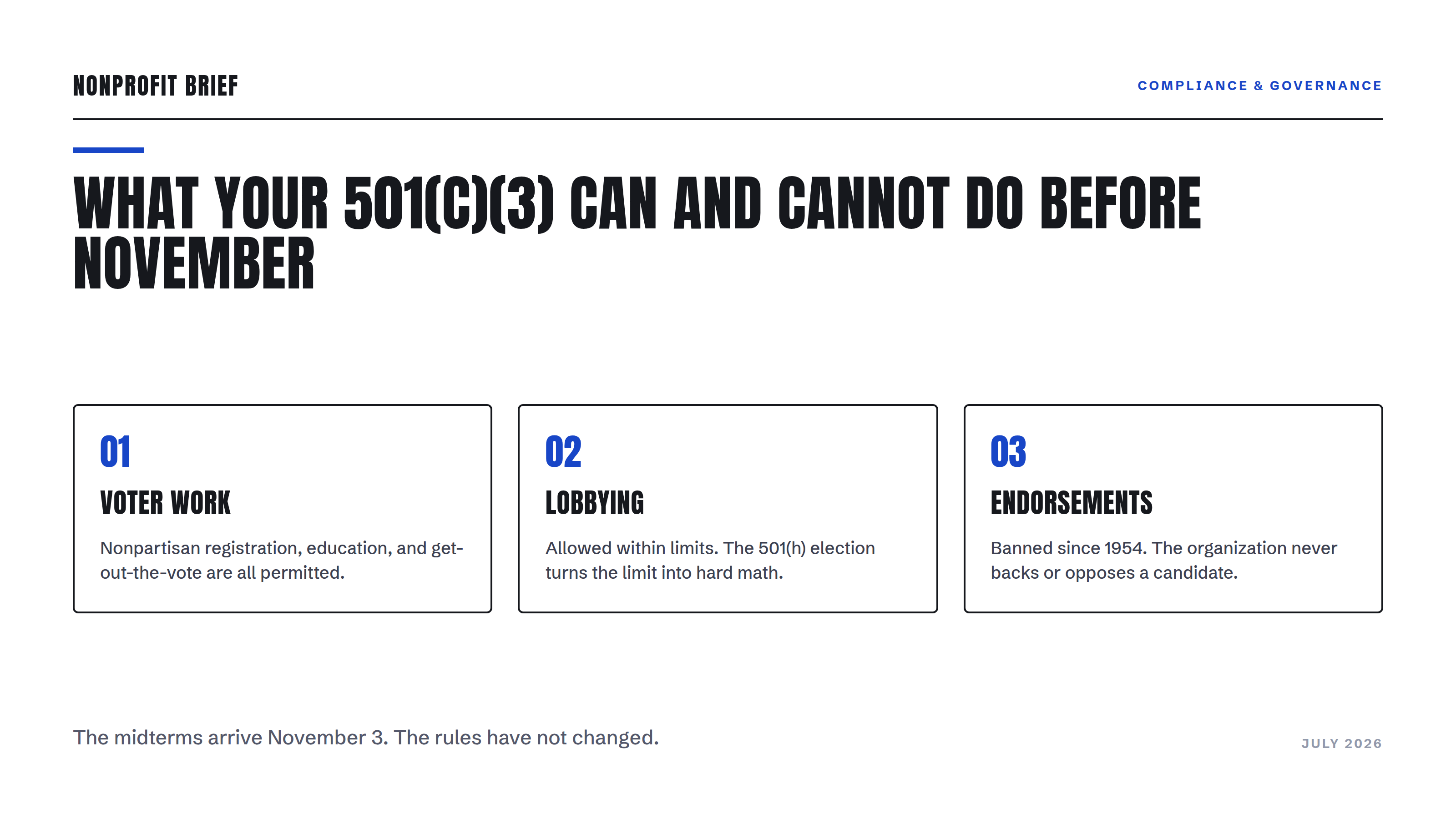
The midterm elections arrive on November 3. Between now and then, somebody will ask your nonprofit to pick a side: a board member who wants the organization to endorse a candidate, a canvasser who wants your email list, a donor who assumes you are "obviously" backing the challenger. After a year of headlines about the IRS loosening the rules on political activity, it would be easy to assume the answer has changed. It has not. The ban on candidate endorsements is exactly where it was, and the useful work your organization can legally do this fall is bigger than most boards think.
The Endorsement Ban Survived a Year of Headlines
Section 501(c)(3) organizations are absolutely prohibited from participating or intervening in any political campaign on behalf of, or in opposition to, any candidate for public office. That is the Johnson Amendment, and violating it can cost you tax-exempt status plus excise taxes.
The confusion traces to a Texas lawsuit. In July 2025, the IRS filed a proposed settlement in National Religious Broadcasters v. Bessent that would have let houses of worship speak to their congregations about electoral politics "through the lens of religious faith," during religious services and through their customary channels, without violating the ban. It never took effect. On March 31, 2026, the federal judge dismissed the case, ruling that federal law barred the court from approving it, and the dismissed deal would have applied only to the named plaintiffs anyway. Treasury and the IRS have promised new Johnson Amendment guidance in their current priority plan, but as of late July, none has been issued. Until it is, the existing limits apply in full, to churches and to every other charity.
What You Can Do Between Now and November
The prohibition is on taking sides, not on touching elections. The IRS itself lists voter education, registration, and get-out-the-vote work as permitted, so long as it is conducted without bias toward any candidate. Registering voters at your food pantry is fine. Registering voters you screen for party preference is not.
Candidate forums are also fine when they are built to be neutral. The IRS walked through 21 factual situations in Revenue Ruling 2007-41, its main guidance here, and the pattern is consistent: invite all the candidates, use a neutral moderator, cover a broad range of issues, and give everyone equal time.
You can also keep advocating on your issues. A housing group does not go silent on zoning because it is October. The risk rises when issue communications start naming candidates, running close to the election, or telling people how to vote; those are among the factors the IRS weighs, along with whether the communication is part of your ongoing work on the issue. And your staff and board members keep their personal political lives. They can endorse, donate, and knock doors as private citizens. They cannot do it in your newsletter, at your gala, or with your laptop. Keeping the organization's resources out of personal politics is part of the compliance job your board already owns under its duty of obedience.
Lobbying Is Not Electioneering
One more distinction worth pinning to the wall: lobbying, meaning work to influence legislation, runs under a different rule than campaign intervention. Charities can lobby, they just cannot make it a substantial part of their activities. The default test for "substantial" is a vague facts-and-circumstances judgment. For most public charities, the fix is the 501(h) election, a one-page Form 5768 that swaps the vague test for hard math. Churches, church-affiliated organizations, and private foundations cannot make the election; they stay under the facts-and-circumstances test.
Under the expenditure test, an electing charity can spend 20% of its first $500,000 of exempt purpose expenditures on lobbying, with the allowance sliding down in brackets to a $1 million ceiling for the largest organizations. Grassroots lobbying, meaning appeals urging the public to contact legislators, is capped at 25% of that overall limit. Go over in a given year and you owe a 25% excise tax on the excess; exemption itself is at risk only if your lobbying spending tops 150% of your limits measured over a four-year period. For a small organization, the arithmetic is generous: a charity spending $400,000 a year can spend up to $80,000 on lobbying, which is far more than most ever use. Where your situation gets close to the lines, outcomes turn on your specific facts, and this is not legal advice for your situation.
The takeaway
Nothing that happened in court this year changed what your 501(c)(3) can do in an election season. Nonpartisan voter registration, education, and turnout work are open to you. Candidate forums are open to you if you build them evenhandedly. Lobbying on your issues is open to you, with a cheap insurance policy available in the 501(h) election. The one closed door is the same one that has been closed since 1954: the organization does not endorse, oppose, fund, or favor candidates. If a plan for the fall involves a candidate's name and your organization's resources in the same sentence, stop and get advice before you hit send.