Somewhere between filing your articles of incorporation and holding your first board meeting, you asked two friends and a former coworker to serve as directors. What you actually asked them to accept is a set of legal obligations that state law attaches to every nonprofit board seat, whether or not anyone ever says them out loud. New board members deserve to hear them named. So here they are.
What Are a Board Member's Three Legal Duties?
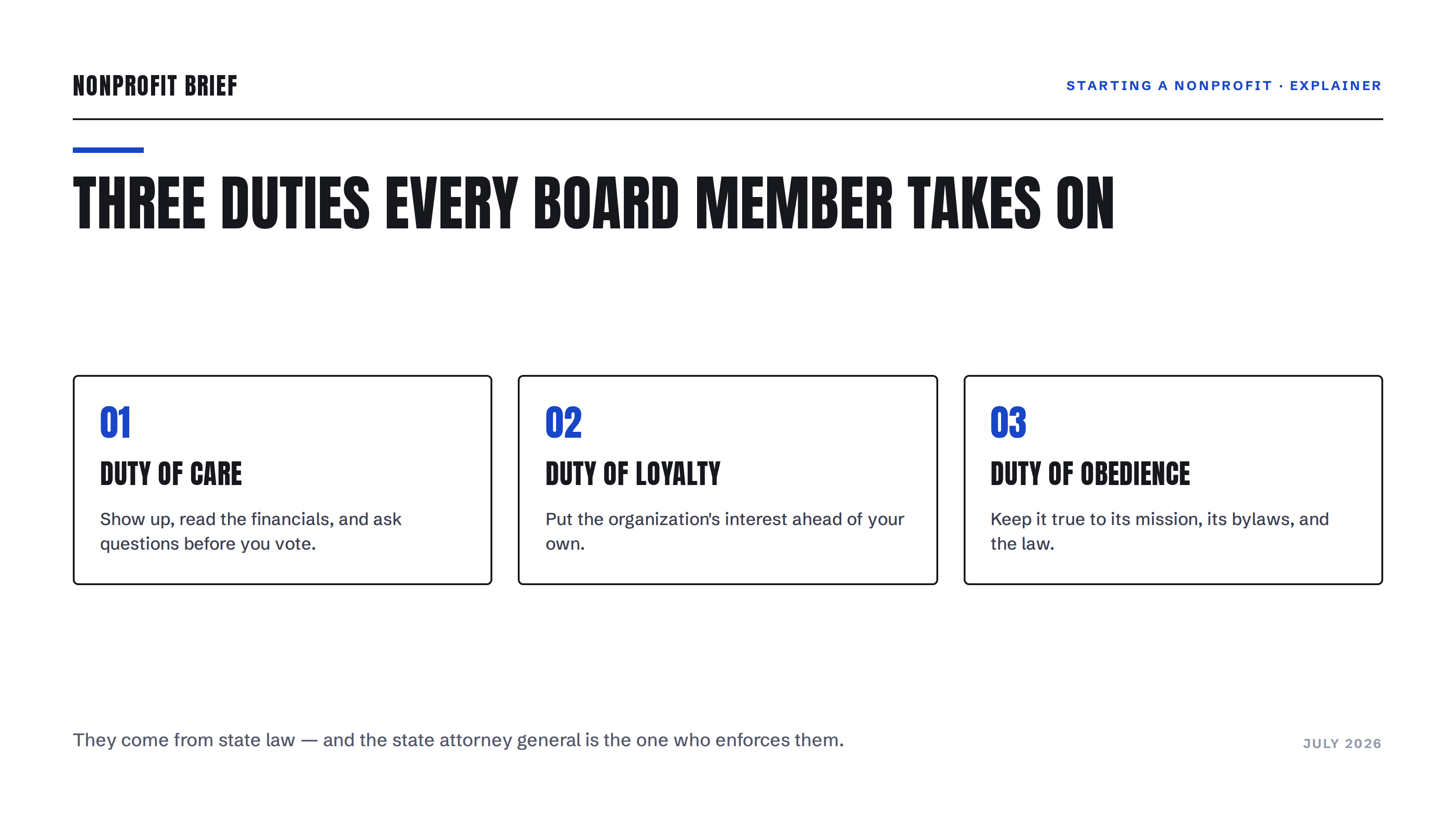
Every nonprofit director owes the organization three fiduciary duties: care, loyalty, and obedience. They come from state corporation law, not the IRS, and the state attorney general is usually the one who enforces them. (Not every state's statute names all three; obedience is the one courts and regulators sometimes fold into the other two.)
The duty of care is the obligation to pay attention: show up to meetings, read the financials before you vote, and ask questions when something doesn't add up. The National Council of Nonprofits describes it as ensuring prudent use of all the organization's assets, including its facility, people, and goodwill. A director who skips every meeting and rubber-stamps whatever lands in front of them is failing this duty, even with the best intentions.
The duty of loyalty means the organization's interest beats yours. In the IRS's words, it "requires a director to act in the interest of the charity rather than in the personal interest of the director or some other person or organization," per the agency's governance guidance. The working machinery here is a conflict-of-interest policy: directors disclose financial interests in anything the nonprofit does business with, and they leave the room when those items come up.
The duty of obedience means the organization follows the law, its own bylaws, and its stated mission. The New York Attorney General's guide for new boards, Right From the Start, frames it plainly: directors must make sure the organization sticks to its charitable purposes and complies with the rules that govern it. Spending money donors restricted to one program on something else is a classic obedience failure; if that distinction is fuzzy, our guide to restricted versus unrestricted funds covers it.
The IRS Watches Your Board, Even Though It Doesn't Regulate It
Board governance is state territory, but the IRS has a well-documented point of view: "a well-governed charity is more likely to obey the tax laws, safeguard charitable assets, and serve charitable interests than one with poor or lax governance," as its governance guidance puts it. The same document encourages boards with independent members and cautions that very small or very large boards may serve the organization poorly.
That point of view shows up in the paperwork. The Form 1023 application for 501(c)(3) status asks whether you've adopted a conflict-of-interest policy. The annual Form 990 asks about family and business relationships among your directors, whether the board received a copy of the return before filing, and whether the organization has a written conflict-of-interest policy; the IRS has even published a governance check sheet for its own examiners. None of these practices are required by federal tax law, though state law is another matter: New York, for one, requires a conflict-of-interest policy. Either way, the questions are public, and funders read the answers.
What This Means in Practice for a First Board
Three habits cover most of the ground. Keep minutes at every meeting, because minutes are how a board later shows it exercised care. Adopt a conflict-of-interest policy with a short annual disclosure form, because loyalty problems are cheap to prevent and expensive to unwind. And have the full board actually read the Form 990 before it's filed, because it is the one document where governance, finances, and mission all get sworn to at once.
What about personal risk? Board service is rarely a source of personal liability in practice. The federal Volunteer Protection Act of 1997 shields uncompensated volunteers, including directors, from liability for ordinary negligence committed within the scope of their role, and states layer their own protections on top. The shield has limits: it does not cover gross negligence, willful misconduct, or the organization's own debts — and it does not stop the organization itself from suing a director over a breach of these duties. The clearest real-world exception is payroll: people who control which bills get paid can be personally liable for unpaid payroll taxes under the IRS's trust fund recovery penalty. Most organizations eventually add directors-and-officers insurance, but for a young nonprofit, the honest ranking of protections is: good process first, insurance second.
The takeaway
Recruit your first board by telling people what the job legally is: pay attention, put the organization first, and keep it true to its mission and rules. Then give them the tools to do it, which cost almost nothing: minutes, a conflict-of-interest policy, and a board that reads its own 990. Boards tend to fail on process, not intent. More on formation and the first year lives in our Starting a Nonprofit section.