You filed the paperwork, recruited a board, and now you run the programs. Somewhere around month six the question gets awkward: can you take a salary from the organization you started? Yes. Founders draw paychecks at nonprofits across the country, legally and openly. The IRS does not ban the paycheck. It regulates the process that sets the number.
The Law Allows a Salary. It Bans Self-Dealing
A 501(c)(3) belongs to no one, including its founder. Federal law says no part of a charity's net earnings may inure to the benefit of an insider. That sentence scares new founders into working unpaid for years, and it should not. Inurement means taking value out of the organization beyond what your work is worth: an above-market salary, a below-market sale of the charity's van to your cousin, a loan that never gets repaid. Paying fair value for real work is an ordinary expense, the same as rent.
The tax code calls people with founder-level influence "disqualified persons": anyone in a position to exercise substantial influence over the organization's affairs, a group that reliably includes a founder serving as executive director, along with their family members. Disqualified persons can be paid. They are simply the people the compensation rules watch most closely.
"Reasonable" Means What the Market Pays
The legal standard for your salary is reasonable compensation: the amount that would ordinarily be paid for like services by a like enterprise under like circumstances. The measure covers your whole package, not just base pay. Bonuses, health premiums, and deferred compensation all count toward the total, and so do fringe benefits, except the ones section 132 already excludes from income, like de minimis perks. One trap: a benefit counts as compensation only if the organization documents its intent to treat it that way at the time, in a written agreement or on the W-2 or Form 990. An undocumented benefit to a disqualified person can be treated as an automatic excess benefit even when total pay is modest.
Comparability data is how you prove it. Treasury regulations treat data as appropriate when it covers pay at similarly situated organizations, taxable or tax-exempt, for functionally comparable jobs. There is a real break for small organizations: if your gross receipts, including contributions, average under $1 million over the three prior years, data on three comparable organizations in the same or similar communities is enough. Three Form 990 lookups on ProPublica's Nonprofit Explorer can satisfy it. For a sense of the wider market, our look at executive pay in 2026 is a starting point.
Three Steps Make Your Salary Presumptively Legal
The regulations offer founders a deal called the rebuttable presumption of reasonableness. Follow three steps and your salary is presumed reasonable, and the burden shifts to the IRS to prove otherwise.
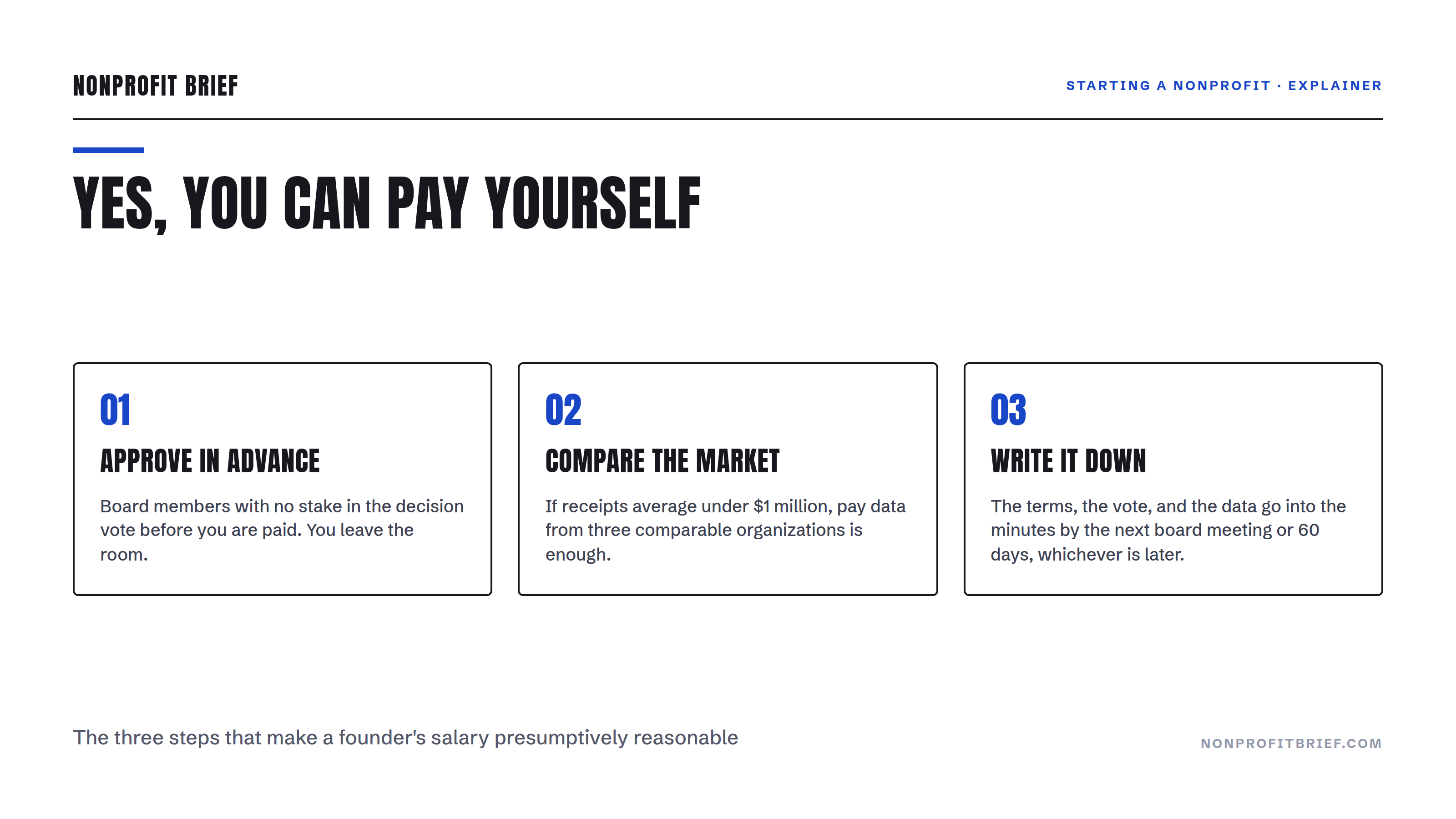
First, the arrangement is approved in advance by an authorized body, usually the board, made up entirely of people with no conflict of interest in the decision. You leave the room, and so does anyone related to you. Second, before voting, that body obtains and relies on comparability data. Third, it documents the decision while it is fresh: the terms, the date, who was present and how they voted, the data considered and how it was obtained, all in minutes prepared no later than the next board meeting or 60 days out, whichever comes later. A board that follows a real conflict of interest policy is already most of the way there, and directors who take their legal duties seriously should welcome the exercise.
Skipping the steps does not make a salary illegal. It just means that if the IRS ever asks, the number is judged on all the facts without the presumption working in your favor.
Overpayment Is Taxed Personally, Not Just Organizationally
Pay above fair value is an "excess benefit transaction," and the penalty lands on people, not just the charity. The recipient owes an excise tax of 25 percent of the excess, and must pay the excess back with interest. Fail to correct it in time and an additional 200 percent tax lands on top. Board members who knowingly approve the deal can owe a further 10 percent, capped at $20,000 per transaction for all managers combined. Revocation of exempt status exists for egregious cases, but Congress built these "intermediate sanctions" as the standard remedy short of it. Separately, compensation over $1 million triggers an excise tax, paid by the organization, on the amount above that threshold, a problem most founders would be delighted to have.
Mind the State Rules and the Payroll Mechanics
State law adds wrinkles. California caps "interested persons" at 49 percent of a public benefit corporation's board: no more than 49 percent of directors may be people the organization has paid in the last 12 months for anything other than board service, or their close relatives. A founder-ED holding one seat on a five-member board fits comfortably. A founder, a paid program director, and the founder's spouse on that same board do not. Other states are looser, but many funders want a majority-independent board even where no statute requires one.
Mechanics matter too. A founder who runs the organization under the board's direction is an employee: that means a W-2, payroll withholding, and payroll taxes, not a 1099 and a shrug. And the number will not stay private. Form 990 reports officer and key employee compensation, and those filings are public. Set a salary you would be comfortable defending to a donor who looks it up, because one will. The good news: grant budgets can and routinely do include the executive director's salary, and paying yourself from grant funds that allow it is normal, not scandalous.
Whether a specific number is reasonable turns on your organization's size, budget, and market, so outcomes here depend on your facts, and this is not legal advice for your situation.
The takeaway
You can pay yourself, and if the work is real and full-time, you probably should before burnout makes the decision for you. Do it in the right order of operations: pull three comparable salaries, hand the decision to board members with no stake in it, get the vote and the data into the minutes right away, and run the pay through payroll. The founders who get in trouble are almost never the ones who took a salary. They are the ones who set it alone, wrote nothing down, and called it a consulting fee.