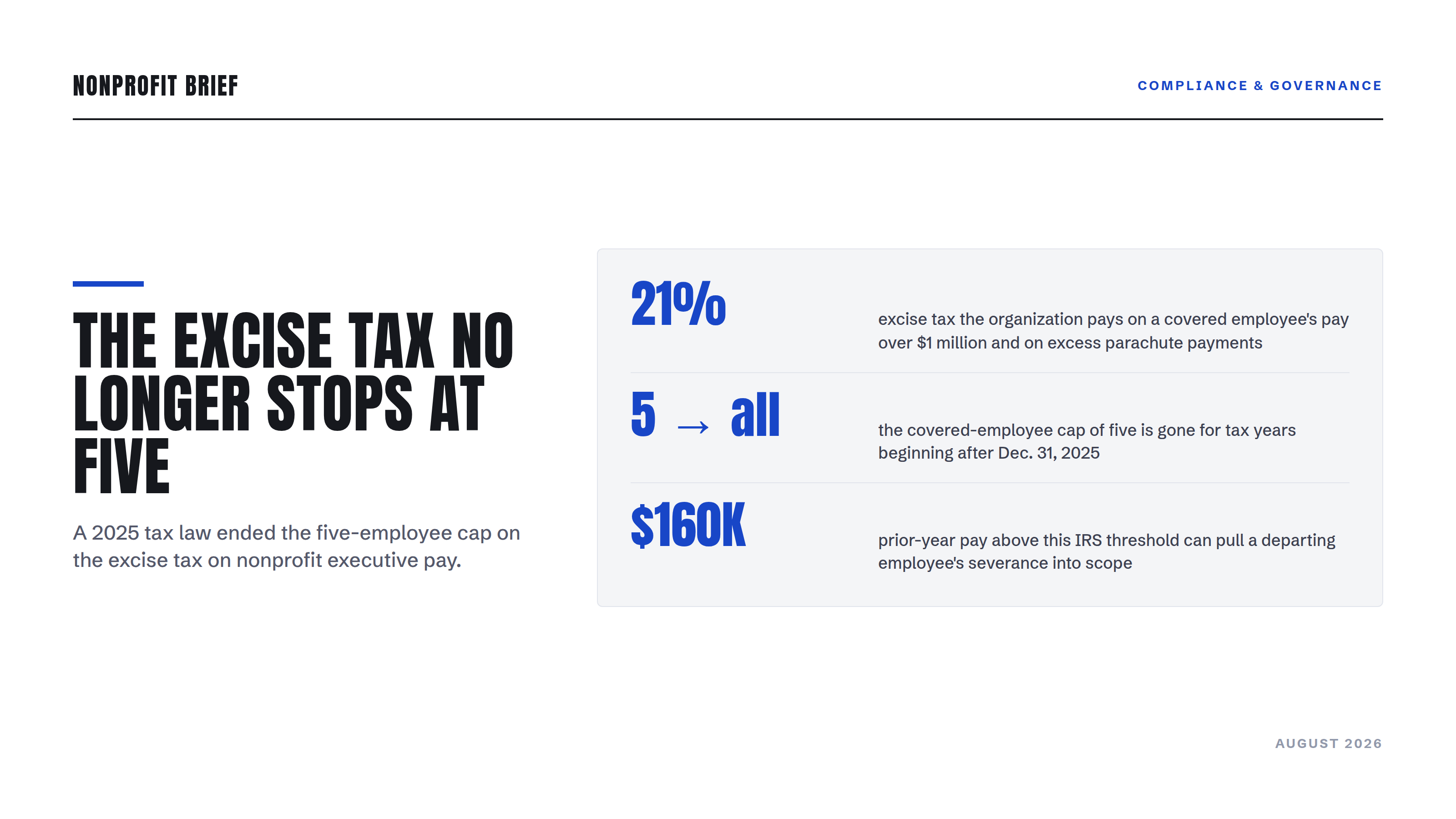
Since 2018, nonprofits that pay anyone more than $1 million have owed a 21 percent excise tax on the amount above that line. The tax had one built-in limit: it only ever applied to an organization's five highest-compensated employees. That limit is now gone. Under the One Big Beautiful Bill Act, for tax years beginning after December 31, 2025, every employee counts. The IRS announced in June that proposed regulations are coming, and the public comment window closed on August 4. If your organization runs on a calendar year, the expanded rule already applies to the year you are in right now.
The tax itself has not changed
Section 4960 works the same way it has since the 2017 tax law created it. The organization, not the employee, pays a 21 percent excise tax on two things: remuneration over $1 million paid to a covered employee in a year, and so-called excess parachute payments tied to an employee's departure. The tax is reported on Form 4720, due the same day as your Form 990. Where pay comes from related organizations, each employer, including a related taxable entity, owes its share. The portion of pay attributable to medical or veterinary services performed by licensed professionals is excluded, which is why a hospital can pay a surgeon seven figures for clinical work without owing this particular tax; the same person's pay for running a department still counts. None of that moved.
What moved is who can trigger it. The old rule capped exposure at the five highest-compensated employees each year, with anyone who ever made the list staying on it. The amended definition covers anyone employed by the organization in a tax year beginning after December 31, 2025, permanently, from that point forward. Former employees who left before then stay in scope only if they were already covered under the old five-highest rule. In practice, an organization can no longer rank its way out: if anyone on the current payroll crosses the thresholds, the tax applies.
Notice 2026-36 tells you what holds until the regulations land
In Notice 2026-36, the IRS said organizations may keep relying on two exceptions from the existing regulations while it drafts new ones. The limited hours exception protects employees of related taxable organizations who draw no pay from the nonprofit and put in only minimal time there: no more than 10 percent of their total working hours, with 100 hours a year as a safe harbor. The nonexempt funds exception protects those paid entirely by a related taxable entity the nonprofit does not control, provided they spend no more than half their working time at the nonprofit. Both matter mostly to nonprofits that share executives with a corporate parent, a foundation, or an affiliated business. A third carve-out, the limited services exception, is being dropped because the five-employee ranking it modified no longer exists.
The notice also confirms the change is not retroactive. Years beginning on or before December 31, 2025 stay under the old five-employee rule, and the coming regulations are expected to apply prospectively only.
The severance trap reaches further down the pay scale
Most organizations reading this will never pay anyone $1 million and can stop worrying about that half of the tax. The parachute half is the one to watch, because it does not require seven-figure pay. A parachute payment arises when payments contingent on an employee's separation, severance being the usual example, add up to three or more times the employee's base amount, roughly their average annual compensation over the prior five years. The 21 percent tax then hits the portion above that base amount. The rule only applies to employees whose prior-year pay topped the IRS highly compensated employee threshold: for a 2026 departure, that means 2025 pay above $160,000, and the threshold stays at $160,000 for 2026.
Under the old law, a generous exit package for, say, a long-tenured program director earning $175,000 usually escaped the tax because that person was never among the five highest paid. Now every departing employee above that threshold is potentially in scope. One law firm analysis is telling exempt organizations to monitor compensation for all employees, not just the top of the org chart, and that is the right instinct.
What to do before year-end
Three moves cover most organizations. First, inventory anyone whose total compensation, including pay from related organizations, approaches either the $1 million line or the $160,000 highly compensated threshold. Second, model any severance or retention package against the three-times-average test before you sign it, not after; qualified retirement plan and 403(b) or 457(b) payouts do not count toward the test, and spreading payments or trimming the multiple can keep an exit package under the trigger. Third, put compensation review on the board agenda, since setting and documenting reasonable executive pay already sits squarely within a board's legal duties. Whether a specific package trips the tax turns on your organization's facts, and this is not tax advice for your situation; if you are anywhere near these numbers, this is a question for your accountant before the package is signed.
The takeaway
The 21 percent excise tax on nonprofit executive pay no longer stops at five names. For tax years beginning after December 31, 2025, any employee paid over $1 million, and any departing employee whose prior-year pay cleared $160,000 and whose exit package is rich enough, can put the organization on the hook. The mechanics, the medical services exclusion, and Form 4720 reporting all stay the same, and Notice 2026-36 keeps the limited hours and nonexempt funds exceptions alive until final regulations arrive. Small organizations with modest pay scales can file this under awareness. Anyone negotiating an executive exit this fall should run the numbers first.