The most useful number a nonprofit board will see this year is not in a grant report. It is in a compensation study, and a new one just landed. Candid released its 26th annual Nonprofit Compensation Report this week, built from 2024 IRS Forms 990 and 990-EZ filed by nearly 120,000 tax-exempt organizations. It covers public charities and excludes private foundations, which file a different return. If you set an executive's salary, defend your own, or sit on a board that approves either, this is the dataset that does the arguing for you.
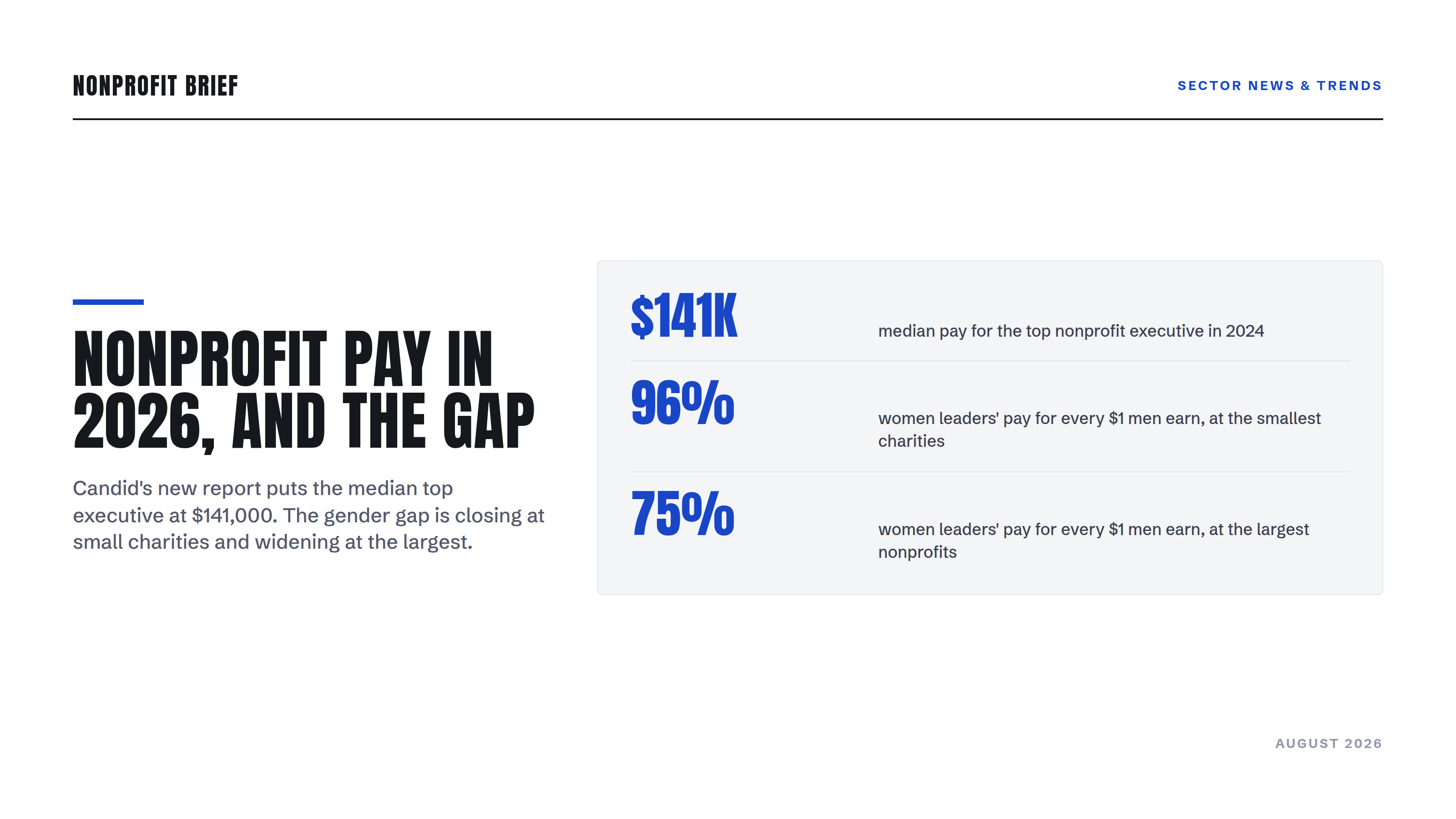
The median nonprofit executive earned $141,000
The report tracks 14 leadership positions. The median top executive made $141,000 in 2024, a 2.9 percent increase over the prior year. Over five years, from 2020 through 2024, median pay rose 13 percent.
Budget size predicts pay more than any other factor. Leaders of organizations with budgets above $50 million had a median salary of $304,000. Leaders of charities with budgets of $250,000 or less had a median of $45,000. Cause area matters too. Executives at technology, medical research, and health organizations cleared $200,000 at the median, while those at arts, animal, and religious groups earned $107,000 or less. Geography sorts the rest, with Washington, D.C. highest at $196,000 and New York state at $167,000.
The gender gap is closing at the bottom and widening at the top
Women who lead nonprofits earned 73 cents for every dollar earned by men in 2024. That is a raw comparison of median pay, not a like-for-like control, and it is up from 69 cents a decade ago, though it has stalled in recent years. The single figure hides two opposite trends. At the smallest charities, those with budgets of $250,000 or less, Candid puts women leaders at 96 cents on the dollar, up from 92 cents a decade earlier. At the largest, above $50 million, the ratio slipped to 75 cents from 77 cents over the same period.
Representation follows the same split. Women hold 58 percent of the top jobs at the smallest charities but only 31 percent at the largest, though that top-end figure has climbed from 20 percent in 2014. The near-parity is at small organizations; the widening gap is at the large ones, where the biggest paychecks sit. "Having the best people being treated fairly leading large organizations is hugely important," said Cathleen Clerkin, Candid's associate vice president of research.
Young-joo Lee, who studies women's philanthropy at Indiana University's Lilly Family School of Philanthropy, pointed past headcount to power: "We need to think about what positions women hold on boards, not just having more women on boards." Compensation decisions are board decisions, and setting executive pay is one of the core duties a board owns. The composition of the group setting the salary matters as much as the salary itself.
What to do with the numbers
Two moves. First, if you are negotiating or benchmarking a salary, remember the raise environment was modest and uneven in 2024. Organizations under $5 million in budget raised pay by 3.1 percent or less, while those above $5 million moved 3.3 to 4 percent. Anchor your ask to your budget tier and cause area, not to the national median. Second, if your organization is large enough that the top-end gap is your gap, the fix is not a one-time adjustment. It is a documented, repeatable pay process, reviewed by a board that reads the pattern and not just the individual number.
One caveat on the source. Candid's report is built on Form 990 filings rather than a survey, which makes it comprehensive but roughly two years behind: the 2026 edition reflects 2024 pay. Use it for structure and ratios, then adjust for two years of movement before you treat any figure as this year's market. The full report is a paid product, at $449 for an individual license, though the topline findings are public.
The takeaway
The median nonprofit executive earns $141,000, budget size drives that number more than mission does, and the gender pay gap is closing among small charities while it widens at the largest ones. If you set or receive a nonprofit salary, pull the benchmark for your budget tier and cause area, bring it to the people who approve pay, and, if you run a large organization, treat the gap at the top as a process problem your board owns.