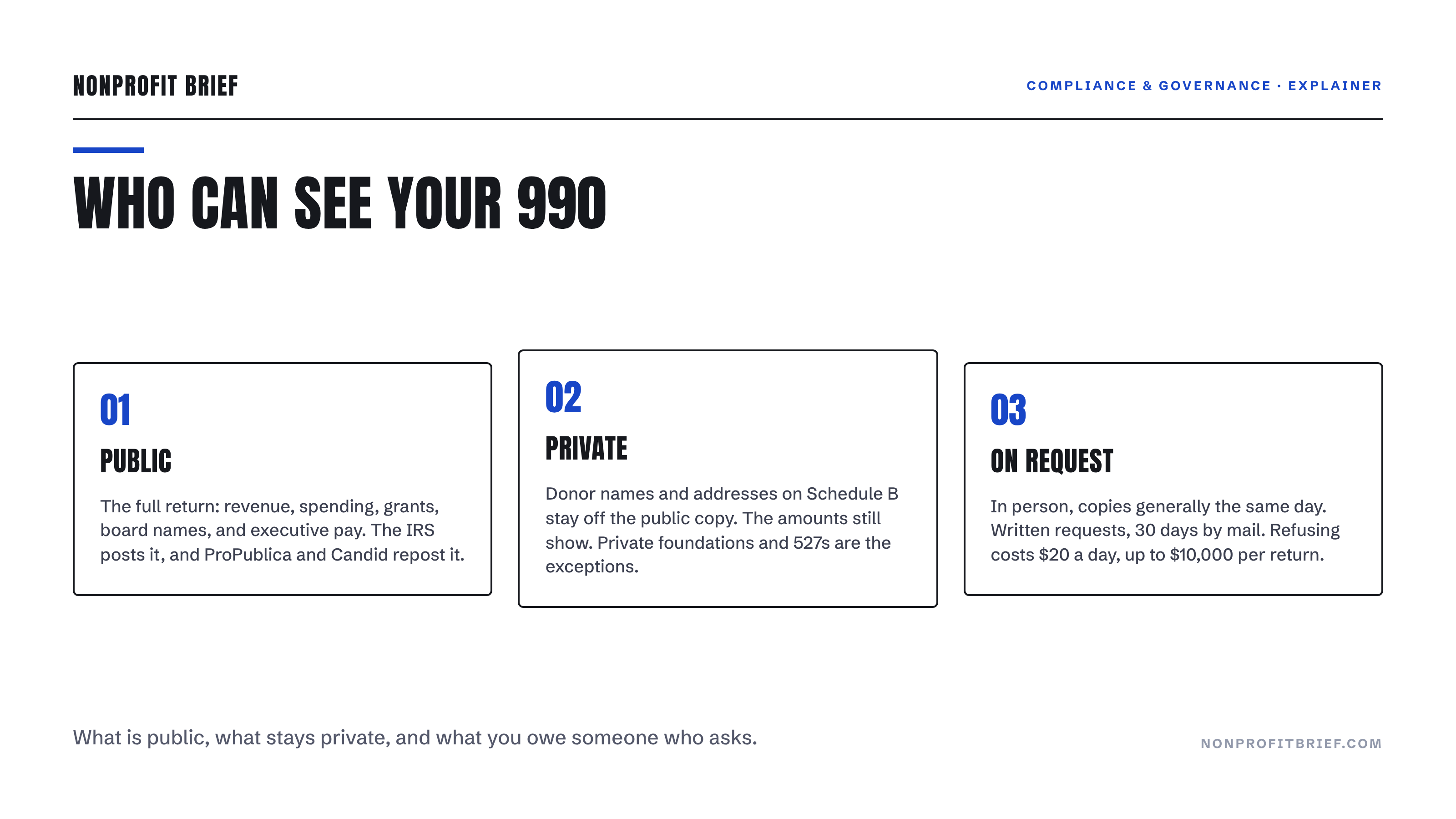
Type a nonprofit's name into a search box and its Form 990 is a few clicks away. The whole return. Salaries included. Founders are often surprised the first time they see it, and board members sometimes more so. The rule is worth knowing cold: almost everything on the 990 is public, a short list of things is not, and a stranger who asks you for a copy has the law on their side.
Yes, Your 990 Is a Public Record
Federal law makes a tax-exempt organization's annual returns open to public inspection. That covers every version of the form you might file: the full 990, the 990-EZ, and the 990-PF that private foundations file. The 990-N postcard is public too, though by a different route: the IRS posts every e-Postcard itself. For a 501(c)(3), it also covers Form 990-T, the return that reports unrelated business income, for returns filed after August 17, 2006.
Your exemption application is public too. Form 1023 or 1024 in any version, the supporting documents, and the IRS determination letter stay disclosable for as long as your organization exists (organizations that applied before July 15, 1987 and no longer kept a copy are excused). Returns age out of the obligation: you must make the three most recent years available, with each return's window running three years from its due date, including extensions, or from the day you actually filed if that came later.
Most People Never Ask You. They Look It Up.
The IRS publishes return images itself through its Tax Exempt Organization Search, along with determination letters and the automatic revocation list. ProPublica's Nonprofit Explorer and Candid's GuideStar repost the same filings with search tools on top. New filings surface with a lag, often months after you file, but they surface.
What a reader sees there: your revenue, expenses, and net assets; what you spent on programs versus overhead; the names of your board members; the compensation of your officers, directors, and key employees, plus your highest-paid employees and contractors above the form's reporting thresholds; and the grants you made. Donors check it before giving. Journalists check it before calling. Write the return knowing it will be read.
Donor Names Stay Private, With Two Exceptions
The names and addresses of your contributors are not part of the public record for most organizations. Schedule B, the contributor list, is excluded from disclosure for public charities and nearly every other kind of exempt organization: the IRS withholds it from the copies it releases, and you redact the names and addresses from any copy you hand out. The amounts still show. A reader can see that you received a $250,000 gift, just not from whom.
Two kinds of filers do not get that shield. Private foundations must disclose their contributors on the 990-PF, and section 527 political organizations disclose theirs on Form 8872, and on their 990s if they file one. If a donor's privacy shapes how a gift arrives, the difference between those vehicles is a real one.
When Someone Asks You Directly, a Clock Starts
The lookup sites make direct requests rare, but the old rules still bind you. Someone who shows up at your office during regular hours can inspect your last three returns and your exemption application on the spot, and generally must get copies the same day. A written request gives you 30 days to mail copies, counted from the day you receive payment if you require prepayment. An organization with no permanent office or regular hours can mail copies within two weeks instead of hosting an inspection. The fees: a per-page charge tied to the IRS schedule plus actual postage. You can require prepayment; if you do, you have seven days to tell the requester the amount due. If you do not require prepayment and the bill will top $20, you need the requester's consent before filling the order.
There is a clean way out of the copy business. Post exact copies of your filed returns and your exemption application on your own website, Schedule B names redacted, and the widely available exception lets you answer copy requests for the posted documents by pointing to the link: immediately for someone standing in your office, within seven days for a written request. The posting must reproduce each document exactly as filed, downloadable free and readable without special software. In-person inspection is the one duty that posting does not remove.
Ignoring a Request Gets Expensive
The penalty for refusing falls on the responsible person, not the organization: $20 a day for each day a request goes unmet, capped at $10,000 per return. Failures involving the exemption application have no cap. A willful refusal adds a separate $5,000 penalty per return or application. The daily penalty can be excused for reasonable cause; the willful one cannot. Whether a given redaction or delay crosses a line turns on your specific facts, and this is not legal advice for your situation. The practical fix costs nothing: decide today who answers disclosure requests, and keep a disclosure-ready copy of your last three returns, names redacted, where that person can find it.
The takeaway
Treat the 990 as a publication, not a paperwork chore. Assume every number in it will be read by a donor, a reporter, or a peer organization, because the IRS, ProPublica, and Candid will publish it whether you think about it or not. Donor names stay private unless you are a private foundation, and the simplest compliance move, posting exact copies on your own site, ends most copy requests before they start. The same return carries real penalties when filed late, and it keeps growing new questions, most recently about who controls sponsored projects. Public is the default. Plan for it.