Every exempt organization has heard of "the 990." Fewer know it is really four different filings, and that the IRS sorts you among them with two numbers: gross receipts and total assets. Land on the right form and the annual information return (the IRS's name for the 990 series, which reports activity and finances rather than computing a tax bill) is a manageable yearly chore. File nothing for three years and your exemption disappears automatically. Here is how to place your organization on the right line, and the exceptions that override the math.
Two Numbers Decide Among Three Forms
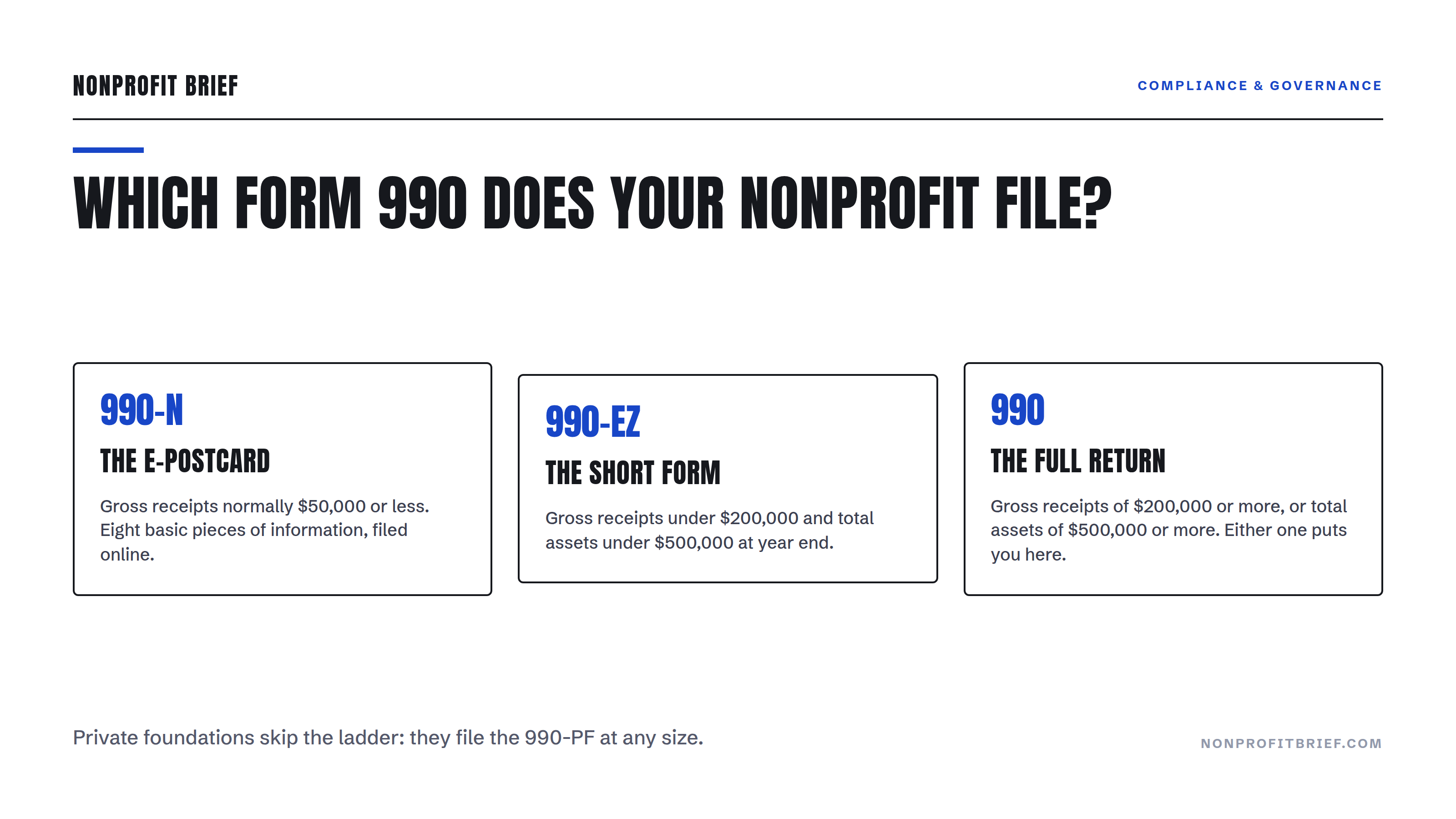
The IRS filing thresholds work like a ladder. If your gross receipts are normally $50,000 or less, you may file Form 990-N, the electronic notice everyone calls the e-Postcard, which asks for eight basic pieces of information. If gross receipts are under $200,000 and total assets are under $500,000 at year end, you may file Form 990-EZ, the short form. Hit $200,000 in gross receipts or $500,000 in assets, either one, and you file the full Form 990. Private foundations skip the ladder entirely: they file Form 990-PF every year regardless of size.
Gross receipts means everything that came in during the year, before subtracting any costs: donations, grants, program fees, event revenue, investment income. A $60,000 gala that cost $40,000 to throw still adds $60,000 to your receipts. If you are anywhere near a threshold, add the number up before assuming last year's form still fits.
You can always file up. An organization eligible for the e-Postcard may file the EZ or the full 990 voluntarily, and some do because a funder wants to see real financials. You can never file down.
"Normally $50,000" Is an Average, Not This Year's Number
The e-Postcard test is built to be forgiving of startup years, and the definition of normally depends on your organization's age. In your first tax year, you qualify if you received, or donors pledged, $75,000 or less. If you are between 1 and 3 years old, you qualify if gross receipts averaged $60,000 or less across your first 2 tax years. Once you are at least 3 years old, the test becomes a $50,000 average over the 3 most recent years, this one included.
The averaging cuts both ways. One strong year does not automatically push a small organization off the e-Postcard, and one lean year does not drop a mid-sized one onto it. Run the math fresh every year, right after your books close. Nothing about last year's form carries over, and your first-year compliance calendar should have a line item for exactly this check.
Some Organizations Never Get the Short Forms
Eligibility is not only about money. Section 509(a)(3) supporting organizations, charities built to support another named charity, generally must file the 990 or 990-EZ regardless of size. The narrow exceptions: integrated auxiliaries of churches and the exclusively religious activities of religious orders, which do not file at all, and supporting organizations with gross receipts normally $5,000 or less that support a religious 501(c)(3), which may use the e-Postcard. Political organizations under section 527 that owe an annual return cannot use the e-Postcard either.
A second list must file the full Form 990 even when their numbers say EZ. Per the Form 990-EZ instructions, that list includes sponsoring organizations of donor-advised funds, organizations that operated a hospital facility during the year, controlling organizations described in section 512(b)(13) that had transfers of funds with a controlled entity during the year, and nonprofit health insurers under section 501(c)(29). If one of those labels might describe you, whether it actually does turns on your specific facts, and that is a question for the instructions or your accountant, not a headline.
And some organizations file nothing at all. Churches, their integrated auxiliaries, and certain religious and governmental organizations are exempt from the annual return entirely. That exemption attaches to what the organization is, not to how small it is. A tiny food pantry is not a church, and skipping the filing on a hunch is how small charities end up revoked.
The Deadline Is Shared. The Consequences Are Not
Every 990-series filing is due by the 15th day of the 5th month after your fiscal year closes. For calendar-year organizations that is May 15. Form 8868 buys filers of the 990, 990-EZ, and 990-PF an automatic 6-month extension. The e-Postcard cannot be extended, but there is also no monetary penalty for submitting it late, so a missed May 15 is recoverable the same afternoon. The whole series is electronic-only now; paper filing ended with the Taxpayer First Act. The e-Postcard is submitted on the IRS site with a Login.gov or ID.me sign-in, and the bigger forms go through IRS-authorized e-file software. Either way, an IRS business tax account is the easy way to confirm what the IRS actually has on file for you, and it is worth setting up before deadline week, not during it.
The consequence that matters is the 3-year rule. Fail to file any required 990-series return or notice for 3 consecutive years and your exemption is automatically revoked, effective on the original due date of the third missed filing. An extension does not move that date. There is no appeal, the IRS publishes your name on a monthly revocation list, and getting back means reapplying. The fix is cheap and boring: file something, every year, even in years you raised nothing.
One more thing arrives with the bigger forms. Every 501(c)(3) that files the 990 or 990-EZ attaches Schedule A, and for most public charities that schedule runs the public support test that keeps you classified as a public charity rather than a private foundation. (Churches, schools, and hospitals check a status box instead of running the numbers.) The e-Postcard asks no such question, which is one more reason the jump from 990-N to 990-EZ deserves a little lead time.
The takeaway
Close your books, compute gross receipts and year-end total assets, and read the two numbers against the ladder: $50,000 normally or less means the e-Postcard, under $200,000 and $500,000 means the EZ, at or above either means the full 990, and private foundations always file the 990-PF. Then check the exception lists, because supporting organizations, DAF sponsors, and hospitals do not get the short forms their size suggests. Calendar the 15th day of your 5th month, file Form 8868 if you need air, and never let the streak of missed years reach 3. The form changes as you grow. The habit of filing it should not.