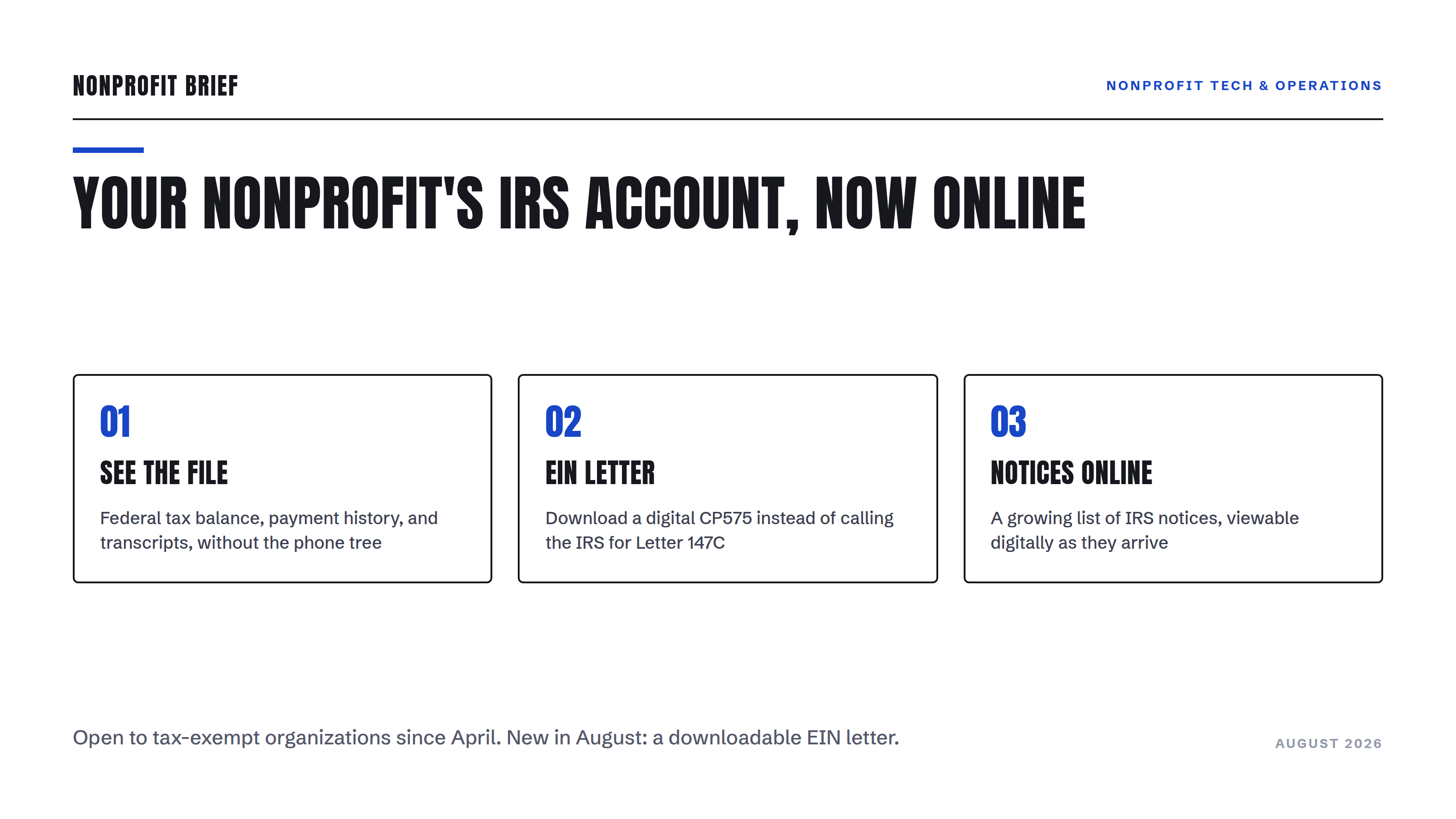
Until this spring, a nonprofit that wanted to know what the IRS had on file for it had two options: call and wait, or write and wait longer. That changed in April, when the IRS opened its Business Tax Account to tax-exempt organizations, and the account got more useful this month, when the agency added digital notices, payment plan tools, and a downloadable EIN verification letter. The IRS's own Exempt Organizations Update flagged the expansion to charities on August 13, which makes this a good week to set your account up.
What Your Organization Can Do in It
Business Tax Account, or BTA, is a free portal at irs.gov/businessaccount. Once someone at your organization is verified, the account shows your federal tax balance and payment history, lets you make payments, download tax transcripts, view a growing list of IRS notices digitally, and request the tax compliance checks that some government funders ask for. August's update added the ability to see an existing payment plan's balance and pay toward it, and to make payments on an offer in compromise, the IRS program that settles tax debt for less than the full amount owed.
The sleeper feature for small organizations is the EIN letter. Banks, payment processors, and some grantmakers ask for official proof of your employer identification number, and the CP575 notice the IRS mailed when your EIN was issued has a way of vanishing along with a former treasurer. The replacement, Letter 147C, has traditionally meant calling the IRS Business and Specialty Tax Line and waiting. A verified account holder can now download a digital CP575 directly, which the IRS says can stand in for Letter 147C with financial institutions.
Payroll Is Where the Account Earns Its Keep
Most charities owe no federal income tax, so "see your balance" may sound like a feature for someone else. It is not. If you have even one employee, you have federal employment tax deposits and quarterly filings, and a misapplied or missed deposit can quietly compound into penalty notices. The account's payment history gives you a way to confirm the IRS received what your payroll provider says it sent, before a discrepancy becomes a letter. And if your organization has fallen behind, the payment plan view and settlement payments now live in the same place as the balance that prompted them.
Who Signs Up, and What It Takes
Access runs through a person, not the organization itself. The IRS calls this person a designated official, and for a tax-exempt organization the list is role-based: an officer such as the president, treasurer, secretary, or CEO, the board chairperson, or, for organizations formed as trusts, a trustee. The designated official proves their own identity through the IRS's third-party identity verification service, and the eligibility criteria differ by entity type, so read the tax-exempt row on the IRS page before nominating whoever happens to have a free afternoon.
Choose the person deliberately, because full access is real access: payment authority and visibility into the organization's entire federal account. Treat it like adding a signer to the bank account, record the decision in board minutes, and plan for the handoff when that officer eventually leaves. Two mechanics are worth knowing up front: the IRS activates the role with a PIN sent by mail, so sign-up is not a same-day process, and designated officials must renew the role annually inside the account or register again from scratch.
What It Does Not Do
BTA is not where you file. The Form 990 series still gets filed elsewhere: the 990 and 990-EZ through an approved e-file provider, the 990-N postcard directly on IRS.gov. State charity registrations still live with state offices, and not every IRS notice appears in the account yet; the agency has been adding them in batches, and its August announcement highlighted three recently added notice types among others. Treat the account as a window into your federal file, not a replacement for your filing calendar. If your organization is new to tracking obligations like these, our first-year compliance calendar shows where the federal pieces fit.
The takeaway
Your nonprofit can now see its own federal tax account without a phone tree, and the sign-up is free. Do it before you need it: the day a bank demands an EIN letter or a payroll notice arrives is a bad day to discover the activation PIN comes by mail. Pick an officer, start the sign-up this week, and make the account part of what gets handed over whenever leadership changes.