Somewhere right now a board treasurer is realizing the Form 990 was due in May. Nobody filed it, nobody filed an extension, and the organization's mail includes a reminder notice from the IRS. If that is you, here is the honest picture: what a late 990 actually costs, when it gets dangerous, and what to do this week. The short version is that one late year is usually a fixable, survivable problem, and three missed years is an existential one.
The Deadline Is the 15th Day of the 5th Month
Every 990-series return is due by the 15th day of the 5th month after your fiscal year closes. For calendar-year organizations that means May 15. A June 30 fiscal year pushes it to November 15. Which return you owe depends on your size, and if you are not sure whether that is the 990-N, the 990-EZ, or the full form, start with our guide to which Form 990 your nonprofit files, because the consequences of missing the deadline differ by form.
An Extension Is Automatic, but Only If You Ask Before the Deadline
If the deadline has not passed yet, this problem has a clean exit. Form 8868 gives you an automatic 6-month extension for Form 990, 990-EZ, and 990-PF. No explanation required, no IRS discretion involved. Two qualifiers matter. You must file the 8868 by the original due date; it cannot resurrect a deadline that already passed. And it extends the time to file, not the time to pay, so a private foundation owing excise tax or an organization owing tax on unrelated business income still needs to pay by the original date. There is no extension for the 990-N e-Postcard, but as you will see below, a late e-Postcard is also the cheapest mistake on this list.
The Daily Penalty Is $25 or $130, and It Compounds Quietly
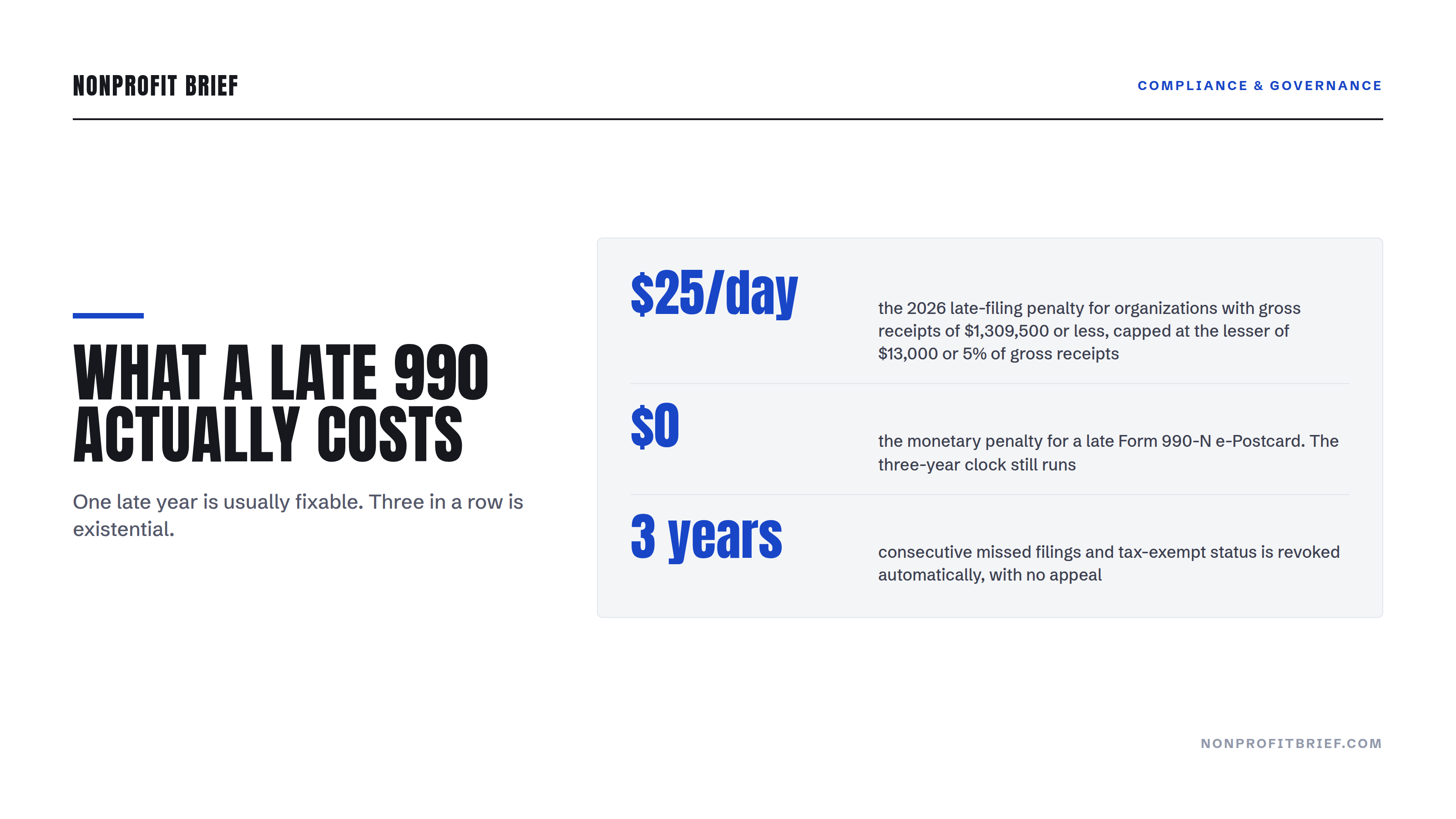
For returns required to be filed in 2026, an organization with annual gross receipts of $1,309,500 or less owes $25 for each day the return is late, capped at the lesser of $13,000 or 5 percent of gross receipts, per the IRS's annual inflation adjustments in Rev. Proc. 2024-40. Above that threshold, the rate jumps to $130 a day with a $65,000 ceiling. The amounts reset each year, so check the current figures if you are reading this later. Run the math on a small organization: a 990-EZ filed 90 days late is a potential $2,250 penalty, real money for a group running on $100,000 a year. The same daily penalty can apply to a return that is filed on time but incomplete or incorrect, so a rushed, half-finished filing is not a safe harbor. If the IRS later sends a demand letter with a fixed response date and the responsible people ignore it, they can be charged $10 a day personally, up to a $6,500 combined maximum per return.
One genuine piece of relief: if your organization files the 990-N, there is no monetary penalty for a late submission. The IRS sends a reminder, you file, and the ledger stays clean. The e-Postcard's danger is not the fine. It is the clock described next, which runs for every organization regardless of size.
Miss 3 Consecutive Years and Revocation Is Automatic
An organization that fails to file for 3 consecutive years automatically loses its tax-exempt status, effective on the original filing due date of the third missed return. Automatic means exactly that: no warning hearing, no appeal, and the law bars the IRS from undoing a revocation that was correctly applied. Your organization lands on the public Auto-Revocation List, updated monthly. From there it owes federal income tax and files taxable returns (Form 1120 or 1041), and it can no longer receive tax-deductible contributions. Donors keep the deduction for gifts made before your name appears on the list, which is small comfort in a grant application that asks for a current determination letter.
Reinstatement exists, but it is a project. The IRS lays out 4 reinstatement paths under Rev. Proc. 2014-11. The friendliest, streamlined retroactive reinstatement, is open to organizations that were eligible to file the 990-N or 990-EZ for all 3 missed years, have never been auto-revoked before, and apply within 15 months of the later of their revocation letter or their appearance on the Auto-Revocation List: reapply, pay the user fee, and status is restored back to the revocation date with no reasonable-cause statement required (990-EZ filers also back-file those 3 returns to get the late penalties waived). Larger filers, and anyone past the 15-month mark, must show reasonable cause, for 1 of the 3 years inside the window and for all 3 years beyond it, and must also file complete returns for the missed years and any years since. The last-resort path reinstates you only from your new application's postmark date, leaving a taxable gap.
If You Are Already Late, File Now and Ask for Abatement
The penalty accrues daily, so the single most effective move is to file the complete return this week, not after the next board meeting. Then, if there is a real story behind the miss, a treasurer's death, a records loss, a bookkeeper who quit mid-year, send a reasonable-cause statement asking the IRS to abate the penalty. The standard is whether you exercised ordinary business care and prudence, and the outcome turns on your specific facts, so treat this as guidance rather than legal advice for your situation. Lay out what happened, when you discovered it, and what you fixed so it cannot recur. Then make the fix real: put every federal and state deadline on a shared calendar with two owners, the way our first-year compliance calendar lays out. Late 990s are almost never caused by bad intent. They are caused by a deadline that lived in one person's head.
The Takeaway
A late 990 costs $25 a day for most small organizations, more for large ones, and nothing at all for 990-N filers. Three missed years costs you your exemption, automatically and without appeal. So the response to a missed deadline is speed: file the complete return now, request abatement if you have a reasonable-cause story, and build the calendar system that makes this the last time. If the deadline has not hit yet, file Form 8868 today and buy yourself 6 calm months.