Most people who set out to start a nonprofit do the steps in the wrong order. They pick a name, print business cards, maybe take in a few donations, and only later discover that the paperwork the IRS wants had to come first, and that some of what they already did has to be undone. The order is not arbitrary. Each step produces something the next step requires. Here is the sequence that works, and what each stage actually asks of you.
First, decide the nonprofit is the right vehicle
Before any filing, answer one question: does this work need its own corporation, or would a fiscal sponsor carry it faster? Standing up a 501(c)(3) means a board, annual filings, and a compliance calendar that never stops. If your project is small, time-limited, or still testing whether it has legs, a fiscal sponsor lets you raise tax-deductible gifts through an existing charity, which takes the funds into its own exemption and regrants them to your project, while you find out. That is not a lesser path. It is often the smart one. If the mission is durable and needs to own its own identity, contracts, and staff, then a standalone nonprofit earns its overhead, and you proceed.
Incorporate at the state level
A nonprofit is born as a corporation under state law, not federal law. You file articles of incorporation with your state, usually through the secretary of state, and pay a filing fee that varies by state, typically somewhere between a token amount and a couple hundred dollars. This is the step people rush, and it is the one the IRS is strictest about, because two clauses in those articles are load-bearing for everything that follows.
The IRS requires that your organizing document limit your purposes to those the tax code recognizes as exempt, and that it permanently dedicate your assets to an exempt purpose, so that if the organization dissolves, whatever is left goes to another 501(c)(3) or to a government body, never to an individual. The IRS calls this the organizational test. A generic corporate template from a business-formation site will not include these clauses, and articles without them will slow or stall your exemption application. A handful of states supply the asset-dedication requirement by statute, but you cannot count on that, so write both clauses in explicitly. Get the purpose clause and the dissolution clause right the first time. This is where outcomes turn on your specific facts, and this is not legal advice for your situation, so if the language is unfamiliar, a short consult with a nonprofit lawyer or a vetted template from your state association is money well spent.
Adopt bylaws and appoint your initial board in the same stretch of work. You do not file bylaws with anyone, but you need them before you apply, and most states set a minimum board size. A conflict-of-interest policy belongs here too; the IRS application asks whether you have one.
Get an EIN, which is free
Once the corporation exists, get an Employer Identification Number from the IRS. Every organization needs one, whether or not it has employees, and it is required before you can apply for exemption. The EIN is free and issued immediately through the IRS website. Ignore any service that offers to obtain one for a fee; you are paying for something the government gives away.
Apply for 501(c)(3) status
Now, and only now, you apply to the IRS for recognition of exemption. There are two doors. Form 1023-EZ is the short one: you qualify if you project annual gross receipts of $50,000 or less for the current year and the next two, have not exceeded $50,000 in any of the past three years, and hold total assets whose fair market value is $250,000 or less. The dollar thresholds are only the start. The eligibility worksheet runs about 30 questions, and any single yes disqualifies you: churches, schools, hospitals, LLCs, and foreign organizations are on it, but so are two that trip up founders who assume they qualify, namely successors to a for-profit business and groups reapplying after their exemption was automatically revoked. The user fee is $275. The full Form 1023 is the long one, with a $600 fee, and it is what most organizations expecting real budgets will file. Which form fits, and the tradeoffs between them, is its own decision, covered in our guide to Form 1023 versus 1023-EZ. Both are filed and paid through Pay.gov.
One timing rule pays for attention. If you file within 27 months of the end of the month you incorporated, your exempt status is recognized retroactively to your formation date, which means gifts received in the meantime are covered. File after that window, and exemption generally starts only from the filing date forward, though a late filer can use Schedule E to ask for an earlier effective date in some circumstances. That gap is why the paperwork sequence matters: incorporate, then apply, without letting a year drift by in between.
Register before you fundraise
An IRS determination letter lets you offer tax-deductible receipts. It does not, by itself, let you ask the public for money. Most states require charitable solicitation registration before you send a single appeal, and several want it before your first event. Then the recurring obligations begin, the annual 990 and state renewals that make up your first-year compliance calendar. Handle registration as the last founding step and the first operating one.
The takeaway
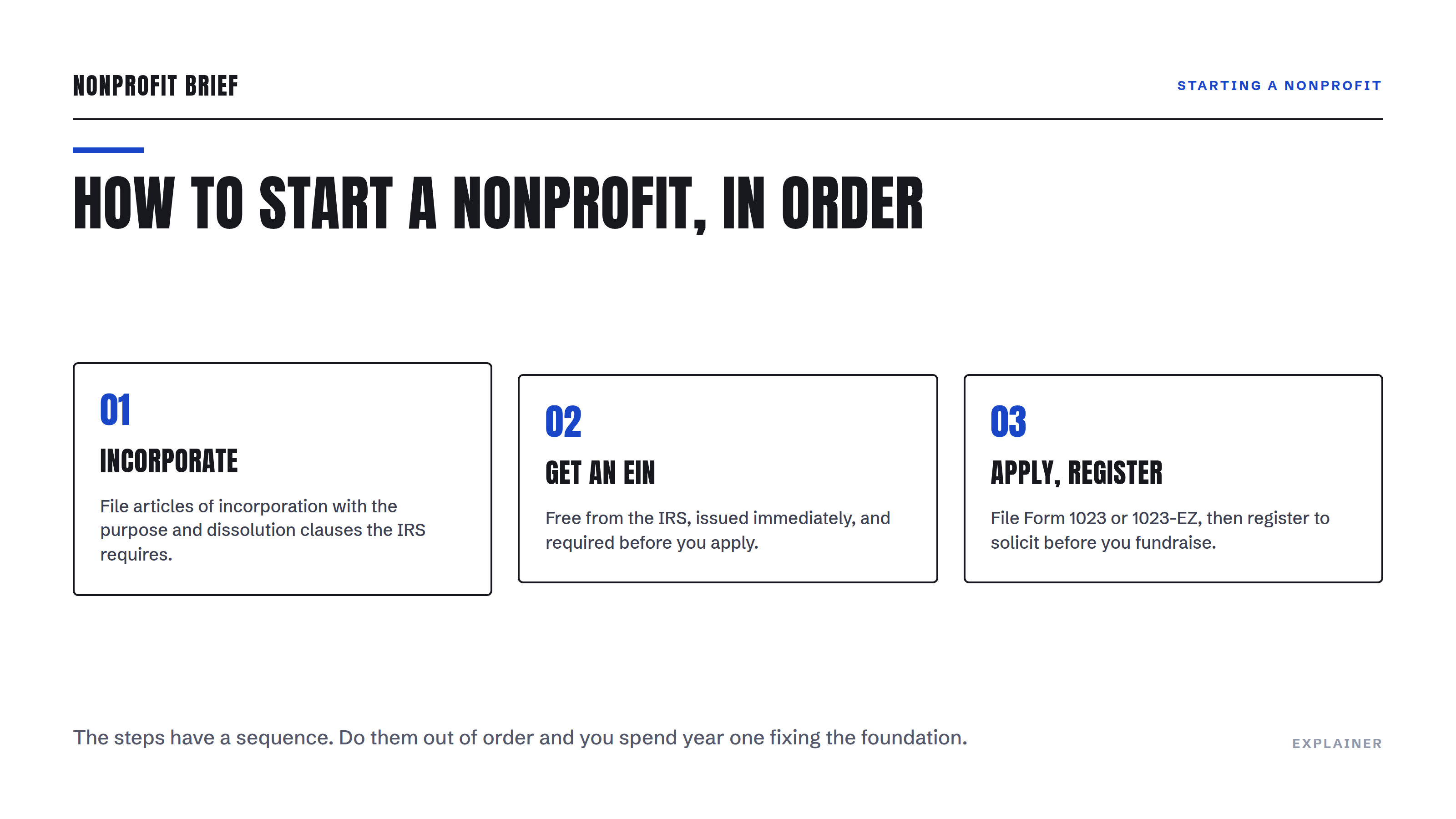
The order is fixed for a reason: confirm a standalone nonprofit is the right vehicle, incorporate with a compliant purpose and dissolution clause, get your free EIN, apply for 501(c)(3) status within the 27-month window, and register to solicit before you fundraise. Do them in that sequence and each step hands the next what it needs. Do them out of order and you will spend your first year fixing the foundation instead of building on it.