The IRS said yes in 121,913 of the 501(c)(3) application and determination cases it closed in fiscal year 2025. It said no in 117. Another 15,513 closed without a ruling: withdrawn, incomplete, or otherwise ended short of a decision. Those are the agency's own Data Book figures, and they tell you something most founders learn too late: the IRS is not the gatekeeper. If you finish the application, the agency almost always says yes. The real question is not whether you can start a nonprofit. It is whether you should, and nobody at the IRS is going to answer that for you.
There are already about 1.9 million registered nonprofits in the United States, per Candid's 2023 count. Some of them are working on your problem right now. Before you add one more, run your idea through the five questions below. They are the ones that actually predict whether a new organization thrives, limps, or quietly dissolves after the founder burns out.
Question 1: Who Is Already Doing This Work?
Spend an evening on this before you spend a dollar on anything else. Search Candid, ProPublica's Nonprofit Explorer, and plain Google for organizations serving your cause in your geography. Read their Forms 990, which are public documents. Call the executive director of the closest match and ask what is missing in the field.
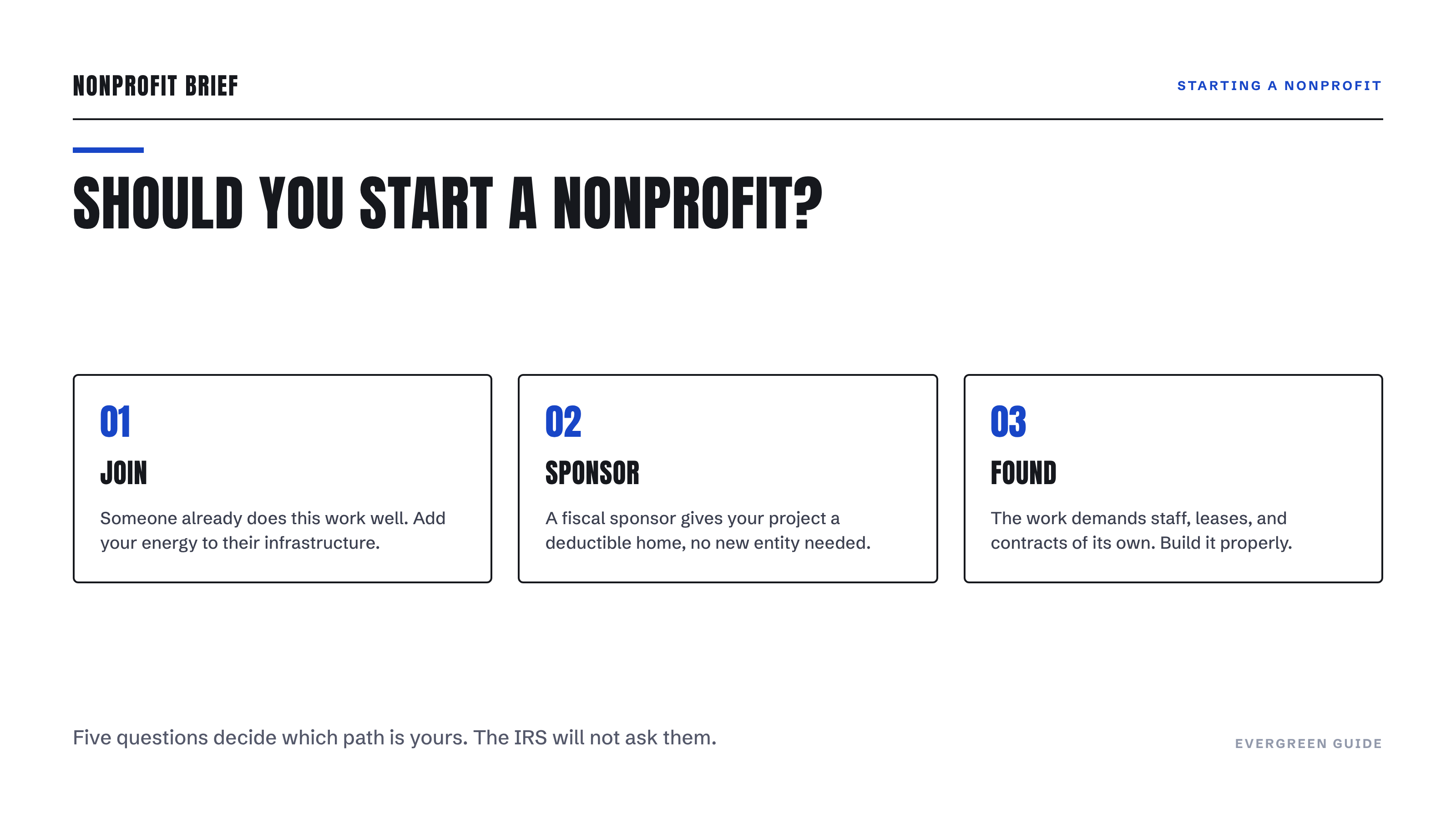
Two outcomes are possible, and both are useful. If someone is already doing the work well, the fastest route to impact is usually joining them: as a volunteer, a board member, a program lead, or the champion of a new initiative inside their existing structure. Their infrastructure, their donor base, your energy. If nobody is doing it, or nobody is doing it well, you have learned why. Sometimes the answer is that the need is real and unmet, which is your green light. Sometimes the answer is that three organizations tried and the funding does not exist, which is a different kind of answer.
Question 2: Where Does the Money Come From in Year Two?
Year one usually funds itself. Founders give their own money, friends and family chip in, a launch event does better than expected. The dangerous year is the second one, when the founding enthusiasm is spent and the organization needs repeatable revenue.
Be honest about what is realistic. Most institutional funders want to see a track record, audited or at least reviewed financials, and evidence of community support before they write a check, which is why grants rarely rescue brand-new organizations. If your plan says "we will apply for grants" and stops there, you do not have a plan yet. The sturdier early answers are individual donors you already know, fees for service, a congregation or civic group that adopts the cause, or an employer matching program you can activate.
Write down the number your program actually needs in year two, then name the first twenty people or institutions you will ask. If you cannot name twenty, the entity is premature.
Question 3: Can You Give It Away?
This is the question founders most often fail. A 501(c)(3) has no owners. The organization you build will belong to the public, supervised by a board of directors with the legal power to overrule you, set your pay, and fire you. That is not a malfunction. It is the design, and it is the price of tax exemption and deductible donations.
You will need a real board from day one, and how many members you actually need depends on your state and your workload. You can draw a salary for real work at a reasonable rate, and we have covered how founder pay works in detail. But you cannot sell the organization, pass it to your kids, or take a cut of the surplus. If reading that paragraph produced a flicker of hesitation, take it seriously. Founders who cannot give the organization away end up with hand-picked rubber-stamp boards, and that failure mode shows up later as compliance trouble, funder flight, or both.
Question 4: Does the Work Need Its Own Entity Yet?
A surprising amount of charitable work does not require forming anything. If your project needs a tax-deductible home but not its own corporation, fiscal sponsorship gives you one: an established 501(c)(3) takes your project in, and donations go to the sponsor, which keeps legal control of the funds and handles the back office for a fee. That control is not a technicality. It is what makes the gifts deductible; a sponsor that just passes through money earmarked for you is a conduit the IRS does not honor. You test the idea, build the track record funders want, and decide later whether to spin out. Many excellent projects stay sponsored forever.
The entity becomes necessary when the work starts accumulating things an individual or a sponsored project cannot hold well: employees, leases, vehicles, government contracts, licenses, or liability that needs a corporate shield. That is the threshold. Form the organization when the work demands a container, not when the idea feels exciting.
Question 5: Do You Want to Run an Organization, or Do the Work?
These are different jobs. The founder of a tutoring nonprofit spends startling little time tutoring. The job becomes fundraising, board management, bookkeeping, insurance, state registrations, and an annual IRS filing, and the first-year compliance calendar is longer than most founders expect. Some people discover they love running the machine. Others discover they have administratively imprisoned themselves away from the exact work they started this to do. Know which person you are before the paperwork decides for you.
Two Founders, Two Right Answers
Here is the test applied twice.
A retired teacher wants to run a Saturday meal program out of her church's kitchen. Budget around $18,000 a year, no staff, volunteers from the congregation. Question 1 finds a food bank nearby but no weekend program. Question 2 is covered by the congregation and two local businesses. Questions 3 through 5 are where it gets clear: she does not need a board, an entity, or a compliance calendar. She needs a kitchen and a deductible way to receive the businesses' checks. The church can host the program directly, or a local fiscal sponsor can receive the funds. Starting a nonprofit here would add roughly a thousand dollars in startup costs and dozens of hours of annual administration while feeding no one extra.
A housing counselor wants to launch a counseling agency in a county that lost its only HUD-approved provider. The work requires agency-level approval, certified staff on payroll, client confidentiality systems, and office space. Question 1 confirms the gap is real: the nearest provider is ninety minutes away. Question 2 has a plausible answer, because HUD grants, bank CRA money, and municipal contracts fund this field, though HUD will not approve a brand-new agency until it has a year of counseling experience, so she will need to launch under an approved intermediary or partner agency first. Questions 3 through 5 she passes with eyes open; she has run programs inside a larger agency before. This work needs its own entity, or at minimum a sponsored launch with a planned spin-out. She should read up on the right order of operations and start recruiting a board that brings housing finance and legal experience.
The Edge Cases That Trip People Up
A funder says they can only give to a 501(c)(3). This is the single most common reason people rush to incorporate, and it usually does not require it. A fiscal sponsor's determination letter covers your project, because the sponsor rather than you legally runs the money, and the sponsor's fee is almost always cheaper than a year of running your own entity.
A memorial fund for someone who died. Grief plus paperwork is a hard combination, and a standalone nonprofit is nearly always the wrong container. A fund at a community foundation or a scholarship administered by an existing institution honors the person without committing the family to decades of filings.
Disaster response. Speed matters more than structure. Give through or organize under an established responder; new entities formed mid-disaster struggle to move money fast and attract scrutiny later.
Advocacy. A 501(c)(3) can lobby within limits but cannot support or oppose candidates, ever. If your real goal is electoral, a 501(c)(3) is the wrong vehicle, and the rules here turn on your specific facts, so this is not legal advice for your situation. Talk to a lawyer who works with exempt organizations before you pick a structure.
If You Passed, Here Is What Yes Looks Like
Suppose the test went well: the need is unserved, year-two money has names attached, you can genuinely share control, the work demands an entity, and you want the job. Then start, and start properly. Incorporate in your state, recruit a board that is more than your relatives, adopt bylaws and a conflict-of-interest policy, then apply for exemption, choosing between Form 1023 and the 1023-EZ based on your size and complexity. Budget realistically for what it costs to launch. The full sequence, in order, is in our pillar guide to starting a nonprofit the right way.
The Takeaway
The IRS approval numbers mean the application is not the test. The test is the five questions, and the people it protects are mostly future-you: the version of you three years in, holding a board meeting nobody prepared for, chasing a grant that will not come, wondering why the work you loved became a filing calendar. If the idea survives all five questions, a nonprofit is a powerful container, and the sector needs well-founded new organizations. If it fails even one, there is a faster, cheaper way to do the same good, and choosing it is not settling. It is the first act of good stewardship.