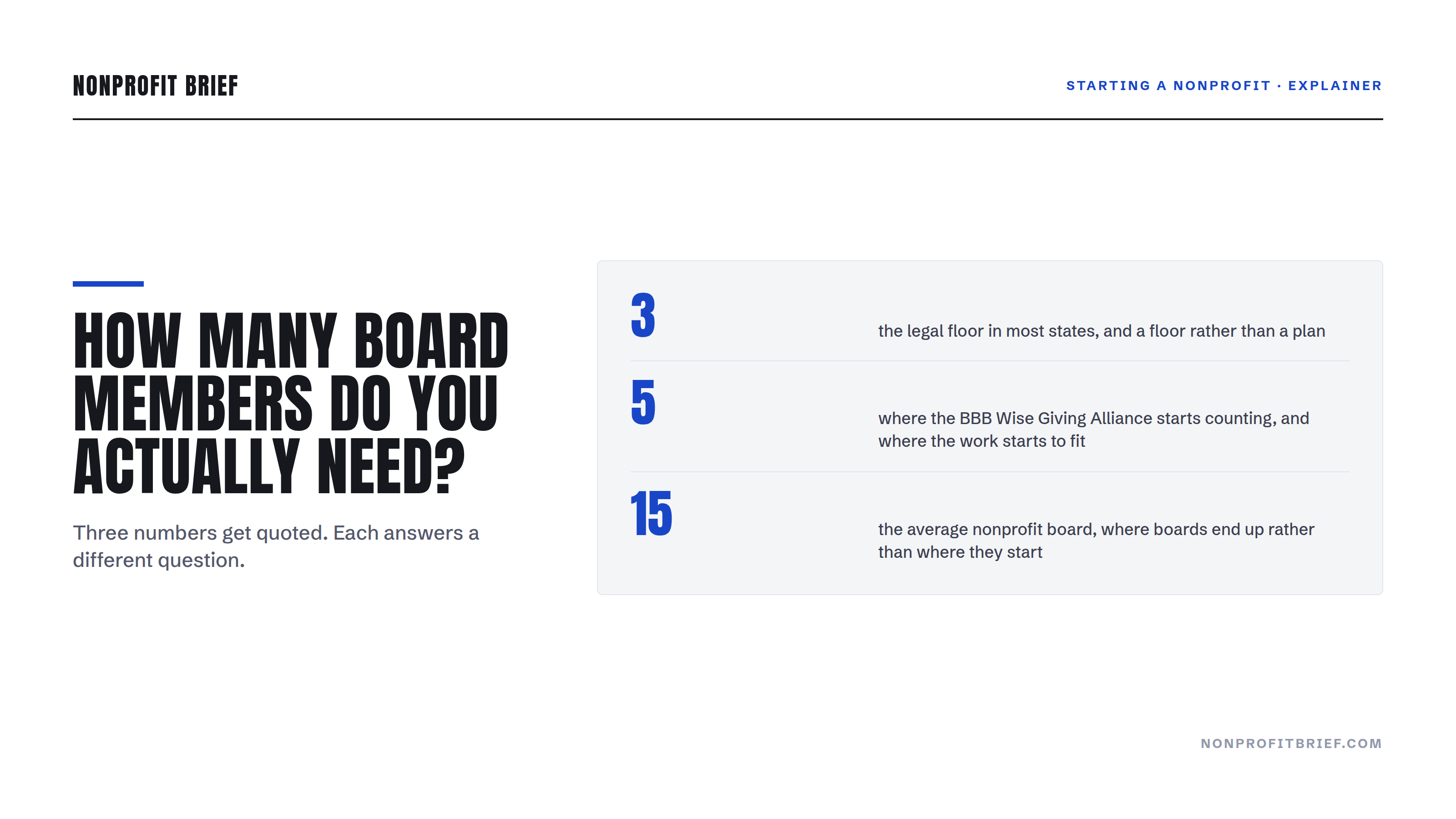
Ask how many board members a nonprofit needs and you will get three different numbers. The legal answer is usually 3. The watchdog answer is 5. The national average is 15, and it is not a target. Each number answers a different question, and a founder filling their first board needs to know which question is actually being asked. Here is what each number means, and the honest range to aim for.
Most States Set the Floor at Three
A nonprofit is a corporation under state law, so your state's nonprofit corporation act sets the legal minimum, not the IRS. In most states that minimum is 3. Texas says a board-managed nonprofit corporation may not have fewer than three directors. New York's statute requires not less than three. A minority of states go lower: California's code allows the number to be one or more for a nonprofit public benefit corporation. And at least one goes higher: New Hampshire generally requires charities to have at least 5 voting members who are not close relatives.
So the first stop is your own state's statute, before you file articles of incorporation. Get the number wrong and your filing can bounce, or worse, sit valid on paper while every later board action is open to challenge. Your bylaws then set the working number, usually as a range like "no fewer than 3 and no more than 9," which lets the board grow without amending anything. We covered how to draft that clause in our guide to the bylaws clauses that matter.
The IRS Has No Minimum, but a One-Person Board Invites Scrutiny
Federal tax law does not set a board size. The Form 1023 instructions, the application for 501(c)(3) status, ask who your officers and directors are and about the organization's financial dealings with them and their families, and never name a required count. That is the technical answer. The practical answer is different. IRS reviewers can deny exemption on private benefit grounds, the doctrine that a charity must serve the public rather than private interests, including its insiders, and practitioners report that applications listing a single director, or two directors who are related, draw exactly that scrutiny. A board your family controls is legal in some states and still a hard sell to the agency deciding whether donations to you are deductible.
The scrutiny does not end at approval. Once your organization grows into filing the full Form 990 (the smallest filers use the 990-N or 990-EZ, which skip this question), it asks how many of your voting members are independent under the IRS's four-part definition, which looks at compensation and at business dealings, yours and your family's, with the organization. The 990 is a public document, and a governing body with zero independent members is visible to every funder who pulls it. Related directors also matter the day you put yourself on payroll: the safest way to set founder pay runs through approval by directors without a stake in the decision, which a two-person family board cannot supply. We walk through that mechanism in our guide to founder compensation.
Watchdogs and Funders Start Counting at Five
The BBB Wise Giving Alliance, whose accreditation many donors check, requires a minimum of 5 voting board members and at least 3 evenly spaced full-board meetings a year, with a majority attending and most of them face-to-face. It also wants a board that is almost entirely unpaid, with no paid member serving as chair or treasurer. Grant reviewers read board lists the same way: a foundation deciding between two small applicants will notice that one board is 5 unrelated people who meet quarterly and the other is a founder, a spouse, and a friend. Neither the BBB standard nor a funder's preference is law. Both are gates you will eventually want to pass through.
Five also happens to be where the work starts to fit. A functioning board needs a chair, a treasurer, and a secretary who are different people, plus members who can carry the three legal duties of care, loyalty, and obedience without burning out. With 3 people, one absence leaves you two votes and no tiebreaker. With 5, someone can miss a meeting and the board still functions, and a conflicted director can step out of a vote without freezing it.
Build for the Work, Not the Average
BoardSource's Leading with Intent research puts the average nonprofit board at 15 members, with a median of 13, and BoardSource itself cautions that averages are not a recommended norm. Those numbers describe established organizations with committees to staff and major donors to seat. A brand-new organization that recruits 15 directors before it has programs will spend its first year managing a board instead of running a mission.
For most new nonprofits the working answer is 5 to 7: enough for independence, officers, and a quorum on a bad night, small enough that every member has a real job. Odd numbers break ties. Recruit for what the organization lacks, someone who reads financial statements, someone who knows your program area, someone who will actually ask people for money, rather than for names that look good on a letterhead. Then let the number grow when the work does, inside the range your bylaws already allow. One caveat as you set all this up: board requirements sit in state law, and outcomes here turn on your specific facts, so treat this as orientation rather than legal advice for your situation.
The takeaway
Check your state's minimum, which is probably 3, and never build to the bare floor. Start at 5 to 7 members, mostly unrelated to you and to each other, with officers in separate hands. That size clears state law, survives IRS scrutiny of insider control, meets the BBB's 5-member standard, and still fits around a kitchen table. The 15-member average is where boards end up, not where they start. If you are still sequencing the larger formation to-do list, our pillar guide to starting a nonprofit shows where board recruitment falls in the order of operations.