Most nonprofit bylaws are copied from a template the week of incorporation, skimmed once, and never read again until a fight breaks out. Then they get read very closely, by people who are angry. That is the test your bylaws were built for, and it is worth an afternoon to pass it. The good news: only a handful of clauses do real work. This piece walks through them, in the order they tend to matter, so you can check your draft against each one before it gets its first hostile reading.
Bylaws Answer to Your State, Not the IRS
Start with what bylaws are not. They are not your organizing document. The articles of incorporation create the corporation; the bylaws are the internal operating manual, covering how directors are chosen, how meetings run, and who can act for the organization. The IRS treats them accordingly. The Form 1023 attachment list requires your organizing document but asks for bylaws only "if adopted." Federal exemption does not turn on having them, and our guide to the 1023 application covers what the IRS does scrutinize instead.
Whether you must adopt bylaws at all is a state-law question, and in most states the answer is yes. Texas, for example, directs that initial bylaws be adopted, by the board or, in member-managed corporations, by the members, and most state nonprofit corporation acts have a similar provision. Unlike articles, bylaws are typically not filed with the state; they live in your minute book. One disclosure wrinkle is worth knowing before you write anything colorful into them: if you submit bylaws with your exemption application, they become part of a document the public can request, because exemption applications and their attachments are open to public inspection.
Decide First Whether You Have Members
This is the structural fork every other clause depends on, and templates get it wrong constantly. A membership corporation gives voting members legal rights: typically to elect directors, approve mergers, and amend bylaws. A board-only corporation vests all of that in the directors, who elect their own successors. Both are legitimate. But they are different machines, and you have to pick one on purpose.
Here is the walkthrough. Ask two questions. First, is there a real constituency that should control the organization, the way a neighborhood association answers to residents or a professional society answers to its profession? If yes, voting members may fit, and you should budget for the machinery that comes with them: member meetings, notice requirements, quorum rules for member votes, and records of who is a member in good standing. Second, if you are honest, are "members" in your draft just donors you wanted to flatter? Then do not give them voting rights. Call them supporters or friends, state in the bylaws that they are not members within the meaning of the state statute, and keep governance with the board. Most small charities belong in this second camp.
The default cuts your way if you say nothing at all. Under California's rule, a public benefit corporation with no membership provision in its articles or bylaws simply has no members, and board approval generally substitutes for member approval where the statute would otherwise require one. The danger case is the template that grants voting membership to "all donors" or "all volunteers." That sentence can hand strangers the legal power to elect your board, and unwinding it later may itself require a member vote. Outcomes here turn on your state's statute and your specific facts, and this is not legal advice for your situation, but the drafting rule is universal: if you did not mean to create voting members, say expressly that you have none.
Quorum Is the Clause You Will Trip Over First
Quorum decides whether the people in the room can act at all, and it fails in both directions. Set it too high and you cannot do business; set it too low and a faction can. Run the arithmetic on your own board before you adopt a number. Nine authorized seats with a majority quorum means five directors, every meeting, including August. If your real attendance runs at six, one flu season puts you below quorum, and everything that meeting "decided" is open to challenge later.
State law usually supplies a default and a floor. California's default is a majority of the authorized number of directors, and bylaws may lower it, but not below one-fifth of the authorized number or two directors, whichever is larger. Two drafting details do quiet work here. Watch the base: a quorum measured against authorized directors counts empty seats against you, so a board authorized at 15 with nine seated needs eight of those nine present. Fixing the authorized number as a range, say seven to 15, and measuring quorum against directors actually in office keeps vacancies from paralyzing you. And resist supermajority quorums. They feel protective and function as a minority veto exercised by staying home.
Write the Exits: Terms, Removal, and Vacancies
Boards change composition more often than they amend bylaws, so the transition clauses carry the load for years. Three of them earn their space. Term lengths with staggering: two- or three-year terms arranged so only a third of the board turns over in any year, which protects continuity without entrenching anyone. Removal: state plainly whether directors can be removed without cause and by what vote, because the statute's default may surprise you, and a removal fight is the single most common moment bylaws get weaponized. Vacancies: say who fills them and for how long, the unexpired term or a fresh one. A board that cannot lawfully replace a resigned treasurer until the annual meeting is a board that stops functioning in March.
None of this changes what individual directors owe the organization once seated. The duties of care and loyalty come from state law, not your drafting, and our guide to board members' legal duties covers them. Bylaws decide who sits in the seats; the law decides how they must behave there.
Meetings: Allow Remote, and Get Consent Right
Two mechanics clauses save more grief than any others. First, authorize remote meetings expressly: directors may attend by video or phone if everyone can hear everyone, and attendance counts toward quorum. Most statutes permit this, but permitting language in the bylaws ends the argument before it starts. Second, handle action without a meeting correctly. The common state default lets a board act by written consent only if the consent is unanimous. That word does the work. A 6-2 email vote between meetings is not board action in a unanimity state; it is six people agreeing informally, and the "decision" may be void. If your board likes deciding by email, the bylaws should say votes happen in meetings, real or virtual, and written consent is reserved for items nobody contests. Check your own state's consent statute before adopting the clause, since a few states now allow less-than-unanimous consent with conditions.
Keep Policies Out of the Bylaws
A recurring template mistake is stuffing the bylaws with the full text of every governance policy. Keep them separate. The Form 990's governance section asks whether you have a conflict of interest policy, a whistleblower policy, and a document retention policy. None of the three is required as a written policy by federal statute, though a few states require some of them by their own law, and the underlying federal conduct rules are real: federal law prohibits corporations, nonprofits included, from retaliating against whistleblowers who report federal offenses and from destroying records with intent to obstruct a federal investigation. Adopt each as a standalone board resolution instead; our walkthrough of the conflict of interest policy explains what a functioning one contains. The reason is mechanical. Policies you revise annually should not require a bylaws amendment each time, and bylaws amendments are exactly the kind of change you have to report, as the next section explains.
The same logic sets the boundary with your articles. Purposes and the dissolution clause belong in the articles, where the IRS requires them (in a handful of states, state law itself dedicates assets on dissolution and the IRS accepts that in place of an express clause, but writing the clause anyway is the safe course). If bylaws and articles conflict, the articles control, so do not restate article provisions in the bylaws where they can drift out of sync. And give the bylaws a clean amendment clause: amendable by a stated board vote, typically a majority or two-thirds of directors then in office, with advance notice of the proposed change. No state filing is needed for a bylaws amendment in most states, which is exactly why they are the right home for rules you may want to tune.
Amendments Land on Your Form 990
Bylaws are not a one-time document, and the IRS assumes as much. Form 990, Part VI asks whether you made significant changes to your governing documents since the last return, with the changes described on Schedule O. The instructions' examples of "significant" read like a list of this article's headings: changes to the governing body's number or composition, quorum or voting rules, member rights, and amendment procedures. So keep one dated, board-approved, current version, note the adoption date of each amendment in the document itself, and put the 990 disclosure on the same checklist as the return. Our first-year compliance calendar shows where that filing falls in the year. If you cannot say which version of your bylaws is in force, you do not have bylaws; you have several drafts and a future argument.
The takeaway
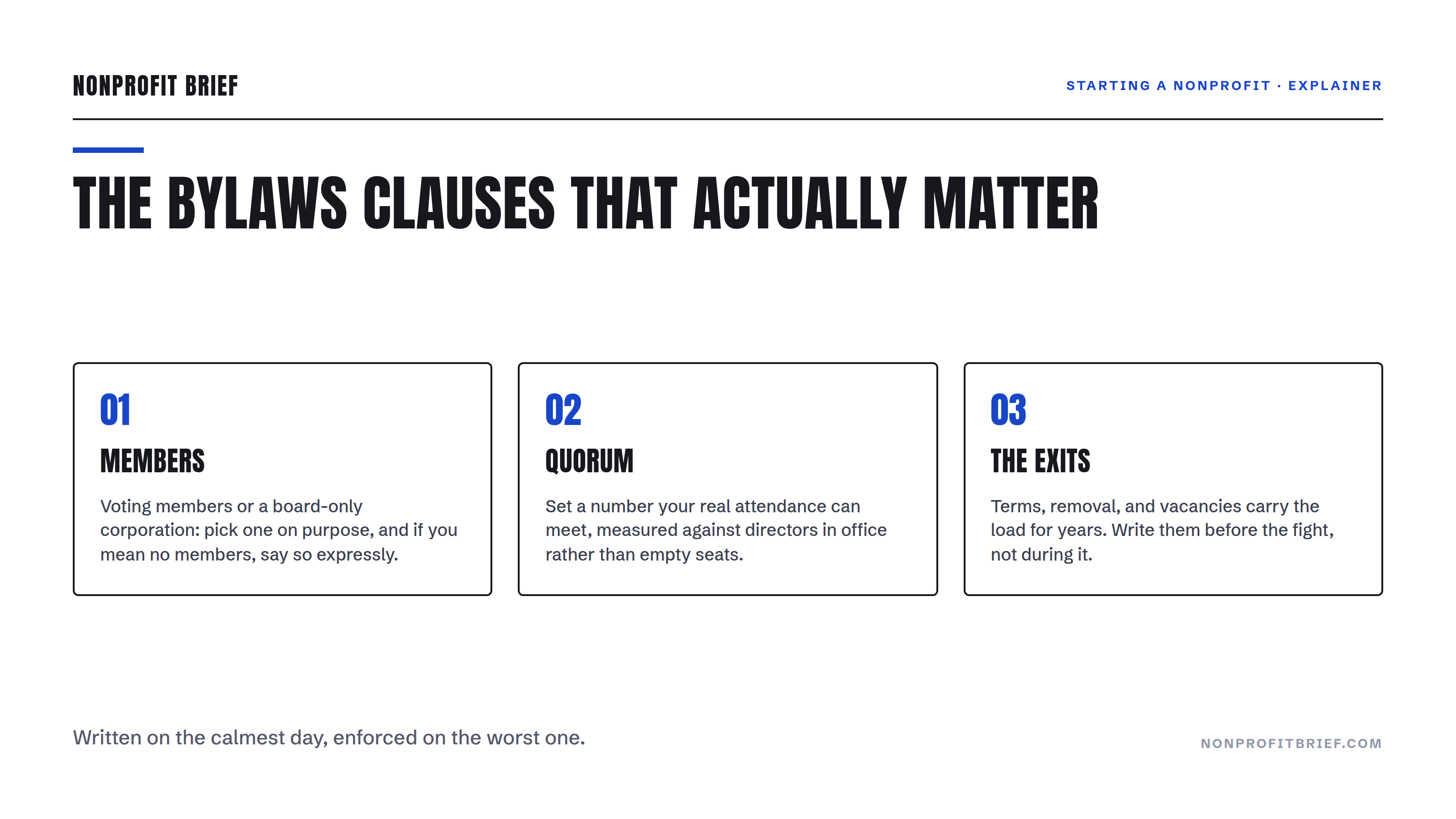
Bylaws are the rules you will be held to on your worst day, written on a day nobody was paying attention. Fix that asymmetry while things are calm. Decide the membership question on purpose and say so expressly. Set a quorum your real attendance can meet, measured against directors in office. Write the exits: terms, removal, and vacancies. Authorize remote meetings and respect the unanimous-consent rule. Keep policies in resolutions, purposes in the articles, and report significant amendments on Schedule O. Then print the current version, date it, and put it where the board can find it, because the reader you are drafting for is a future director in a dispute you cannot see yet. If you are still upstream of all this, our pillar guide to starting a nonprofit shows where bylaws fall in the formation sequence.