Sooner or later, your nonprofit will do business with someone in the room. The treasurer's firm submits the cheapest audit bid. The founder's spouse is the obvious first hire. A board member owns the storefront you want to rent. None of this is a scandal, and most of it may be good for the organization. The question a regulator, a funder, or a future board will ask is simpler: who decided, and what got written down?
A conflict of interest policy is the document that answers that question before anyone asks it. Here is the reassuring part for a founder with no lawyer on staff: the IRS publishes a sample policy in Appendix A of the Form 1023 instructions, it runs a few pages, and adopting something like it at your first board meeting handles most of what follows. The rest of this article is why that 20-minute agenda item matters.
A Conflict Is a Situation, Not a Sin
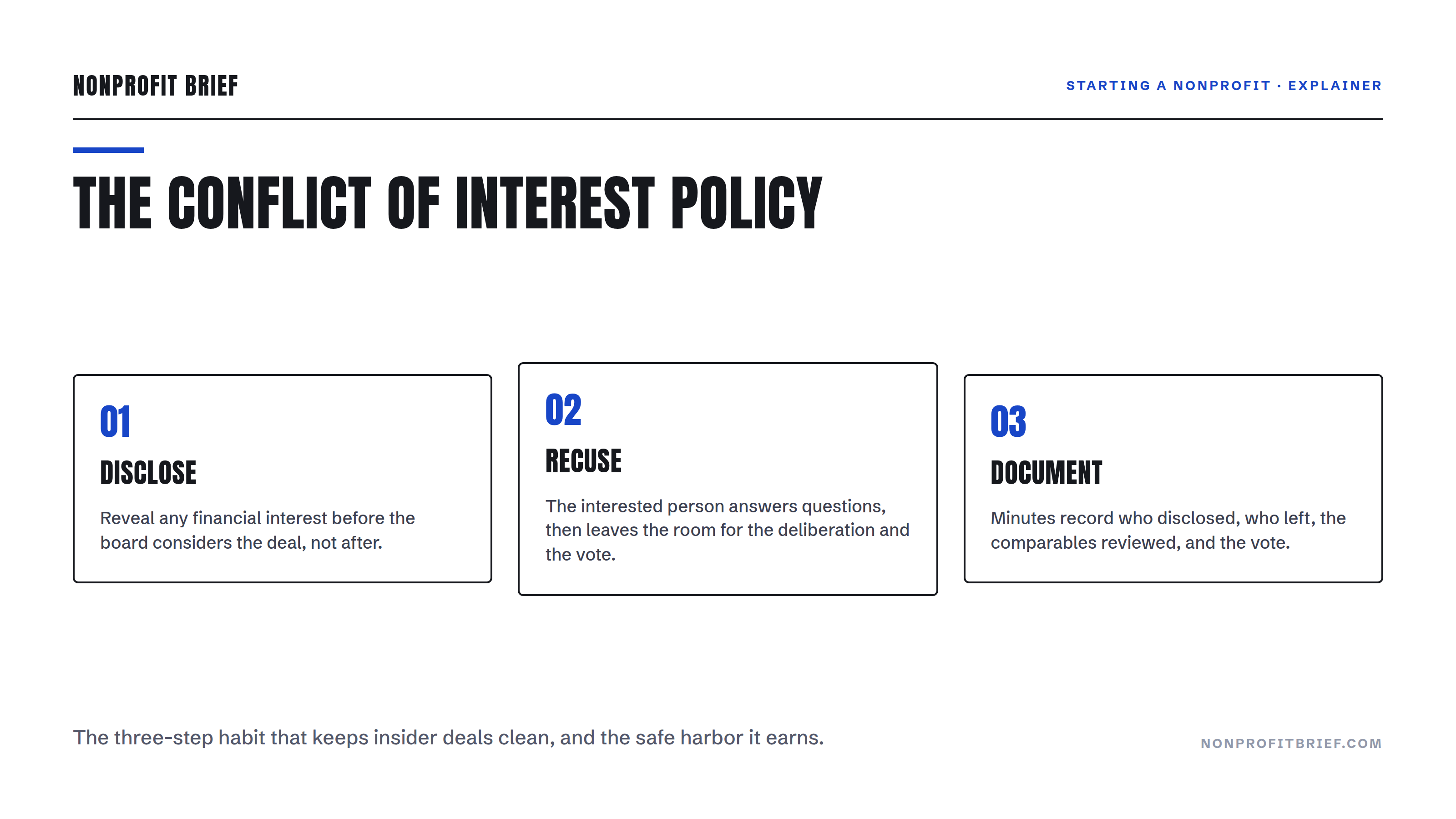
A conflict of interest exists whenever a person who helps govern the organization also stands to benefit personally from a decision in front of it. Board members already owe the organization a duty of loyalty, one of the three legal duties every director carries, which requires putting the nonprofit's interest ahead of their own. The policy does not add a new obligation. It converts the duty into a procedure: disclose, step out, document. Procedures survive board turnover. Good intentions do not.
No Federal Law Requires the Policy. The IRS Asks Anyway
Federal tax law does not mandate a conflict of interest policy, and the IRS itself, as a legal memo published by Public Counsel puts it, has acknowledged it has no statutory authority to require one. What the IRS does instead is ask, every year, in public. The full Form 990, the annual return larger nonprofits file, devotes three governance questions to the subject: whether you have a written policy, whether officers, directors, trustees, and key employees disclose their interests annually, and whether you actually monitor and enforce compliance. Organizations small enough to file the 990-N postcard or 990-EZ skip those questions for now, but growth, a government grant, or a funder's due diligence form tends to put them in front of you eventually. Your answers are public record. Grantmakers and donors who pull your 990 will see three no's, and checking "yes" untruthfully is its own problem.
State law is a separate layer, and it is not uniform. New York requires nearly every nonprofit incorporated there to adopt a conflict of interest policy by statute, with required elements spelled out in the law and summarized in a Lawyers Alliance alert. Other states, California among them, regulate insider transactions through approval procedures rather than a required document. Check your state of incorporation before assuming the federal answer is the whole answer.
The Real Teeth Are in Section 4958
The consequences that make the policy worth having sit in the excess benefit rules. When an insider, a "disqualified person" in the statute's terms, gets more value out of a transaction than the organization received, the IRS can impose an excise tax of 25 percent of the excess on that person, rising to 200 percent if the deal is not unwound in time. Board members who knowingly and willfully approve the transaction, without reasonable cause, face their own 10 percent tax, up to $20,000 per transaction, out of their personal pockets. These are the "intermediate sanctions," intermediate because the IRS can apply them without revoking the organization's exemption, though revocation remains on the table for serious cases. One scope note: these rules cover public charities and 501(c)(4) organizations. Private foundations answer to a separate, stricter regime, the Section 4941 self-dealing taxes, which bar most insider transactions outright no matter how fair the price.
The action attached to that risk is a safe harbor. IRS regulations give insider deals a rebuttable presumption of reasonableness when three things happen: people without a stake in the deal approve it in advance, they rely on comparability data such as market rates or salary surveys (an organization under $1 million in gross receipts can satisfy this with data from three comparable organizations), and they document the basis for the decision when they make it (records prepared by the next board meeting count). Do those three things every time money meets an insider, and the burden shifts to the IRS to prove the deal was off-market. A decent policy is simply this safe harbor written down as standing procedure.
Four Pieces Every Policy Needs
- A duty to disclose. Anyone covered by the policy must reveal a financial interest in a proposed transaction before the board considers it, not after.
- Recusal that means leaving the room. The interested person answers the board's questions, then exits for the deliberation and the vote. Abstaining while staying to listen changes the conversation, so the sample policy sends them out.
- Minutes that prove it happened. Record who disclosed what, who left, what comparables the board looked at, and how the vote went. The minutes are the evidence side of the safe harbor.
- An annual disclosure statement. Once a year, every director, officer, and key employee signs a statement listing their interests and affirming they have read the policy. This is exactly what the Form 990 asks whether you do.
Adopt the policy at the first board meeting and put the annual statements on your first-year compliance calendar, alongside the state filings that follow your exemption application. Whether any specific deal is fair to the organization turns on your facts and your state's law, and this is not legal advice for your situation. The policy's job is to make sure the right people decide with the right paper trail.
The takeaway
No federal statute forces a conflict of interest policy on your nonprofit, but the full Form 990 asks about one annually in public, New York requires one outright, and Section 4958 taxes the insiders and the board members who approve a bad deal without one. The IRS gives away a workable sample policy in the Form 1023 instructions. Adopt it early, collect the annual disclosures, and make disclose-recuse-document a reflex before the first interesting transaction arrives.