The fee conversation is usually where fiscal sponsorship gets real. One sponsor quotes 8% of everything you raise. A colleague swears her project pays 5%. A sponsor that handles government contracts wants 15%. All three can be normal, because the percentage only means something next to what it covers. If you are still deciding whether sponsorship is the right structure at all, start with our fiscal sponsorship primer. This piece assumes you are already shopping.
The going rate is 5% to 10% of revenue
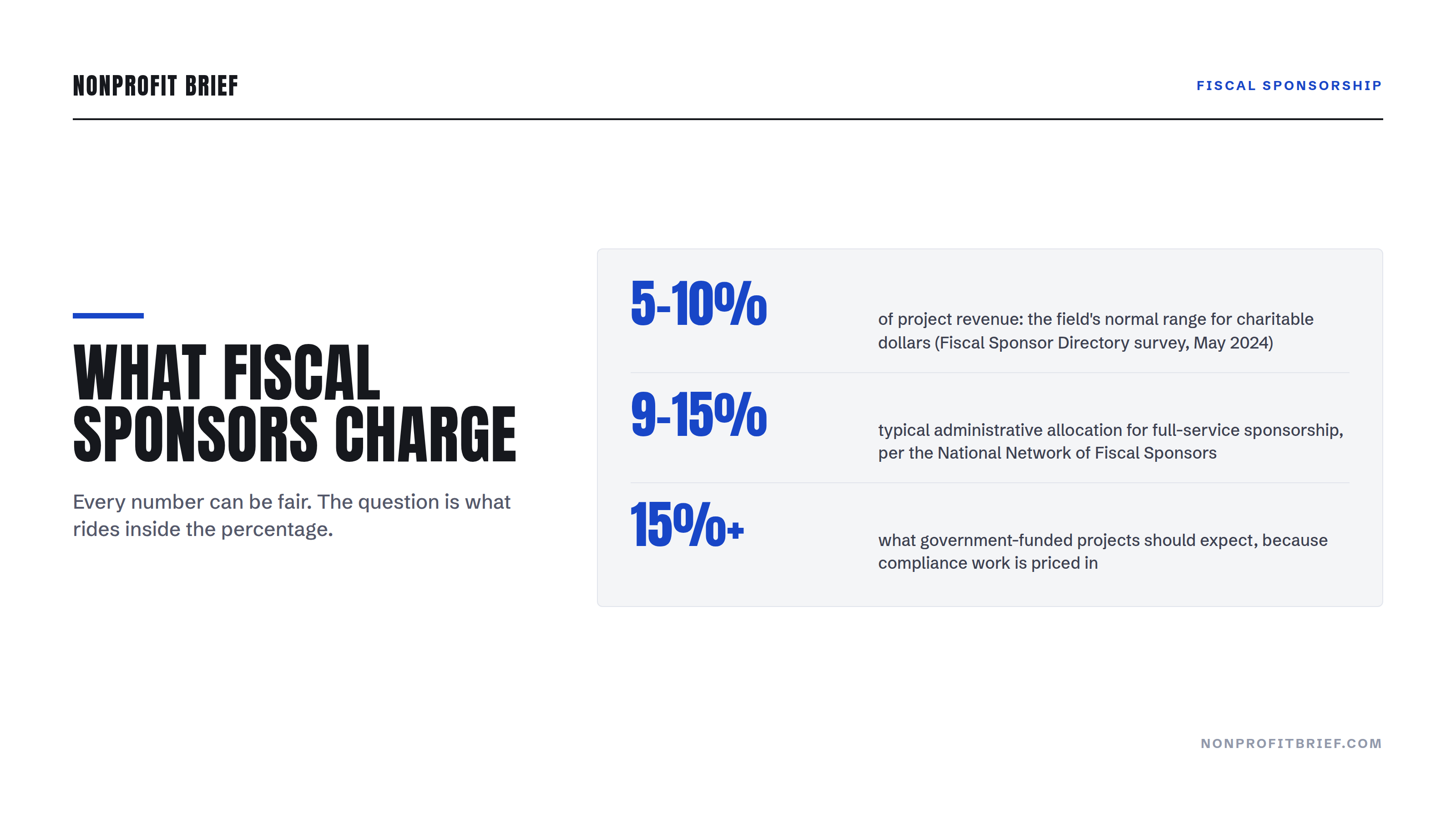
The widest lens on the field comes from the Fiscal Sponsor Directory, the San Francisco Study Center's long-running census of fiscal sponsors. In its survey data, updated in May 2024 across the 376 sponsors then listed, 96% of sponsors report charging a percentage of project revenues. Nearly half charge a flat percentage between 5% and 10%, and the rest mostly use sliding scales keyed to a project's revenue and needed services, many of which land in the same range.
Propel Nonprofits' board guide gives boards the same benchmark: generally 5% to 10% of the funds held on a sponsored group's behalf.
The National Network of Fiscal Sponsors, the field's professional network, puts typical administrative allocations at 9% to 15%, calculated against project revenues or expenses. That is not a contradiction. As the Directory puts it, what mostly accounts for the disparity is the range of services a sponsor provides, and the services depend heavily on which kind of sponsorship you are buying.
Comprehensive sponsorship charges more because it does more
Under comprehensive sponsorship, often called Model A, your project lives inside the sponsor's legal entity: your staff are its employees, its insurance covers your work, and its audit includes your numbers. Under a pre-approved grant relationship, Model C, you remain a separate entity and the sponsor mainly receives, vets, and regrants charitable dollars. The Model A versus Model C distinction drives more of the service load than anything else: a comprehensive sponsor's fee is buying payroll administration, employee relations support, insurance, and a slice of the annual audit, while a Model C fee is mostly buying gift processing and oversight. When you compare two quotes, the first question is whether they are even quoting the same job.
Government money fairly commands 15% or more
In the Directory's data, 55 sponsors charge up to 15% or more, usually to handle government-funded projects. That premium is earned. Public dollars arrive with reimbursement-based invoicing, compliance reporting, procurement rules, and audit exposure, and it is the sponsor's name on the award and, eventually, on the Form 990 that discloses the relationship. A sponsor offering to run your federal award at its standard 7% is either quietly subsidizing you or about to do the compliance work thinly, and neither ends well for the project.
The percentage is not the whole price
Before you compare quotes, ask each sponsor what sits outside the fee. The common extras: one-time setup charges, monthly minimums or membership dues, credit card processing passed through at cost, payroll vendor charges, and exit-related costs if you eventually leave your sponsor. A concrete example of how the pieces combine: Fractured Atlas, one of the largest arts sponsors in the country, charges a flat 8% administrative fee on donations with credit card processing included, on top of a paid membership that runs about $10 to $20 a month, and it may pass through certain vendor charges and add fees for grants administration in some cases. None of that is hidden; all of it is on their own pages. But two sponsors can both say "8%" and cost meaningfully different amounts once you account for what rides inside the number.
Ask about the fee base too. Most sponsors calculate on revenue as it arrives; some calculate on expenses as they go out. The money is the same over time, but the timing differs, which matters in a year when you raise far more than you spend.
Then there is interest. Sponsors hold your balance, sometimes a large one, and their policies differ on who keeps the interest earned on funds advanced or held for the project. The National Network of Fiscal Sponsors flags this in its questions projects should ask: some sponsors retain that interest to cover administrative costs, others reserve it for the project. On a six-figure balance held across a year, that answer is real money. Bring the full NNFS list to every screening call. It is the closest thing the field has to a standard diligence checklist.
A suspiciously low fee is its own red flag
It is tempting to treat the fee like a tax and shop for the smallest number. Resist that. A sponsor charging far under market is covering your project's back office from somewhere else, or not really covering it, and the back office is the product you are buying. The same diligence logic applies here as when you are vetting a donor-advised fund sponsor: the cheap option is only cheap if the work still gets done.
Whatever number you land on, it belongs in the written agreement: the percentage, the base it is calculated on, every pass-through, and the interest policy. A sponsor that hesitates to put its full fee picture in writing is telling you something more useful than any percentage could.
The takeaway
For straightforward charitable revenue, 5% to 10% is the field's normal range, with full-service sponsorship that carries payroll, insurance, and audit coverage running toward the top of the published ranges. Government-funded projects should expect 15% or more and be glad the compliance work is priced in. Compare what is included rather than the headline number, get the whole fee picture into the agreement, and treat a far-below-market quote the way you would treat a far-below-market bid on a roof.