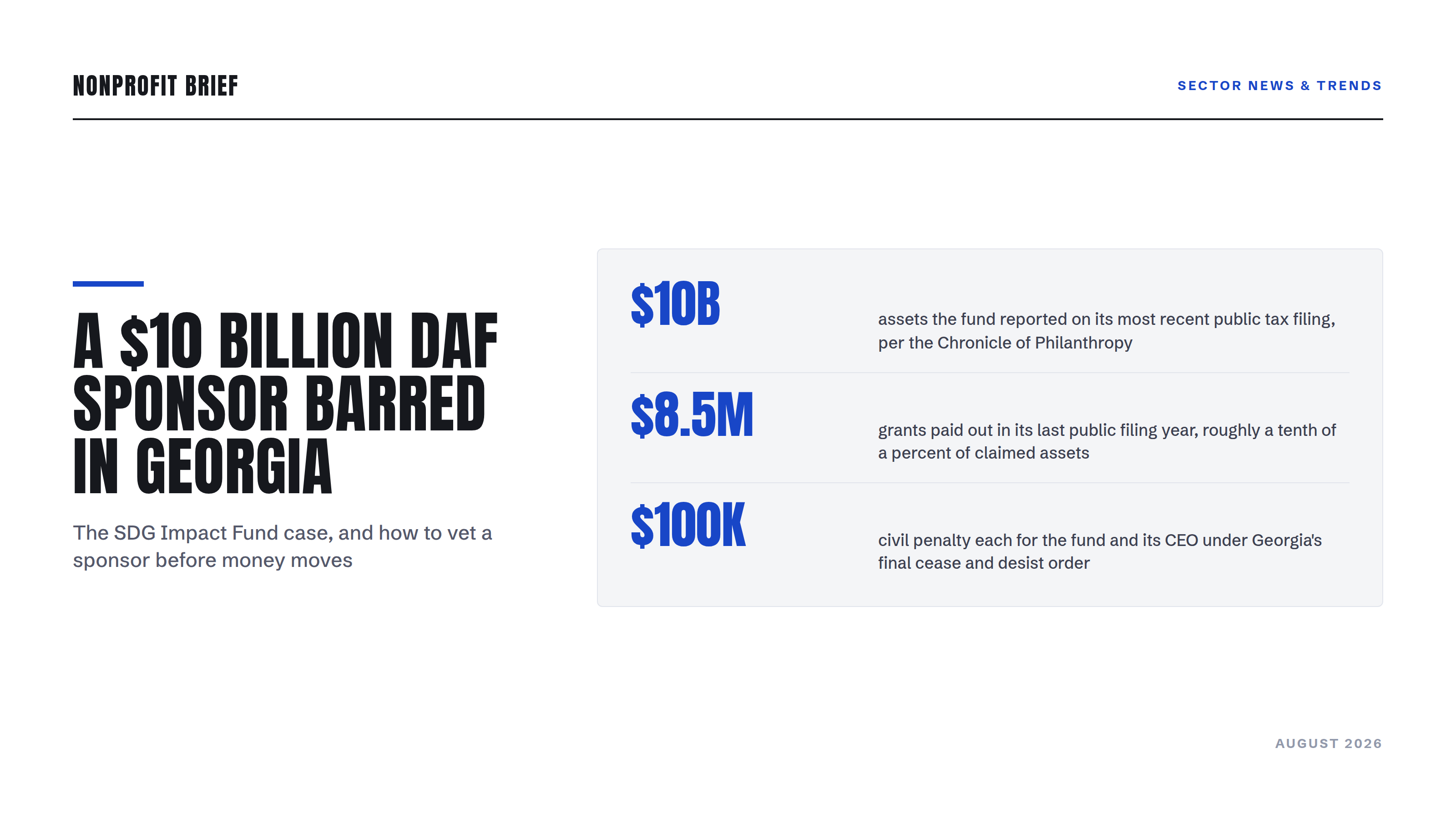
On paper, the SDG Impact Fund's claimed assets would have ranked it among the largest donor-advised fund sponsors in the country. The Cartersville, Georgia charity reported $10 billion in assets on its most recent public tax filing, according to the Chronicle of Philanthropy, which reviewed its filings. In June, the Georgia Secretary of State's office issued an emergency cease and desist order barring the fund and its chief executive, Anthony "Tony" Suber, from operating as a charity or soliciting donations in the state.
The order alleges that donor money went to private school tuition, personal credit cards, luxury purchases, and payments to the Atlanta Hawks. No hearing was requested, which made the order final. The Daily Tribune News, which reviewed the order, reports the fund and Suber were fined $100,000 each. These are a state regulator's findings and allegations, not criminal convictions, and Suber has defended the fund's practices. He told WSB-TV that donors hold recommendation privileges only and that final decisions rest with the organization.
That defense is the reason this story matters beyond Georgia. Suber was describing donor-advised funds accurately. The case is a stress test of the trust the whole DAF system runs on, and it is worth 10 minutes of any development director's attention.
The Order Describes Donor Money That Never Reached Charities
Beginning around 2020, the order alleges, the fund commingled restricted donor funds with other money and moved some of it to entities Suber controlled, according to the Daily Tribune News, which reviewed the order. Specific items include $171,618 in preparatory school tuition for Suber's children, $42,525 paid to the Atlanta Hawks, and real estate in Louisiana. One donor says a $1.9 million contribution meant for a California church and monastery never arrived.
The fund's own filings had already raised questions. The Chronicle reports that its assets grew from $117,000 in 2017 to $10 billion in 2021, driven by cryptocurrency donations, while its last public filing showed about $8.5 million in grants paid out in a year. That is roughly a tenth of a percent of claimed assets, in a sector where sponsors as a group pay out at several times the 5 percent minimum that applies to private foundations. DAF sponsors themselves face no legal payout minimum at all, which is why a sponsor's near-zero rate drew notice rather than penalties.
Donors Advise, but the Sponsor Owns the Money
A donor-advised fund is owned and controlled by its sponsoring organization. The donor keeps advisory privileges, not ownership. That structure, together with the sponsor's status as a qualified public charity, is what makes the immediate tax deduction work; the IRS warns it can disallow deductions for contributions to abusive DAF arrangements, which is exactly the risk donors to a failed sponsor face. We walk through the mechanics in our guide to how DAF grants reach nonprofits. All of it means sponsor governance is the main safeguard. When the sponsor is a large national fund or a community foundation with audited financials and an independent board, that diligence is handled for you. When the sponsor is unfamiliar, the account paperwork protects no one.
Oversight Is a State Patchwork, and a Barred Sponsor Can Move
Charity oversight in the United States runs mostly through state registration regimes, the same authority Georgia used here. Our charitable solicitation registration explainer covers how those work. The catch is that a sponsor shut down in one state can reincorporate in another. The Chronicle reports that a Wyoming nonprofit named SDG Global Impact Fund was incorporated in February 2026 and received IRS tax-exempt recognition, with its officers listed behind a registered agent. Wyoming ranks second-lightest for charity regulation in the Philanthropy Roundtable's 50-state index, behind only Montana. The Georgia attorney general's office has an active investigation, and as of early August 2026 no federal action has been reported.
What to Check Before DAF Money Moves
For a nonprofit that receives a DAF grant in good faith, the direct legal risk is low, with one standing exception: a DAF grant cannot provide the donor more than incidental benefits, so no gala tickets, memberships with real perks, or auction items against DAF money, and take care before applying a DAF grant to a legally binding pledge. Beyond that rule, the exposure sits earlier in the chain: donors choosing a sponsor, and fundraisers steering them. Three checks cover most of it.
First, pull the sponsor's Form 990 through the IRS Tax Exempt Organization Search. Assets, grants paid, and officer pay are all public, though filings can run a year or more behind, as this case shows. A sponsor claiming billions in assets while granting out a fraction of a percent warrants direct questions before anyone's gift goes in. Second, confirm the sponsor is registered to solicit in your state; most states publish a searchable charity database. Third, ask an unfamiliar sponsor for audited financials and its board roster. Established sponsors publish both without being asked. Some donors also say the fund solicited loans from donor accounts with promised returns that never materialized. A sponsor that talks about investment returns owed back to anyone has stopped acting like a charity vehicle. Treat that as disqualifying.
The takeaway
A DAF gift is only as strong as its sponsor. Most sponsors are boring, audited, and fine, and boring is exactly what you want. When a sponsor fails, the money can be gone before any regulator moves, and advisory privileges will not bring it back. Check the 990, check the state registration, and treat an unfamiliar sponsor the way you would treat a new major donor's pledge: verify before you count it.