At some point a fiscally sponsored project starts to feel like an organization. The budget clears half a million, a funder asks why you still pay an administrative fee, and the advisory committee starts using the word "board." Leaving can be the right call. But most project leaders plan the exit as if the project were theirs to take, and legally it is not.
Your Sponsor Owns the Project's Assets
Under comprehensive fiscal sponsorship (Model A in the standard taxonomy, where the project operates inside the sponsor as a program), the sponsor holds legal title to everything the project has: its cash, its equipment, its name and mailing lists, even its staff, who are the sponsor's employees. The National Network of Fiscal Sponsors' guidelines for comprehensive sponsorship say it plainly: the sponsor "retains full legal discretion and control over the project, its staff and its activities," and intellectual property is "normally held as assets of the sponsor restricted for the purpose of the project."
That is not a defect in your agreement. It is the structure that made your donors' gifts deductible in the first place. The consequence is that a spin-out is not a withdrawal. It is a negotiated transfer of charitable assets from one organization to another, and the sponsor's board is responsible for making sure those assets are not misused when they move. If the structure itself is new to you, start with our fiscal sponsorship explainer.
Read the Exit Clause Before You Announce Anything
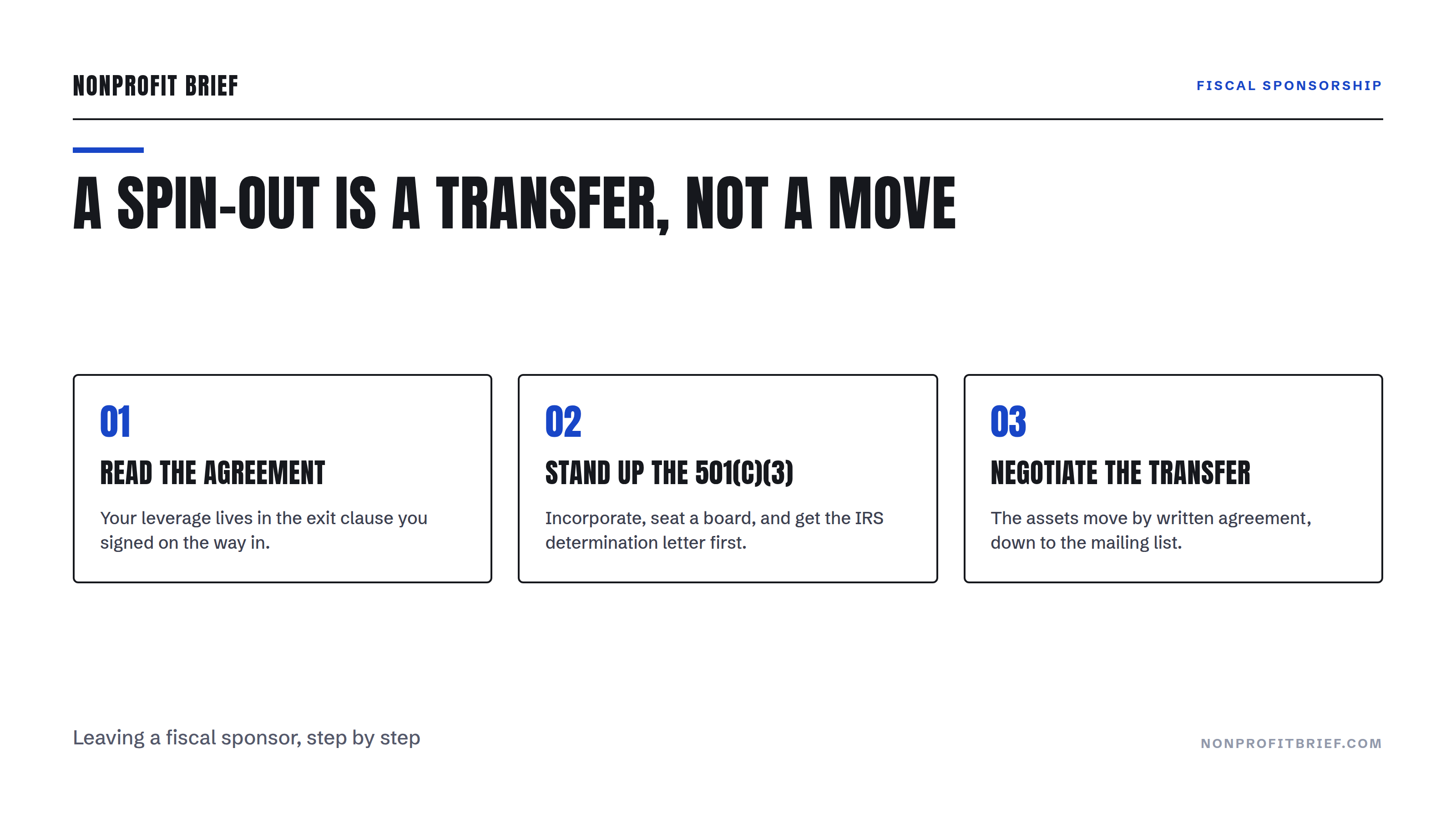
Your leverage lives in the agreement you signed on the way in. A well-drafted fiscal sponsorship agreement spells out termination: how much notice each side gives, how a successor is chosen and vetted, and what happens to remaining project funds. NNFS best practice is that a sponsor separating from a project will "transfer remaining project assets to a successor charity" or otherwise reach a responsible decision about them. The hard exits are the ones where no written agreement exists or the agreement is silent on termination, and a common dispute is over who qualifies as an acceptable successor. If you are still shopping for a sponsor, put exit terms on your due-diligence list now.
Stand Up the New 501(c)(3) First
Sponsors generally expect the successor to hold its own IRS determination letter before any assets move. That expectation sets your timeline. You incorporate the new entity, get an EIN, adopt bylaws, seat a real board, and apply for recognition of exemption on Form 1023 or Form 1023-EZ.
The streamlined form is only available to organizations that project annual gross receipts of $50,000 or less in each of the next three years, have not exceeded that figure in the past three, and hold total assets with a fair market value of $250,000 or less. Those are only the financial tests: the IRS eligibility worksheet separately excludes churches, schools, hospitals, foreign-formed organizations, successors to for-profit entities, and roughly two dozen other categories regardless of size. A project big enough to justify its own 501(c)(3) will often fail the financial tests alone and need the full Form 1023. Either way, the filing date matters. File within 27 months after the end of the month you were legally formed and, once the IRS approves the application, your exemption generally runs back to the formation date, so donations to the new entity are covered from day one. File later than that and the effective date is generally the date you submitted, not the date you formed.
Budget real calendar time for the wait. As of early August 2026, the IRS reports issuing 80 percent of Form 1023-EZ determinations within 22 days and 80 percent of full Form 1023 determinations within 191 days, with applications flagged for further review running longer. Six months of overlap, with the project still running under the sponsor, is normal, not a delay. Our Form 1023 vs. 1023-EZ comparison walks through the choice in detail.
Negotiate the Transfer Agreement Like the Contract It Is
The handoff itself should be a written transfer agreement, not a handshake. It lists what moves: cash, equipment, furniture, mailing lists, trademarks, and other intellectual property tied to the project. Expect a holdback; sponsors commonly hold back a portion of project funds for a few months to cover invoices that arrive after the transfer. On liabilities, one common compromise has the successor accept those incurred in operating the project, but only up to the value of the assets it receives.
Contracts the sponsor signed for the project need review before they can be assigned, and some will require the other party's consent. Employees do not transfer automatically: the new organization hires them fresh, which means payroll setup, benefits enrollment, and an offer letter for every person you intend to keep. And avoid operating under the exact same name as the sponsored project while both versions exist in transition; a state charities regulator can read that as a misrepresentation to the public.
Grants, Donors, and Registrations Do Not Move Automatically
Open grants were made to your sponsor, not to you. Each funder decides whether to re-grant the remaining balance to the new entity, and some will prefer to let the award run out through the sponsor. Tell them early. The NNFS guidelines also call for consulting original donors where appropriate or required before project assets move. Donor data deserves the same care: handing a mailing list to a new legal entity is a data transfer, and it should comply with your published privacy policy and state law.
The new organization also starts its compliance life from zero. That means charitable solicitation registration in the states where you fundraise and the full set of filings on our first-year compliance calendar. None of this is a reason to stay put. It is a reason to run the exit as a project with an owner, a budget, and a six-to-twelve-month timeline. Outcomes here turn on your agreement and your state's law, and this is not legal advice for your situation.
The takeaway
A spin-out succeeds when you treat it as a transfer between two charities rather than a move you announce. Read your agreement before you say a word. Stand up the new entity and get the determination letter. Put the handoff in writing, down to the mailing list and the holdback. Give funders and donors a clean story and enough notice to act on it. And if you are choosing a sponsor today, negotiate the exit before you sign anything, while everyone still likes each other.