Two projects sign up with fiscal sponsors in the same month. A year later, one has its payroll, insurance, and bookkeeping run entirely by the sponsor, and its team members are the sponsor's employees. The other runs its own payroll, files its own taxes, and receives a grant check from the sponsor every quarter. Both call the arrangement "fiscal sponsorship." The difference between them is the difference between Model A and Model C, and picking the wrong one is one of the most expensive unforced errors a new project can make.
The letters come from the framework attorney Gregory Colvin laid out in Fiscal Sponsorship: 6 Ways to Do It Right, the field's standard text, now co-written with attorney Stephanie Petit, which summarizes each model in use today. Models A and C are the two that dominate practice. If you are new to the concept entirely, start with our explainer on how fiscal sponsorship works and come back.
Model A makes your project part of the sponsor
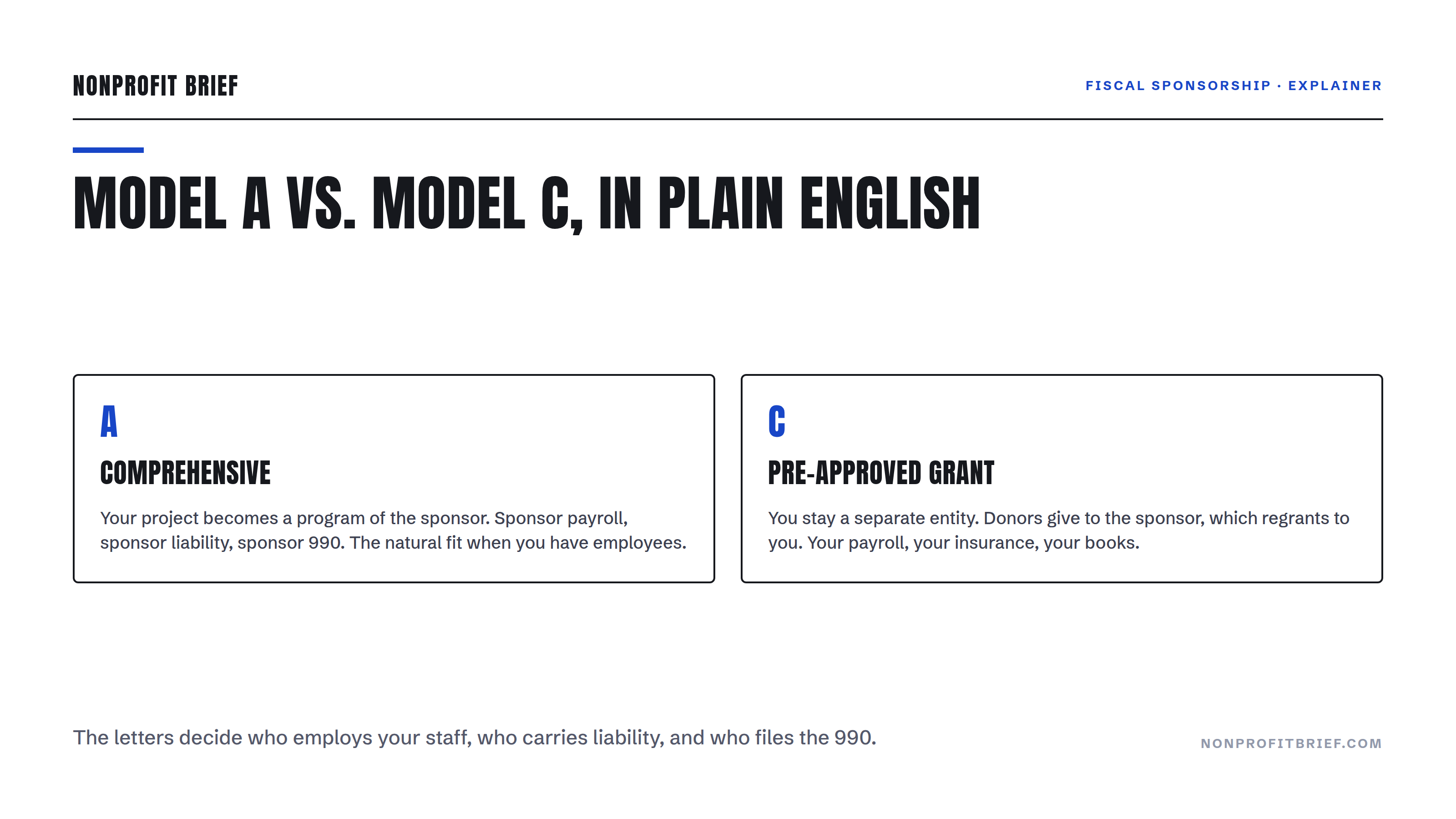
In Model A, sometimes called comprehensive fiscal sponsorship, your project has no separate legal existence. It becomes a program of the sponsor, the way a food pantry might be a program of a community center. The National Network of Fiscal Sponsors describes it as a fully integrated arrangement in which the sponsor holds all legal and fiduciary responsibility for the project, including its employees and activities.
Notice what that handles for you: payroll and payroll taxes, workers' compensation, liability insurance, financial reporting, and the annual Form 990, all carried by the sponsor. Your staff are the sponsor's employees or volunteers. Donations and grants belong to the sponsor, which spends them on the project's work. The tradeoff is control. The sponsor's board is legally in charge, and if the relationship sours, untangling who keeps the project's name, funds, and momentum depends heavily on the agreement you signed. We covered that exit problem in how to leave a fiscal sponsor.
Model C keeps you separate and regrants the money
In Model C, the pre-approved grant relationship, your project is a separate entity. It might be an LLC, an unincorporated association, or an individual artist. Donors still give to the sponsor and still get a charitable deduction, because the sponsor is the 501(c)(3). The sponsor then makes grants to your project from those funds, after approving your purpose up front. Two conditions ride along with that approval. Your project's work has to further the sponsor's own exempt purposes, not just any good cause, and you will owe the sponsor reports and records showing the grant money was spent on the charitable work you described. Beyond that, the NNFS is blunt about what stays on your plate: a Model C project is responsible for its own tax reporting and liability. Your payroll, your insurance, your books.
The legal heart of Model C is that the sponsor must keep real discretion and control over the money; in your agreement this often appears as the sponsor's variance power. If the sponsor acts as a mere pass-through that forwards whatever arrives with your name on it, donors' deductions and the sponsor's own exempt status are both at risk, which is why careful funders write grants to the sponsor, not the project, and why a legitimate sponsor will sometimes say no to how you want to spend a grant. A sponsor that never says no is a red flag, not a convenience. How the details play out turns on your specific agreement and facts, and this is not legal advice for your situation.
Choose by employment first, then by independence
The cleanest decision rule in the field: if your project has or will soon have employees, Model A deserves the first look, because employment is exactly the risk a comprehensive sponsor absorbs. NNFS notes the comprehensive model is particularly valuable when a project has staff. If your project is an independent production, a time-boxed campaign, or an artist's body of work where you want to own the results, Model C fits better; it is the model most used in the arts, and the sponsor does not automatically own what you make.
Two more forks worth walking through before you sign. First, money: sponsors charge for either model, typically as a percentage of funds, and comprehensive service costs more than regranting. Second, disclosure: sponsors are facing growing reporting expectations about the projects they house, including a proposed Form 990 revision that would ask who really runs sponsored projects, so expect a serious sponsor to do real diligence on you in both models.
The takeaway
Model A and Model C are not premium and budget tiers of one product. They are different legal relationships. Model A trades autonomy for a full administrative home and is the natural fit for projects with employees. Model C trades support for independence and is the natural fit for separate entities that need deductibility, not a back office. Decide which relationship you are actually in before you sign, get it named in the agreement, and make sure the sponsor's answers about employment, ownership, and control match the letter on the tin.