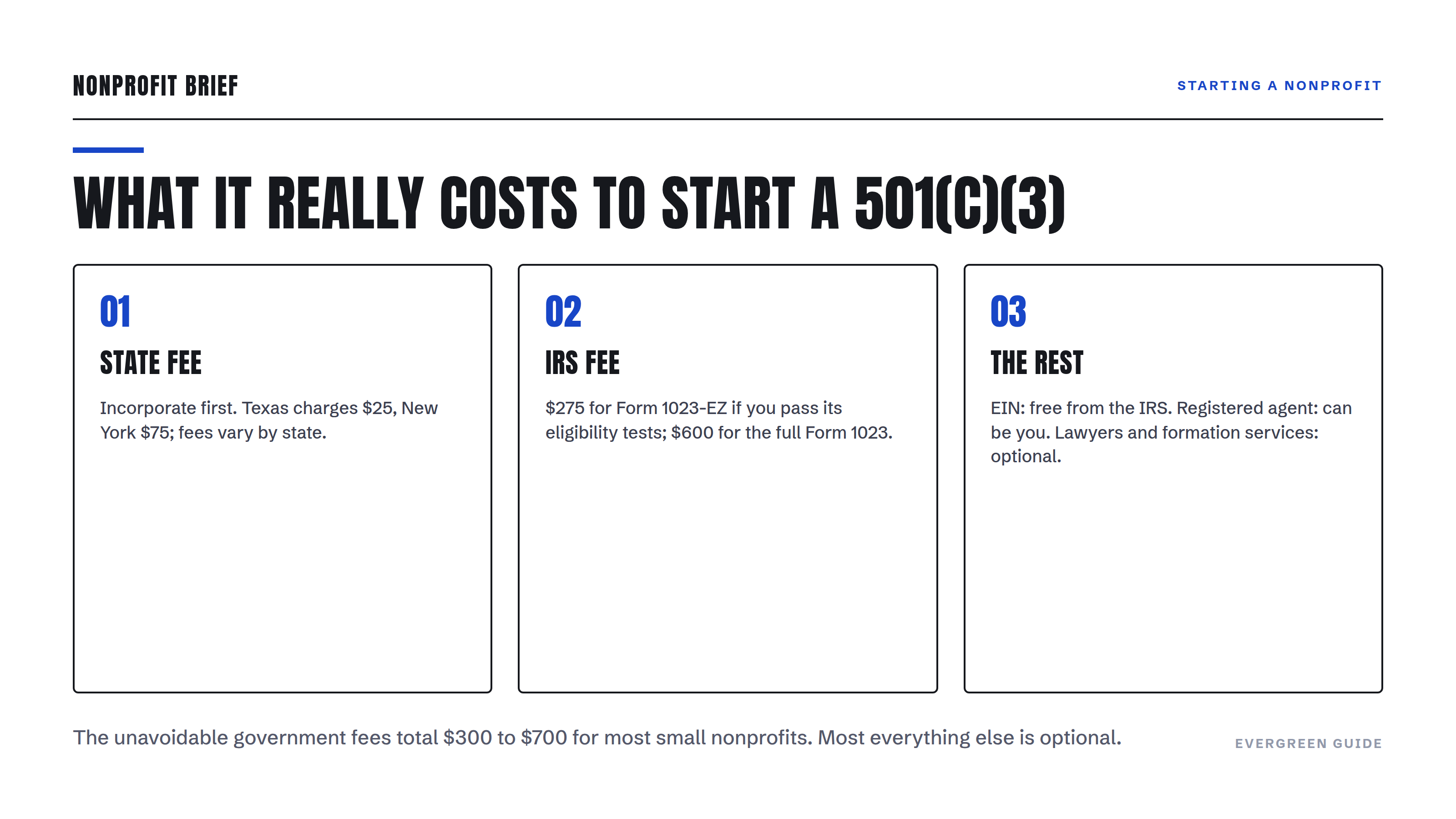
Two government fees stand between you and 501(c)(3) status: your state's incorporation fee and the IRS application fee. For most small organizations, those two add up to somewhere between $300 and $700. Everything beyond that, and there can be a lot beyond that, is either optional, avoidable, or a cost of fundraising rather than a cost of forming.
Here is the honest budget, line by line.
The IRS Fee: $275 or $600
The biggest single line item is the federal application for tax-exempt status. The IRS charges a user fee of $600 for Form 1023, the full application, and $275 for Form 1023-EZ, the streamlined version. Both are filed electronically and paid through Pay.gov. The IRS notes these amounts are subject to change, so check the current figure before you file.
Which form you file is not a free choice. Form 1023-EZ is limited to organizations that pass a two-part receipts test, no more than $50,000 in annual gross receipts projected for any of the next three years and none above $50,000 in any of the past three, and that hold total assets of $250,000 or less. The eligibility worksheet in the 1023-EZ instructions also excludes whole categories regardless of size, including churches, schools, hospitals, foreign organizations, LLCs, private operating foundations, and successors to for-profit businesses; all of these must file the full Form 1023. Work through every question on that worksheet before you assume you qualify; filing the EZ when you were ineligible is a mess to unwind. Our Form 1023 vs. 1023-EZ comparison goes deeper on which form fits which organization.
The fee difference buys speed as well. As of mid-2026, the IRS reports issuing 80 percent of 1023-EZ determinations within 22 days, against 191 days for the full Form 1023. That gap, roughly three weeks versus six months, matters more than $325 to most founders.
The State Fee: Usually Under $100
Before the IRS will look at you, you need to exist, which means incorporating in your state. Filing fees vary but are mostly modest: Texas charges $25 for a nonprofit certificate of formation, New York charges $75 for a certificate of incorporation, and most states fall in a similar band. Check your secretary of state's fee schedule directly rather than a third-party site; these numbers drift.
A few incorporation-adjacent items are free or nearly so. Your employer identification number costs nothing: the IRS issues EINs at no charge, so never pay a website that offers to "expedite" one. Your registered agent can be you, for free, as long as you have a physical street address in the state and are reachable there during business hours; commercial registered-agent services charge an annual fee and are a convenience, not a requirement, in most states. Bylaws and a conflict of interest policy are documents you write, not fees you pay.
The Costs People Forget
Formation is not the last government transaction. If you solicit donations, most states require charitable solicitation registration, each with its own fee and renewal cycle; our guide to charitable solicitation registration walks through how that works and what it costs. Some states also make you apply separately for state tax exemption. And year one comes with a calendar of filings, the annual information return above all; the first-year compliance calendar lays out what is due when, and most of it costs time rather than money.
Then there is professional help. An attorney or a formation service can run from a few hundred dollars to several thousand. For a small organization with a straightforward charitable purpose and a founder willing to read instructions, the do-it-yourself path is well trodden. Paid help earns its fee when something about you is not straightforward: complicated revenue, related businesses, real estate, or any of the categories forced onto the full Form 1023. Whether that applies turns on your specific facts, and this is general information, not legal advice for your situation.
Or Spend $0 on Formation, for Now
If you are still testing whether the idea works, there is a path that skips every fee above: operating under a fiscal sponsor, an existing 501(c)(3) that receives tax-deductible gifts on your project's behalf and handles the compliance layer for you, in exchange for an administrative fee on funds raised. Fiscal sponsorship is how many organizations prove their program before spending a dollar on incorporation. The full order of operations for starting a nonprofit covers where that choice fits.
The Takeaway
Budget $300 for a small Texas nonprofit filing the 1023-EZ, around $675 for a New York organization filing the full 1023, and something in between for most states. Add your state's solicitation registration fee if you will fundraise. Treat everything else, agents, services, attorneys, as optional purchases you should be able to justify. The scarce resource in starting a nonprofit is rarely the filing fees. It is the months of your time the process takes, which is exactly why the 22-day 1023-EZ exists.