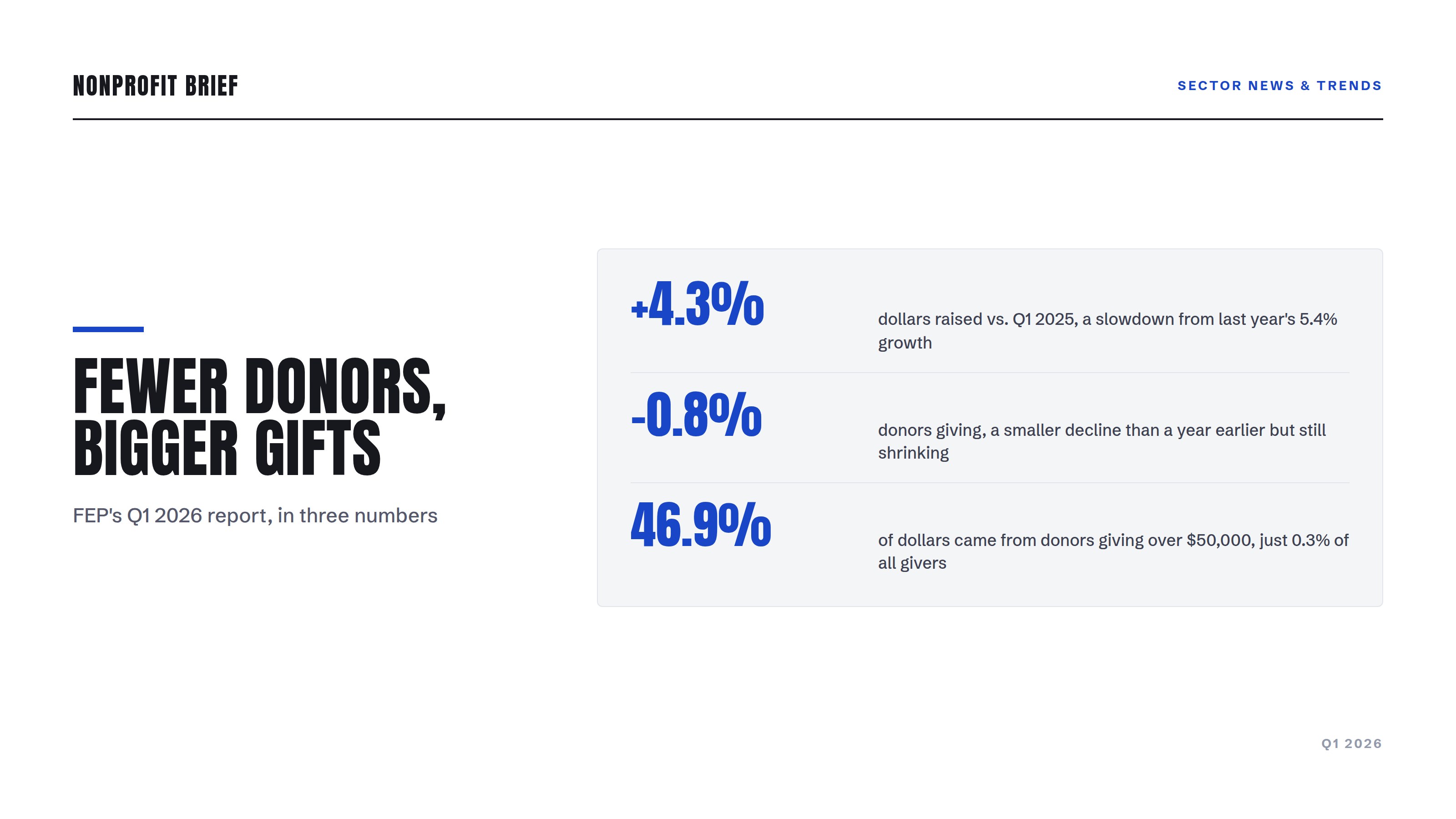
Charitable giving grew 4.3% in the first quarter of 2026 compared with the same period last year. The number of people doing the giving fell again. That is the headline pair from the new quarterly report of the Fundraising Effectiveness Project, the donor-data collaboration between the AFP Foundation for Philanthropy and GivingTuesday, and it is worth sitting with both numbers before celebrating either one.
The Growth Came From Gift Size, Not Donor Count
Decompose the 4.3% and the picture sharpens. First, the growth itself is slowing: dollars grew 5.4% in last year's first quarter, so this year's 4.3% is a deceleration, not a takeoff. Second, donor counts declined 0.8% year over year. That is a gentler slide than the 2.3% drop the report now measures for the year before under its restated methodology, but it is still a decline. So every dollar of growth came from larger gifts, not more givers.
The size bands tell the story plainly. Donors FEP labels supersize, those giving more than $50,000, are 0.3% of donors in the panel and accounted for 46.9% of the dollars, with their giving up 5.8%. Major donors, at $5,001 to $50,000, added another 27.5% of dollars. At the other end, micro donors giving $100 or less are still 57% of all donors but produced just 2.4% of the money, and their ranks shrank another 2.5%. The middle held up: small and midsized donor counts grew modestly, 1.3% and 1.8% respectively.
Put differently: nearly three quarters of first-quarter dollars came from just over 2% of donors. That is the concentration problem the sector has been talking about since Giving USA's record 2025 numbers, a record built more on bequests and foundation grants than on a broader base of everyday givers.
Retention Is Flat, and Flat Is Not Good
FEP's first-quarter retention rate held at 18.0%. That figure reads alarmingly low, so a definition helps: it counts only prior donors who have already given again by March 31. Most renewals land later in the year, so the Q1 rate is a leading indicator, not a final grade. The trouble is the direction. The rate did not improve, and within the report, retention actually slipped in every gift-size band except micro donors.
For a small shop, that pattern matters more than the topline. Growth built on a few large gifts is real money, but it is volatile money. One postponed six-figure gift can turn your year negative. The boring arithmetic of keeping mid-level donors, which we walked through in Donor Retention Math, is what smooths that volatility, and the new data says most organizations are not gaining ground there.
The Report Itself Changed, So Compare Carefully
One more thing before you drop these numbers into a board deck: FEP rebuilt its methodology this quarter, its first major overhaul in five years. The project revised how it builds its panel of organizations, how it adjusts for donations reported late in the quarter, and how it weights organizations, now by cause area rather than size. It also began reporting median growth for the typical organization alongside the aggregate numbers.
That last change is useful to you. The aggregate says dollars grew 4.3%; the typical organization saw 3.2% dollar growth and a donor count that was flat, not falling. If your own results look more modest than the headline, you are normal. But it also means this quarter's figures are not perfectly comparable to the FEP numbers you may have quoted last year, so date-stamp and footnote anything you carry forward.
What the Numbers Do Not Capture
FEP is candid about its blind spots, and they are worth repeating. The panel reflects gifts from identifiable individual donors recorded in participating CRM and giving platforms. Government funding cuts to your subsector, local economic conditions, and gifts that arrive through third-party or corporate platforms without being credited to an individual donor can all move your revenue without appearing in these numbers. The report also notes that some of late 2025's growth may have been donors accelerating gifts ahead of anticipated tax-law changes. If that is right, it flatters last year's baseline rather than signaling new giving, and it means the second half of 2026 could prove tougher.
The takeaway
The first quarter of 2026 looked steadier than the year before: donor losses slowed and the typical organization held its ground. But dollar growth decelerated, from 5.4% to 4.3%, which is why FEP's own announcement warns that the growth is not sticking. Treat this as stabilization, not recovery. The growth that exists is concentrated in a thin band of very large gifts, micro donors keep leaving, and early retention is stuck at 18%. The practical response is not complicated. Know which of your donors renewed last year and which have not yet this year, get your donor data clean enough to see the difference, and put your effort into the second gift. Concentration at the top is the sector's problem to debate. The second gift is the part you control.