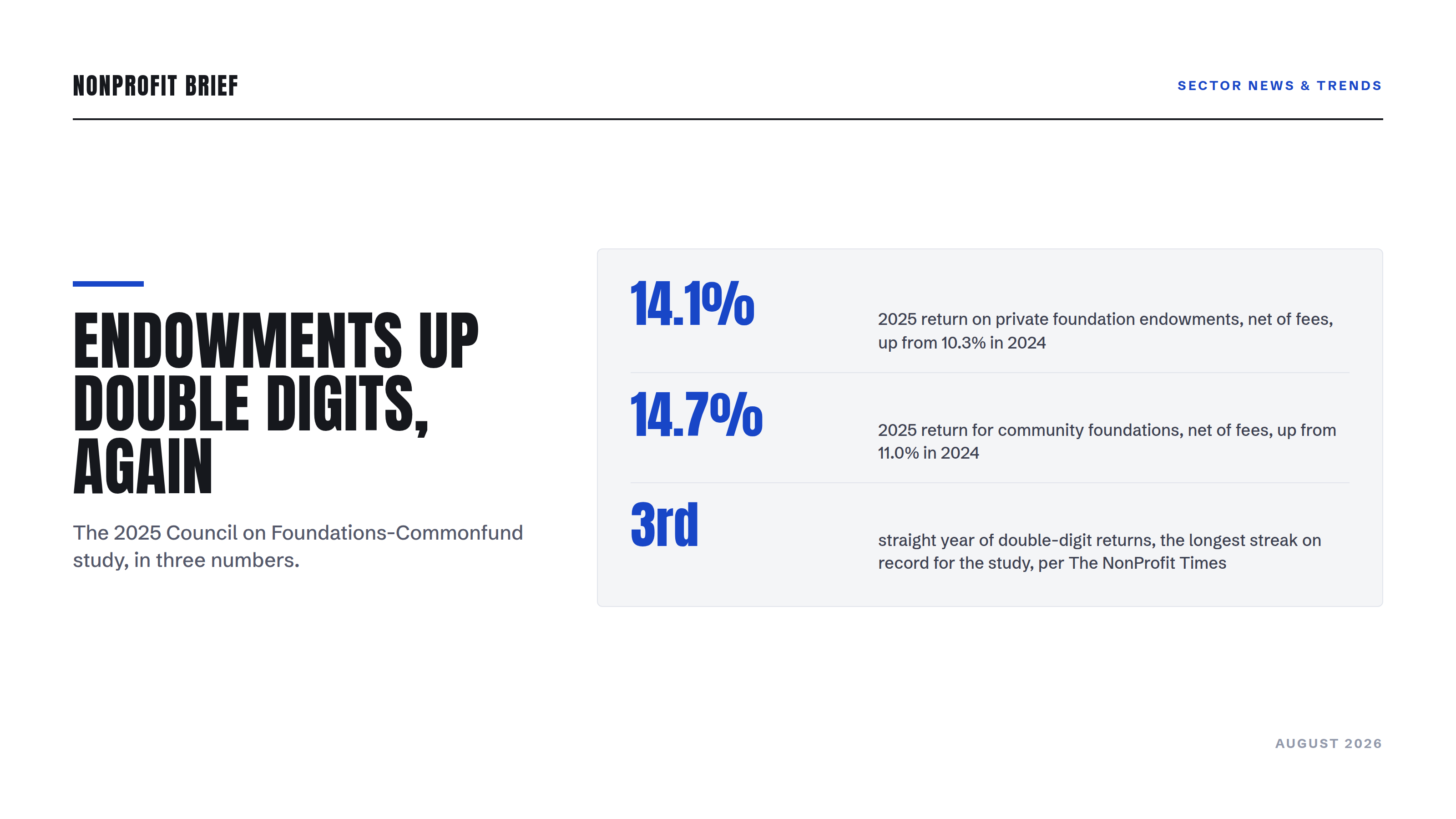
Foundation endowments grew by double digits for the third year in a row. The 2025 Council on Foundations-Commonfund Study of Foundations, released August 19, puts private foundation returns at 14.1 percent for calendar 2025 and community foundation returns at 14.7 percent, both net of fees. That is up from 10.3 and 11.0 percent in 2024.
The study covers 285 foundations holding $126.9 billion in combined assets: 171 private foundations and 114 community foundations. If you raise money from institutional funders, this is a report worth five minutes of your attention, because endowment math eventually becomes grant math.
The Numbers Behind the Headline
Three straight years of double-digit returns is the streak that matters. The NonProfit Times, covering the study's release, notes it is the longest such run on record for the survey, though the Times adds a caveat: the sharp three-year rebound owes a lot to 2022's losses rolling out of the calculation window.
The longer view improved too. Ten-year average annual returns reached 9.0 percent for private foundations and 8.6 percent for community foundations, up from 7.3 and 7.0 percent a year earlier. Fifteen-year and twenty-year figures sit at roughly 7 to 8 percent. Those trailing numbers are what foundation boards look at when they debate whether their spending policy is sustainable, and right now the numbers say yes, comfortably.
Community foundations had a second piece of good news: gifts coming in the door. Per the NonProfit Times account, 51 percent of community foundations reported an increase in gifts received during 2025, with large median jumps among those that grew.
Why Grantseekers Should Care
Private foundations are required to spend a floor amount every year. Federal law requires them to make qualifying distributions of roughly 5 percent of the market value of their investment assets, meaning assets not used directly for their charitable programs, and the rules give them until the end of the following tax year to do it. Qualifying distributions include grants plus certain administrative costs, so not every dollar reaches grantees. But the direction is mechanical: when asset values rise 14 percent, the distribution floor rises with them, on a lag. Money earned in 2025 shows up in payout requirements for 2026 and grant budgets through 2027.
Community foundations face no federal payout minimum, but many set spending as a percentage of a trailing average of asset values. Three consecutive strong years pull that whole trailing average up, which is the slow-but-durable way grantmaking budgets grow.
Set this against the other funding headline of the year: federal grants to nonprofits fell sharply over the past year. Private philanthropy cannot replace federal money dollar for dollar, and funders keep saying so. What this study establishes is narrower and still useful: the capacity conversation has changed. A program officer who pleaded portfolio losses in 2022 is now sitting on three years of double-digit growth and a 9 percent ten-year average.
How to Use This in an Ask
First, bring the numbers with you. When a funder says budgets are tight, it is fair to note, politely, that the sector's own benchmark study shows endowments at record strength. You are not arguing with your program officer's constraints; you are giving them ammunition for their own internal case.
Second, aim at the lag. Foundations that base spending on trailing averages will see their formula-driven budgets rise into 2027. That makes right now a sensible moment to propose multi-year grants, which lock in commitments while the math is favorable. A few funders are choosing to spend far beyond the 5 percent floor, some down to zero; our grantee playbook for spend-down funders covers what that means when your funder is one of them.
Third, revisit community foundations near you. Rising markets plus rising gifts mean donor-advised funds and discretionary pools at community foundations are both better resourced than they were two years ago. If your last approach to a community foundation was pre-2024, the answer you got then may not be the answer you would get now.
The Takeaway
Foundations closed 2025 with a third straight year of double-digit endowment growth, 14.1 percent for private foundations and 14.7 percent for community foundations, and their ten-year averages are back near 9 percent. Payout rules and spending formulas translate that growth into grant dollars on a one-to-two-year lag. Build your 2027 asks, especially multi-year ones, on that arithmetic.