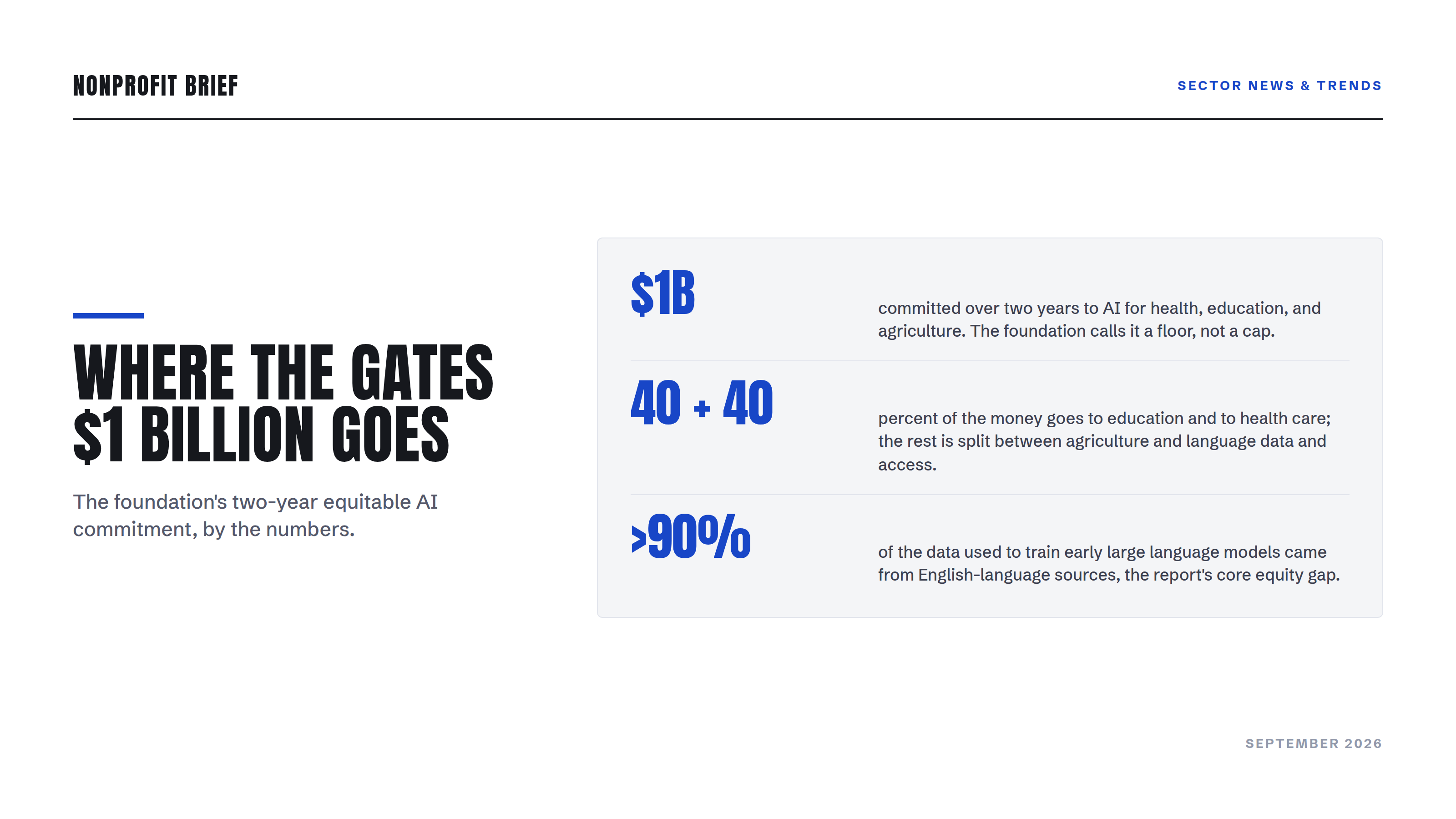
The Gates Foundation put a number on its AI strategy this week: $1 billion over two years to build and deliver AI tools for health, education, and agriculture in places the AI industry is not building for. The commitment anchors the foundation's 10th annual Goalkeepers Report, released September 14 under the title "Make This Matter: AI, Equity, and the Choice We Can't Delay." The foundation's own language is "at least US$1 billion," so read the number as a floor, not a cap.
The Split Is 40-40-10-10
The foundation says the money will be split roughly four ways: 40% to education, 40% to health care, 10% to agriculture, and 10% to what it calls the digital foundation, the underlying plumbing of language data and access that every other tool depends on. The examples it points to are concrete: AI tutoring that adapts to individual students, diagnostic and clinical decision support for frontline health workers, maternal and newborn care tools, drug and vaccine discovery, and advice for smallholder farmers keyed to their soil, weather, and crops.
The through line is delivery: the money is aimed at getting working tools into the hands of teachers, health workers, and farmers, mostly in low- and middle-income countries, with the education slice reaching US classrooms as well. The Associated Press reports the foundation will work with OpenAI, Anthropic, Google.org, and Microsoft on the effort.
The Report's Argument Is About Language, Not Models
The Goalkeepers Report's case for urgency rests on a data point worth remembering: more than 90% of the data used to train early large language models came from English-language sources. Tools built on that foundation work worst for the people the foundation says need them most. The report names three priorities: make AI work in every language people actually speak, build tools for the specific contexts where people will use them, and invest in people and access so communities can shape how AI works for them rather than receiving whatever ships.
Bill Gates wrote in the report that "the people with the greatest needs often have the least power to shape where innovation and investment go." CEO Mark Suzman put the evaluation standard plainly in an interview with Seattle's KUOW: "We are interested in the outcomes. Is it helping the human beings at the other end?"
There Is No Application Portal, at Least Not Yet
Here is the part that matters if you run a nonprofit and are already drafting a letter of inquiry: the announcement includes no open application process. The press release calls on other funders and companies to invest their own resources and expertise, but the $1 billion will flow through partners the foundation says are already working to close AI access gaps, the way most Gates money moves. If your work sits in global health, education technology, or smallholder agriculture, the practical move is to watch the foundation's program pages and the usual federal and philanthropic channels for downstream RFPs from its grantees and intermediaries, not to cold-pitch Seattle.
For everyone else, the announcement is still a signal worth reading. The largest private foundation in the United States just declared AI delivery, not AI experimentation, its two-year priority. That will pull other funders' attention the way its global health commitments have for two decades, and program officers at smaller foundations will be asked this fall what their answer to it is. Expect AI lines to start appearing in funder strategy refreshes, and expect grantees to be asked about their own AI use in due diligence. Boards that have been treating AI as a someday question now have a concrete reason to ask where their own organization stands; our reporting on the sector's AI adoption and governance gap found most nonprofits are already using these tools without policies to match. If your team needs a structured on-ramp, free AI training built for nonprofits exists and costs nothing but staff time.
The Takeaway
The Gates Foundation committed $1 billion over two years to AI tools for health, education, and agriculture, with a 40-40-10-10 split and a thesis that language and context, not model quality, are the real equity gaps. There is no portal to apply to, so the near-term opportunity for most organizations is indirect: downstream partnerships, and the sector-wide legitimacy the commitment lends to practical AI adoption. The report's evaluation question is a good one to steal for your own board packet. Is it helping the human beings at the other end?