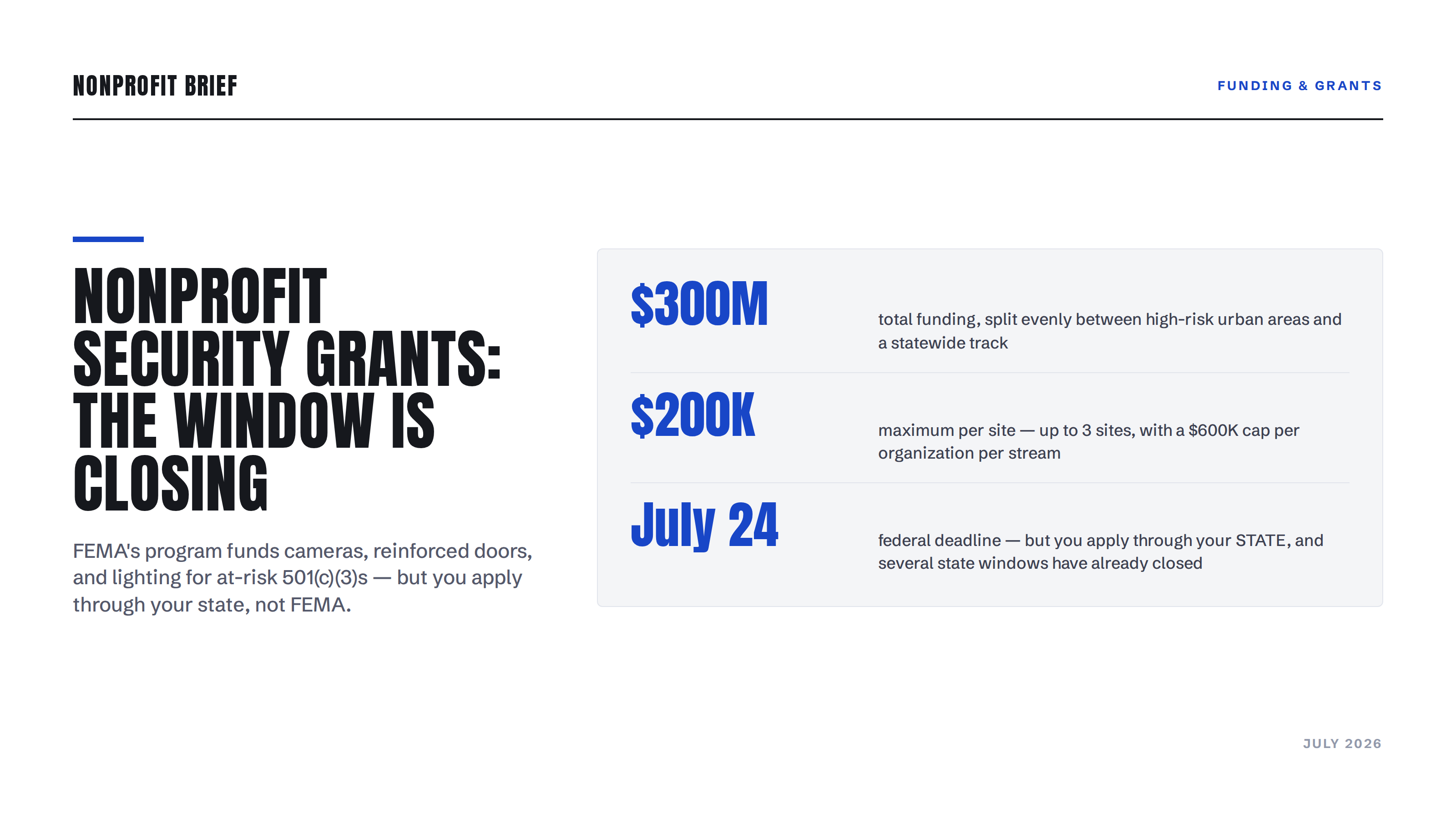
FEMA is sitting on $300 million for nonprofit security upgrades, and the fiscal year 2026 application window closes at 11:59 p.m. Eastern on July 24. Awards run up to $200,000 per site for cameras, reinforced doors, lighting, and contracted security. Two things every eligible organization should know before Friday: you don't apply to FEMA, and the deadline that matters to your organization probably isn't July 24.
What Does the Nonprofit Security Grant Program Fund?
The Nonprofit Security Grant Program (NSGP) pays for security improvements at 501(c)(3) organizations (including houses of worship that have never sought a formal IRS determination letter) that can document a high risk of terrorist or other extremist attack. It is the federal government's main vehicle for hardening nonprofit facilities, administered by FEMA. Eligible organizations include houses of worship, schools, museums, senior centers, and community centers, according to Feldesman LLP, a law firm that tracks the program, and FEMA's own award announcements show past funding going heavily to houses of worship.
This year's funding notice splits the $300 million evenly between two tracks: $150 million for organizations in designated high-risk urban areas (NSGP-UA) and $150 million for everyone else (NSGP-S). An organization can request up to $200,000 per site, for up to three sites per funding stream, with a $600,000 cap per organization per stream. Allowable costs include video surveillance, access control systems, impact-resistant doors, barriers, lighting, contracted security personnel, and security planning and training. Hiring your own security staff is not allowable, and neither is general operating support.
You Apply Through Your State, Not FEMA
Nonprofits cannot apply directly to FEMA. Every application flows through your State Administrative Agency (SAA), the state office that handles homeland security grants. Your organization submits a subapplication to the SAA, built around an Investment Justification: a structured narrative that ties a documented vulnerability assessment of your facility to the specific projects you want funded. The SAA scores and ranks the submissions from across the state, then sends its prioritized list to FEMA by the July 24 federal deadline.
That structure means each state sets its own cutoff, usually ahead of the federal date and sometimes on a different calendar entirely: Texas took FY2026 applications from mid-January to mid-March. New York and Arizona closed their subapplication windows on July 10. North Carolina, working under a FEMA-granted extension, is accepting applications through July 24. As of July 19, some states still have days left and others are already done. If you serve an at-risk community and haven't checked, contact your SAA today; FEMA keeps a directory of SAA contacts by state.
Before you scramble, apply the same screen you'd use on any funding opportunity: the NSGP wants evidence of specific risk, not general worry. A rushed Investment Justification with no vulnerability assessment behind it scores poorly against organizations that spent months preparing.
Missed This Round? Start the FY2027 File Now
The NSGP runs annually. Funding rebounded to $300 million this year from $274.5 million in FY2025, though it remains below the roughly $454 million awarded in FY2024, when Congress added supplemental funds. Organizations that win tend to be the ones with a complete file waiting when the notice drops, because the window between announcement and cutoff can be brutally short. This year's notice posted June 24 and New York's window closed 16 days later; the FY2025 round ran just 14 days from notice to federal deadline.
Four things to do between now and next spring:
- Get a vulnerability assessment. The Cybersecurity and Infrastructure Security Agency (CISA) offers no-cost facility security assessments through its protective security advisors, and an assessment is the backbone of a competitive application.
- Get a Unique Entity Identifier. Subapplicants need a UEI from SAM.gov, though generally not a full SAM registration, as Washington, D.C.'s homeland security agency spells out. Getting the identifier is quick; do it early anyway, and check whether your state asks for more.
- Draft the Investment Justification early. The current template is posted on FEMA's NSGP page. A draft you refine beats a blank form in June.
- Get on your SAA's mailing list. State agencies typically announce their internal deadlines through their own channels, and there is no central federal list of state cutoffs.
Money for federal security work sits alongside bigger changes in how federal grants operate; if your organization touches any federal funding, the grant rule changes proposed to take effect October 1 are worth your time too.
The takeaway
If your state's NSGP window is still open, call your SAA today rather than reading the full notice first; the clock is the binding constraint. If your state has closed, treat FY2027 as already live: book a free CISA assessment, register in SAM.gov, and draft your Investment Justification this fall. This is a program that rewards the organization with a file ready to go. More funding coverage lives in our Funding & Grants section.