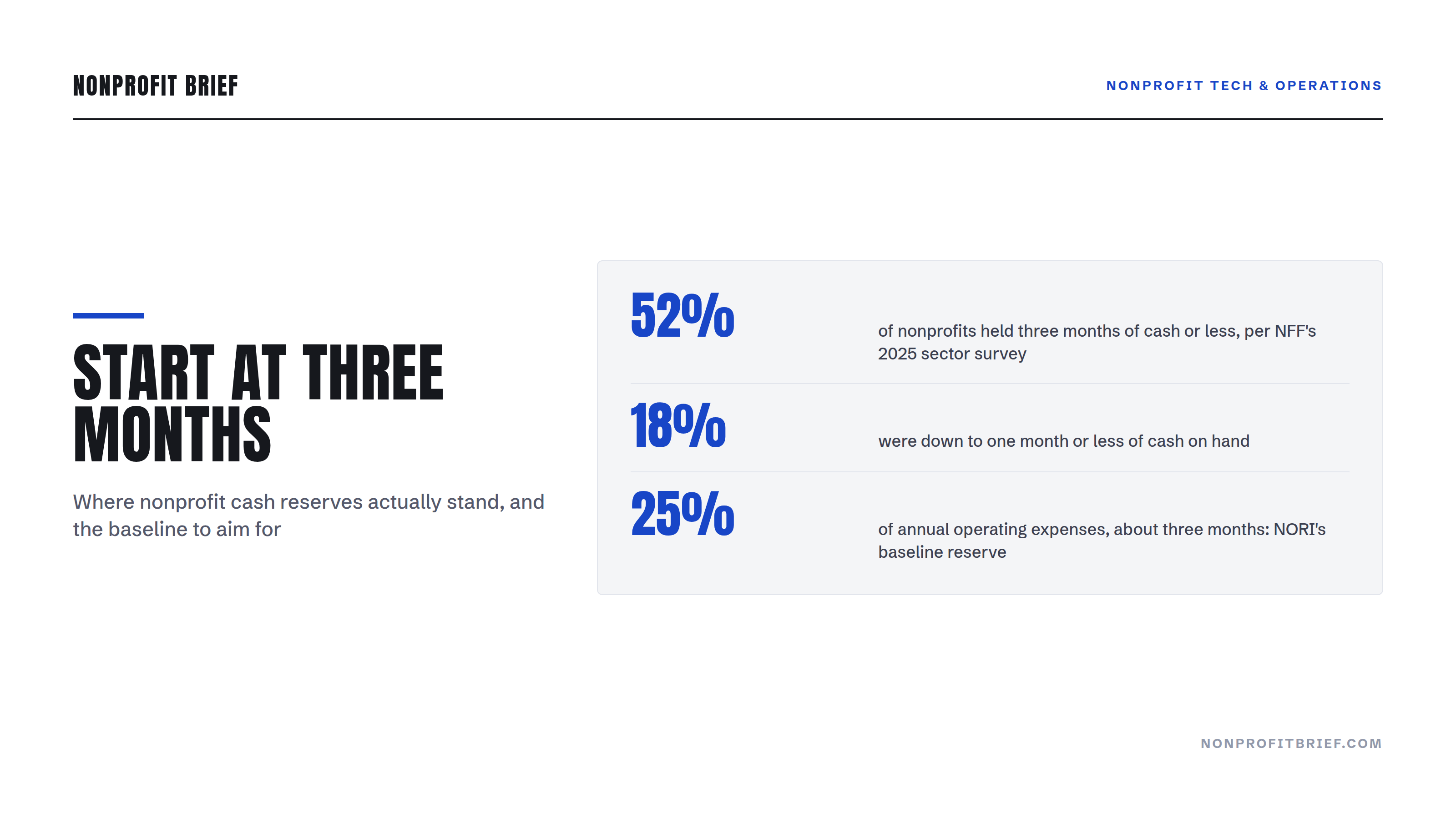
In the Nonprofit Finance Fund's 2025 State of the Nonprofit Sector survey, 52% of the 2,200 leaders who responded said their organization held three months of cash or less. Another 18% were down to one month or less. Only 20% had more than six months, the lowest share across the ten editions of the survey. The report's authors put it plainly: many nonprofits are living one unexpected cost away from catastrophe.
That data was collected in early 2025, before this year's federal funding turmoil had worked through most budgets. Since then, federal grants to everyday charities fell nearly 38% by the Chronicle of Philanthropy's count, and the organizations riding out terminations and payment delays are, to a large degree, the ones that had something set aside. If your board has been postponing the reserve conversation, this is the year to have it. Here is how to run it well.
A Reserve Is Not Whatever Is in Checking
An operating reserve is the portion of your unrestricted net assets that the board has formally designated to keep the organization running through a shock: a lost contract, a late reimbursement, a boiler that quits in January. That definition comes from the Nonprofit Operating Reserves Initiative (NORI), an all-volunteer national effort whose materials are the closest thing the sector has to a standard on this subject.
Three things do not count toward a reserve, per NORI's guidance: donor-restricted funds, equity tied up in buildings and equipment, and anything you cannot turn into cash quickly. Reserves live entirely on the unrestricted side of your books. If the restricted-versus-unrestricted distinction is fuzzy in your shop, start with our plain-English guide and come back.
Cash on hand is not the same thing as a reserve either. Cash is what happens to be in the account today, and much of it is already spoken for by payroll and payables. A reserve sits deliberately on top of that working capital, with a policy attached. The distinction shows up in the NFF data: 66% of respondents reported reserve funds separate from operating cash. Among organizations with budgets under $250,000, only 47% did.
The Floor Is 25% of Annual Expenses
NORI's workgroup recommends 25% of annual operating expenses, roughly three months, as a baseline. Sector advisors mostly land in the same range. Propel Nonprofits puts the common target at three to six months and advises that reserves not exceed two years of budget. The National Council of Nonprofits is careful to call any single figure a myth rather than a standard, and it is right. Treat three months as the floor you justify going below, not a finish line.
Your Real Number Depends on How You Get Paid
Two organizations with identical budgets can need very different reserves. Reimbursement-based government contracts argue for more, because you spend first and invoice later, and a 60-day payment delay is a cash crisis even when the revenue is certain. Concentration argues for more: if one or two funders supply most of your revenue, your reserve is the bridge you would need if one of them walked. A staff-heavy program model argues for more, because payroll cannot be paused the way a printing order can. Steady, diversified individual giving and a flexible cost base argue that the low end of the range may be enough. Set your target by asking what would actually break first, and how many months it would take to replace the money or shrink the budget in an orderly way.
Surpluses Are How Reserves Get Built
Tax-exempt status does not prohibit ending the year with money left over. The old line that nonprofits cannot make a profit refers to who benefits from the money, not to whether you can budget a surplus. Reserves get built the unglamorous way: budget a modest surplus on purpose, land it, and have the board designate it before it dissolves into next year's spending. Windfalls help too. An unexpected bequest or an oversized year-end gift is reserve material, not a license to grow the budget. What reserves are not built from is hope that a funder will someday write a check labeled "reserves." Waiting for one is not a plan.
Write the Policy Before You Need the Money
A reserve without a policy is just a tempting line on the balance sheet. The Council of Nonprofits recommends the policy cover five things: what the target is, what circumstances allow the reserve to be used, how the decision to draw it down gets made, how and when the money gets repaid, and whether any uses are off limits. Propel Nonprofits publishes two sample policies you can adapt in an afternoon. Keep yours to a page or two. The point is that a 2 a.m. crisis should not be the moment your board first debates what the reserve is for.
The takeaway
Run the math this month: liquid, unrestricted assets divided by average monthly operating expenses. If the answer is under three months, you are in the majority, and the fix is a board-adopted target, a budgeted surplus, and a written policy, in that order. If you are past six months, ask the opposite question: whether money is sitting idle that the mission could use. Either way, put the number in front of your board with a policy attached. Funders increasingly read a healthy reserve as evidence of competence, not excess.