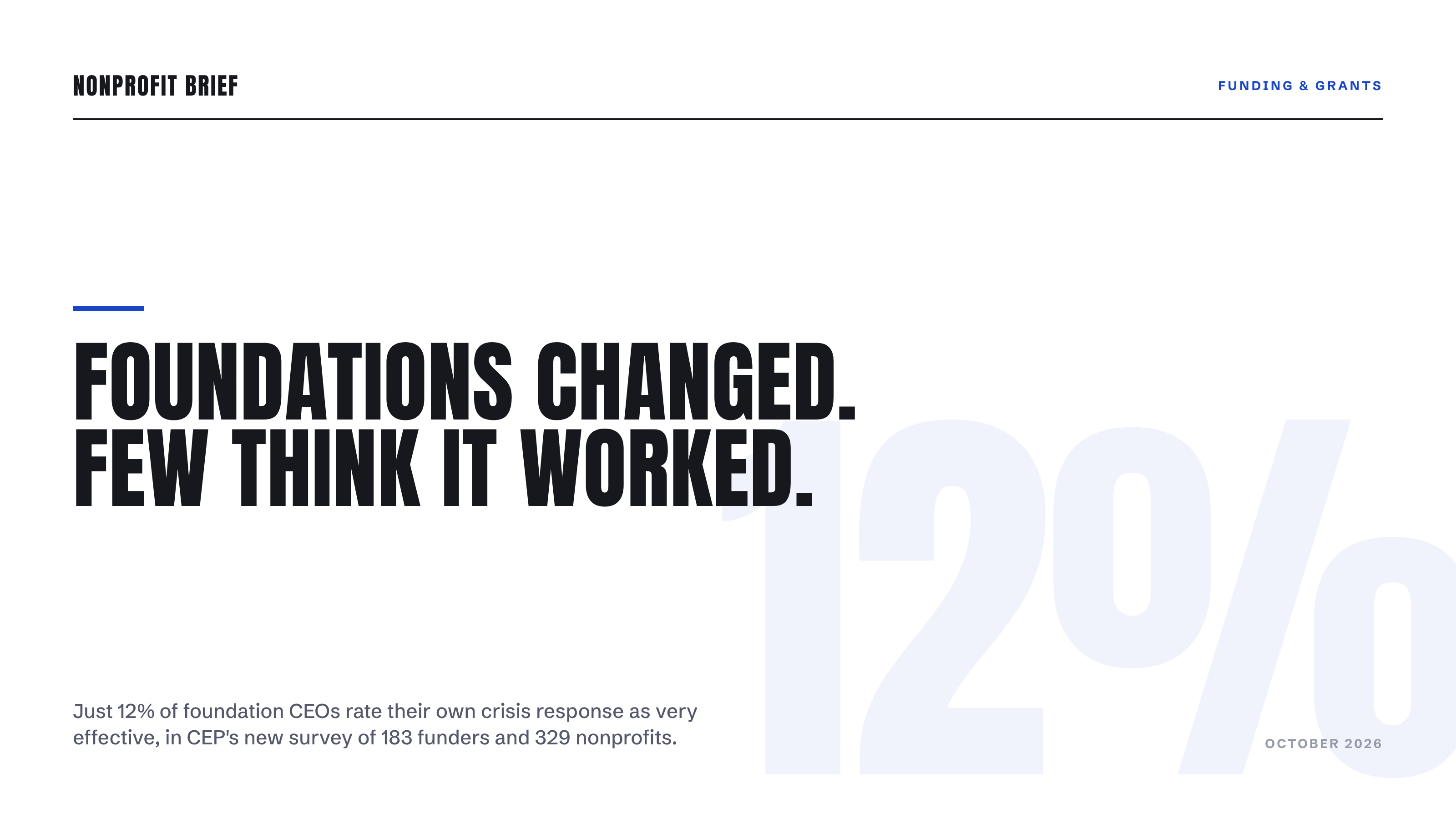
Nearly every large foundation in a new national survey says it changed how it works this year in response to the sector's funding crisis. Almost none of them believe the change has been enough, and the nonprofits on the receiving end agree. That is the blunt summary of Evolving Foundation Responses to a Sector in Crisis, released September 29 by the Center for Effective Philanthropy. If you are heading into fall funder conversations, this report is worth reading before you draft a single ask, because it tells you what funders already know about themselves.
What Funders Actually Did
CEP surveyed 183 leaders of independent, community, and health conversion foundations giving at least $5 million a year, plus 329 nonprofit leaders from its Nonprofit Voice Project panel, with surveys fielded in May and early June 2026. The topline: 93% of foundation CEOs report making at least one change in response to federal funding cuts and policy pressure on nonprofits. Among the most common moves, 62% increased funding in an area of need, 53% joined funder collaboratives or pooled funds, and 48% increased their policy or advocacy engagement. Nine in ten report providing some form of support beyond grants: nearly half offer professional development, 46% help build partnerships, and 41% provide fundraising assistance.
So the picture is not inaction. Foundations moved. The question the report quantifies is whether they moved the thing that matters.
Payout Is Where the Change Stops
Only a third of independent foundations report a higher payout this fiscal year than in previous years, and across independent and community foundations together, just 27% of CEOs say they raised payout in response to the moment. CEP itself calls this a striking contrast with the pandemic, when most foundations increased their giving; this time, with federal support for nonprofits falling further and faster, most endowments are holding their normal course. That restraint is the live wire in the sector's ongoing fight over foundation payout, and it lands on top of a year in which federal grant funding fell sharply for many organizations.
The funders themselves supply the diagnosis. Just 12% of foundation leaders rate their own institution's response as very effective. Among those who judged their response less effective, 53% named risk aversion as a constraint. Read that pairing again: the people who control the money say, in large numbers, that caution is what held them back. Only a minority of nonprofits let them off the hook; 12% of nonprofit leaders say funders have very effectively taken the risks the moment requires.
Nonprofits Are Not Saying What They Think
The report's quietest finding may be its most useful. A majority of nonprofit leaders, 58%, say they hold back from telling funders what they actually need. Of those, 68% fear jeopardizing future funding and 64% say they have limited opportunities to raise it at all. The result is a market with broken signals: funders redesign their support based on what grantees are willing to say out loud, grantees say what is safe, and both sides end up with professional development workshops when what organizations wanted was flexible money and fundraising help. Notably, 60% of nonprofit leaders said support with fundraising strategy and donor development would be useful, while 41% of foundations provide it; CEP names fundraising among the largest gaps between what grantees want and what funders give.
How to Use This Report This Fall
The practical value of a study like this is cover. You no longer have to be the lone grantee claiming the emperor's response is underdressed; CEP's panel said it for you, in aggregate, with funder numbers alongside.
Three uses. First, when a program officer asks how your organization is holding up, answer specifically and cite the report's finding that most grantees self-censor; naming the dynamic is the cleanest way to exit it. Second, if your funder offers beyond-the-grant support, steer it toward the categories grantees actually rated useful, fundraising strategy chief among them. Third, if a foundation partner has signaled flexibility, ask directly whether it has considered a temporary payout increase or front-loading next year's grant; roughly a quarter of its peers have raised payout already, and some funders have gone further and accelerated spending on purpose. The worst realistic outcome is a no from a funder that was never going to move.
The Takeaway
CEP's data confirms what most EDs have sensed since winter: foundations are busy, sincere, and mostly operating inside their comfort zones. Nearly all changed something; barely a quarter raised the number that counts. The report hands grantees two usable facts: funders privately doubt their own response, and they know risk aversion is why. Fall funding conversations go better when both sides stop pretending otherwise, and for once the data is on the table where everyone can see it.