The Center for Effective Philanthropy spends its year surveying foundations and the nonprofits they fund. On Saturday, its president, Phil Buchanan, and its vice president of research, Elisha Smith Arrillaga, published an essay in Fortune that says out loud what their data has implied all year: foundations are meeting the sector's worst funding shock in a generation at a business-as-usual pace.
That is their argument, not ours. But if your 2027 budget quietly assumes that institutional philanthropy will backfill lost government revenue, their numbers deserve 10 minutes of your attention.
The Charge, in Four Numbers
The essay's case rests on figures that will look familiar to regular readers.
Federal grants to everyday operating charities fell from $36.3 billion to $21.4 billion, roughly 41 percent, comparing February through September 2025 against the same months a year earlier. That is Granted AI's running analysis of USAspending.gov data, which we covered in August when the measured drop stood at 38 percent; Granted has since revised its baseline. The analysis deliberately excludes hospitals, universities, and one-time clean-energy and rural electric co-op money, and it counts only direct federal grants, not pass-through funding routed through states. The essay works from the same research: some $14 billion, gone in eight months.
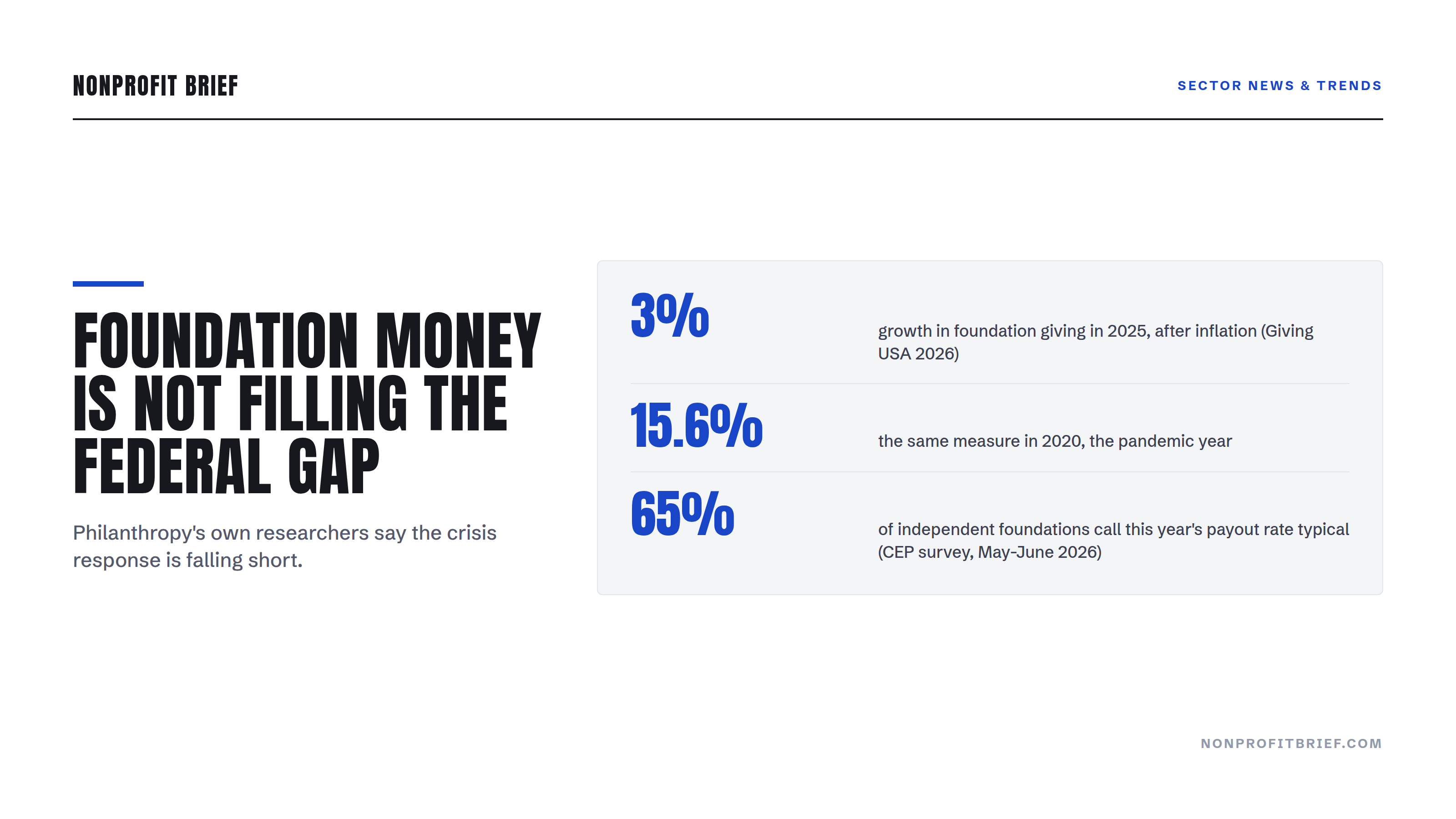
Foundations, meanwhile, gave $117.2 billion in 2025, by Giving USA's count. That is up 5.7 percent in current dollars and about 3 percent after inflation. In 2020, the pandemic year, foundations raised their giving 15.6 percent after inflation. The comparison is the essay's centerpiece. A crisis arrived in 2020 and philanthropy's reflex fired. A crisis arrived in 2025 and, in the aggregate, it did not.
Then there is the survey data. CEP polled foundation leaders in May and June of this year, and the essay discloses the results. Sixty-five percent of independent foundations said their payout rate, the share of assets they distribute each year, was typical this year. Eight percent of foundation CEOs rated philanthropy's collective response to the moment as very effective. Twelve percent said that about their own foundation. A majority named risk aversion as a reason foundations are not doing more.
Run the dollar math and the gap is hard to miss. Foundation giving grew by roughly $6 billion in nominal terms in 2025. The measured federal decline was nearly $15 billion, over eight months, in a slice of the sector defined to exclude its largest institutions, so the full federal loss runs higher. The two windows do not line up perfectly. The conclusion survives the imprecision: new foundation dollars covered less than half of the measured federal drop.
What Foundations Can Say Back
Foundations are not without answers, and fairness requires the ledger's other side.
Some moved early and publicly. CEP's own tracking, published in March 2025, lists the funders that raised payout: MacArthur lifted its grantmaking floor to at least 6 percent for 2025 and 2026, the Robert Wood Johnson Foundation moved to 6.5 percent, its highest rate ever, and smaller funders went further still. CEP's January research report, A Sector in Crisis, found 30 percent of foundation leaders had increased payout beyond their planned 2025 levels and 64 percent of foundations had made rapid-response grants.
The critique is about the median, not the exceptions. Candid surveyed 542 foundations this year and found the median payout rate for independent foundations stuck at 5 percent for the fifth consecutive year, with 62 percent of those reporting a rate holding it steady. Five percent is not an arbitrary habit. Federal law requires private non-operating foundations to pay out roughly 5 percent of the value of their investment assets each year in qualifying distributions, a category that includes grants plus certain administrative and direct charitable spending. A 30 percent excise tax applies to amounts still undistributed by the end of the following tax year, and a 100 percent tax follows if a shortfall is not corrected within 90 days of IRS notice. The legal floor has long functioned as the practical ceiling.
What the floor-as-ceiling defense has to contend with is the market. Foundation endowments have now posted double-digit returns three years running, including 14.1 percent for private foundations in 2025. Buchanan and Smith Arrillaga put the sector's holdings at $1.8 trillion. Assets, in other words, grew much faster than grantmaking, which makes a typical payout year a choice rather than a constraint. That last sentence is their argument. The numbers behind it are not in much dispute.
Budget Like the Median Funder Is Your Funder
Whether the essay moves foundation boardrooms is a 2027 question. Your budget cannot wait for the answer. Three practical moves follow from the data.
First, ask your institutional funders the direct question this fall: is your 2027 grantmaking budget growing, holding, or shrinking? The payout debate is live inside foundations right now, and program officers will usually tell you where their board landed. A funder that answers "typical year" has told you something useful. Plan on renewal at current levels, not expansion.
Second, weight new pipeline effort toward money that behaves more predictably. Individuals still supply just under two thirds of American giving, and the retention work you control pays better than waiting on a payout decision you do not.
Third, if you have lost federal funding, say so in every funder conversation, with numbers. The January CEP report found 93 percent of funders rating themselves effective at understanding grantee challenges. Fifty-four percent of nonprofits agreed. That gap is an argument for narrating your losses specifically, in dollars and programs, rather than assuming your funders already know.
The Takeaway
The people whose job is measuring philanthropy just said its crisis response is not enough, in public, with data. Maybe that changes what boards decide this winter. Until it does, the observable behavior of the median foundation is a typical year at a 5 percent payout. Build your 2027 revenue plan on that, pursue the generous exceptions deliberately, and if institutional philanthropy surprises you, let the surprise be upside.