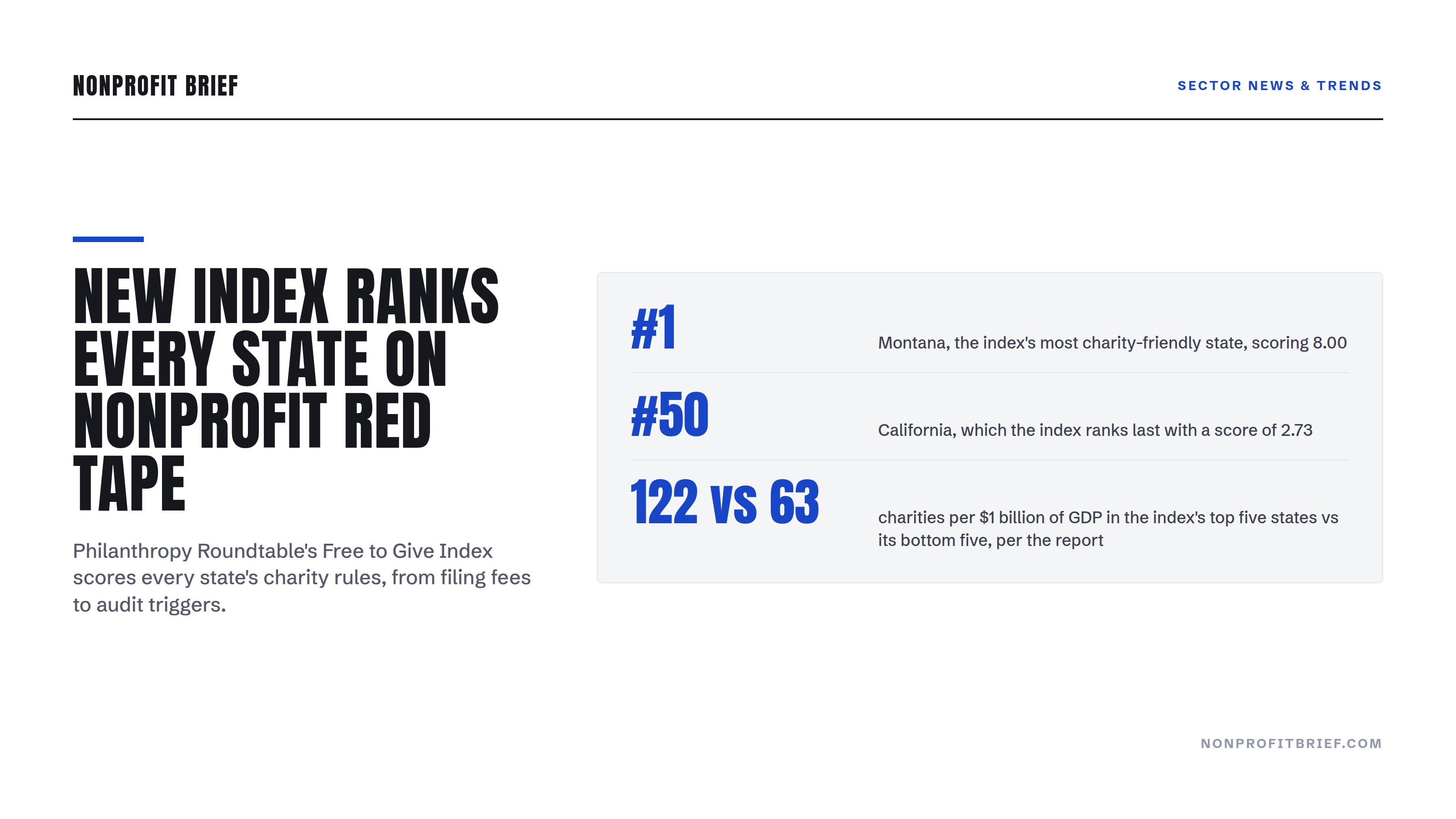
Montana is the easiest state in the country to run a charity. California is the hardest. That is the verdict of the Free to Give Index, a 50-state scorecard released this year by Philanthropy Roundtable that is now drawing trade press attention. Whatever you make of the group's politics, the dataset underneath is one an executive director can actually use.
What the Index Measures
The 74-page report, by researchers Matthew Mitchell and Jack Salmon, scores each state on 33 variables in three buckets. The first is the broad policy environment: economic freedom, tax competitiveness, and occupational licensing. The second, and the one that matters most day to day, is what the authors call nonprofit freedom: 22 regulations covering what it costs to incorporate and register, whether the state requires an annual report and what it charges for one, how it treats paid solicitors (the professional fundraisers some charities hire, who in many states must register and post surety bonds), and where it sets its audit threshold, the revenue line above which state law requires an independent CPA audit. The third bucket scores donor confidence: 8 policies on donor privacy, protections of donor intent, and the tax treatment of gifts.
Who Ranks Where
The top 5 are Montana (8.00), Wyoming (7.85), South Dakota (7.52), Iowa (7.41), and Indiana (7.35). The bottom 5 are Illinois (3.58), Connecticut (3.57), Washington (3.18), New Jersey (3.03), and California (2.73).
The spread is concrete, not abstract. Idaho has no general charitable registration requirement and zero-dollar filing fees, per the report. Florida charges up to $400 to register. Illinois requires an audit once contributions pass $500,000, one of the lowest triggers in the country. That trigger drops to $25,000 if the charity uses a paid professional fundraiser, and contributions between $300,000 and $500,000 call for CPA-reviewed financial statements, a lighter cousin of the audit. In California, charities required to register and report to the state attorney general need an audit at $2 million in gross revenue under the Nonprofit Integrity Act, not counting government grants and service contracts for which the government requires an accounting, and the state's top annual reporting fee runs $1,200.
The Charity-Density Claim, and Its Limits
The report's headline finding is about density: the bottom 5 states average 63 charities per $1 billion of GDP, while the top 5 average 122. Its regression suggests a one-point gain on the index is associated with about 7 more charities per billion dollars of GDP.
Read that with both eyes open. Association is not causation, and the report itself frames the finding that way. Philanthropy Roundtable is an advocacy organization that favors lighter regulation and stronger donor privacy, so the index rewards the absence of rules. State charity regulators would tell you those same rules exist to catch fraud before donors get burned. Both things can be true: a rule can deter fraud and still be priced beyond what a $200,000-a-year food pantry can absorb.
Why Donor Privacy Is on the Scorecard
The donor confidence bucket has a legal backstory. In 2021 the Supreme Court struck down California's blanket demand that charities hand over their major-donor lists, holding in Americans for Prosperity Foundation v. Bonta that the disclosure regime violated the First Amendment. States have moved in different directions since, and the index gives credit to those that wrote donor privacy protections into statute.
What to Do With Your State's Grade
You are probably not going to relocate over a ranking, and for most organizations the rules are a manageable list, not a wall. Treat the index as a prompt to look up three numbers you should know anyway. First, your state's audit threshold: a first audit costs real money and takes lead time to schedule, so you want to see it coming before your budget crosses the line. Second, your registration duties: most states require charitable solicitation registration wherever you ask for donations, not just where you are incorporated. Third, your annual filing dates, which belong on the same calendar as your federal deadlines. State charity law also moves: Illinois raised its audit threshold effective 2024. Check your own regulator's site before relying on any figure here, because the thresholds that apply to you turn on your state and your specific facts.
The Takeaway
The Free to Give Index is an advocacy document with a real dataset inside. Its rankings tell you how heavy your state's hand is; they do not tell you what to do about it. The useful move is smaller: look up your state's registration rule, audit trigger, and filing dates once, put them on the calendar, and stop being surprised by them.