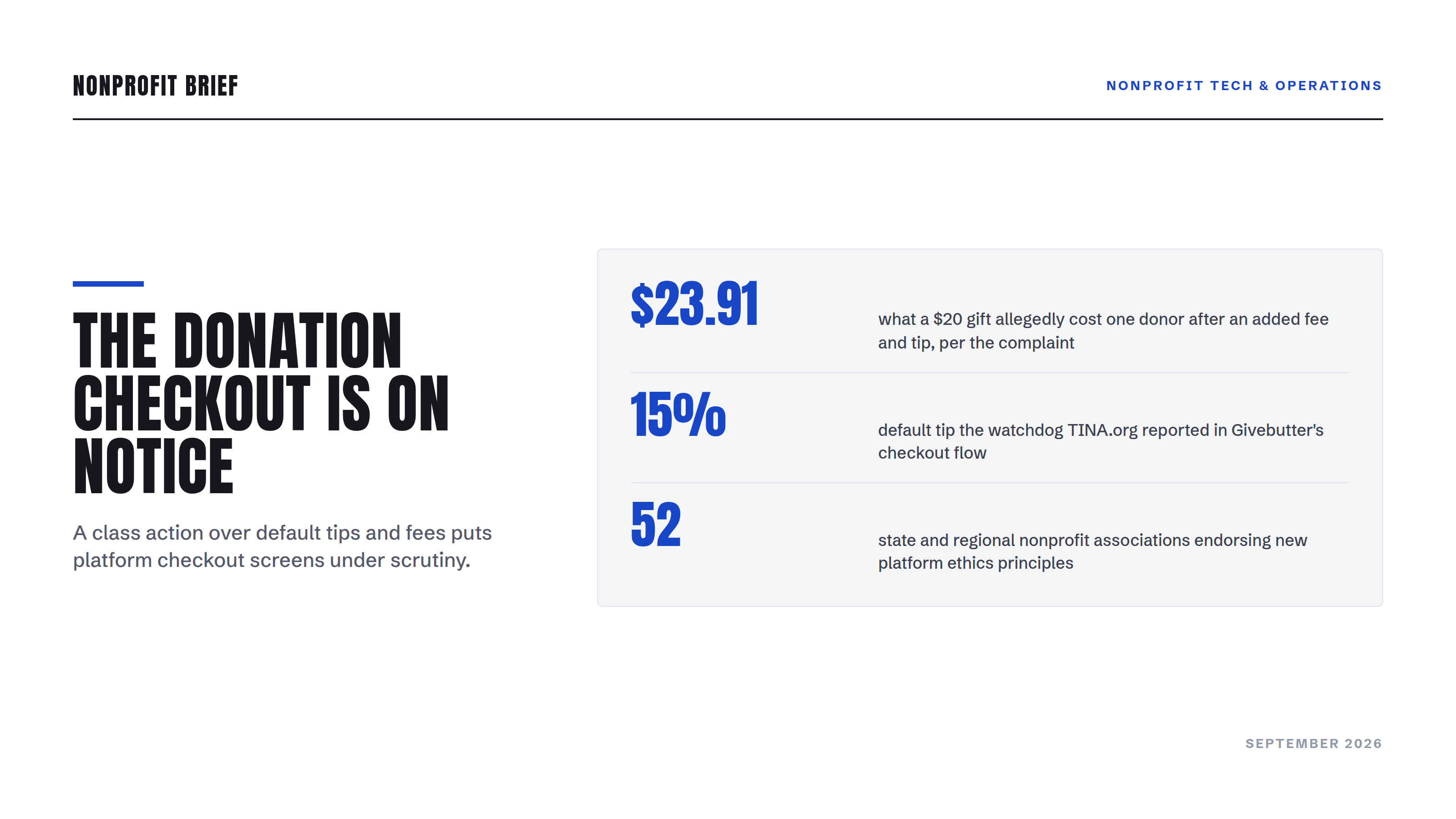
A donor gives $20 to your organization through your donation page. Her card gets charged $23.91. She finds out later, gets angry, and the name she remembers is yours, not your platform's. That scenario is now the subject of a proposed class action against Givebutter, a widely used platform that markets its fundraising tools as free, and the National Council of Nonprofits flagged the suit to its members this week. Whatever happens in court, the lesson for nonprofits is immediate: you are accountable for a checkout experience you may never have personally clicked through.
What the lawsuit actually alleges
The complaint, McClintock v. Givebutter Inc., was filed this spring by a Pennsylvania donor. As Top Class Actions reported, she alleges that a $20 donation she made to a local charity came with a $0.91 processing fee and a $3.00 tip she never agreed to, and that the ways to remove both were buried in fine print. The suit invokes Pennsylvania and Delaware consumer protection statutes. These are allegations, not findings. Givebutter has not been found liable for anything, and platforms routinely defend these designs as clearly disclosed.
The consumer watchdog TINA.org ran its own review of the checkout flow and reported a default tip of 15 percent, a total that only appears after the donor has entered payment information, and opt-outs that are easy to miss. In its example, a $500 donation became a $590 charge.
The model itself is legal, common, and disclosed. That is not the same as safe
To be fair to the platforms: the tip-supported model is how "free" fundraising tools stay free, and Givebutter documents its pricing openly. With tips on, the organization pays no platform fee and, for standard online donations, receives the full intended donation. Organizations can also turn tips off entirely, in which case a 3 percent platform fee applies on top of standard card processing of 2.9 percent plus 30 cents. The mechanics are handled for you either way; what is not handled for you is the donor's reaction to the checkout screen.
That reaction is what regulators and the sector's own institutions are now organizing around. In June, the National Council of Nonprofits published principles for ethical fundraising platforms, endorsed by 52 state and regional nonprofit associations, naming default tips and hidden fees as practices that erode donor trust. The backdrop is not hypothetical: in late 2025, the platform Flipcause faced a lawsuit and a cease-and-desist order after allegedly withholding more than $1 million in donations from the nonprofits it served, according to the same Council analysis.
Run the five-dollar test this week
The fastest audit available to any executive director costs five dollars. Make a real donation to your own organization on a personal card and screenshot every step. Three questions matter. What total does the donor see, and when? Is there a pre-set tip, and how obvious is the way to change it? Does the receipt match what the card was charged?
Then open your platform settings. On Givebutter, tip and fee behavior is configurable per campaign, and other major platforms offer similar controls. Decide your posture deliberately: tips on with clear disclosure, tips off with the platform fee absorbed, or fees passed to donors who affirmatively opt in. Any of these can be defensible. Drifting along on defaults you have never reviewed is the position you do not want to explain to a donor, a journalist, or a state attorney general. While you are in there, confirm the platform's receipts carry the language the IRS requires; our guide to donation receipts in 2026 covers what a compliant acknowledgment says.
One more step for organizations with staff capacity: put the donation flow on the same annual checklist as your email authentication setup. Both are infrastructure donors never see until it fails, and both fail in public.
The takeaway
The Givebutter suit is unresolved, and the company may well prevail. But the direction of scrutiny is clear: courts, watchdogs, and the sector's own associations are converging on the view that what happens at checkout is the nonprofit's reputation, even when it is the platform's revenue model. You cannot control the litigation. You can control whether you know, today, exactly what a donor is charged when they give you twenty dollars. Spend the five dollars and find out.