On September 2, Senators Ron Wyden and Raphael Warnock sent Treasury Secretary Scott Bessent and IRS chief executive Frank Bisignano a letter with a pointed question: is the administration building a plan to strip tax-exempt status from organizations it opposes? The letter cites press reports from late August that Treasury officials are preparing IRS enforcement against several large left-leaning nonprofits, and it demands answers by September 15. The next day, two House Democrats introduced the PROOF Act, a bill that would write examination due process for nonprofits into statute. Back in January, Chairman Jason Smith and every other Republican on the House Ways and Means Committee had pushed in the other direction, urging the IRS to take "a more hands-on approach" to nonprofit oversight, including revocations.
If you run a nonprofit, the noise is unsettling. So here is the thing worth actually knowing: the revocation process itself. It has more steps than the headlines suggest, and most of those steps exist to protect you.
Revocation starts with an examination, not an announcement
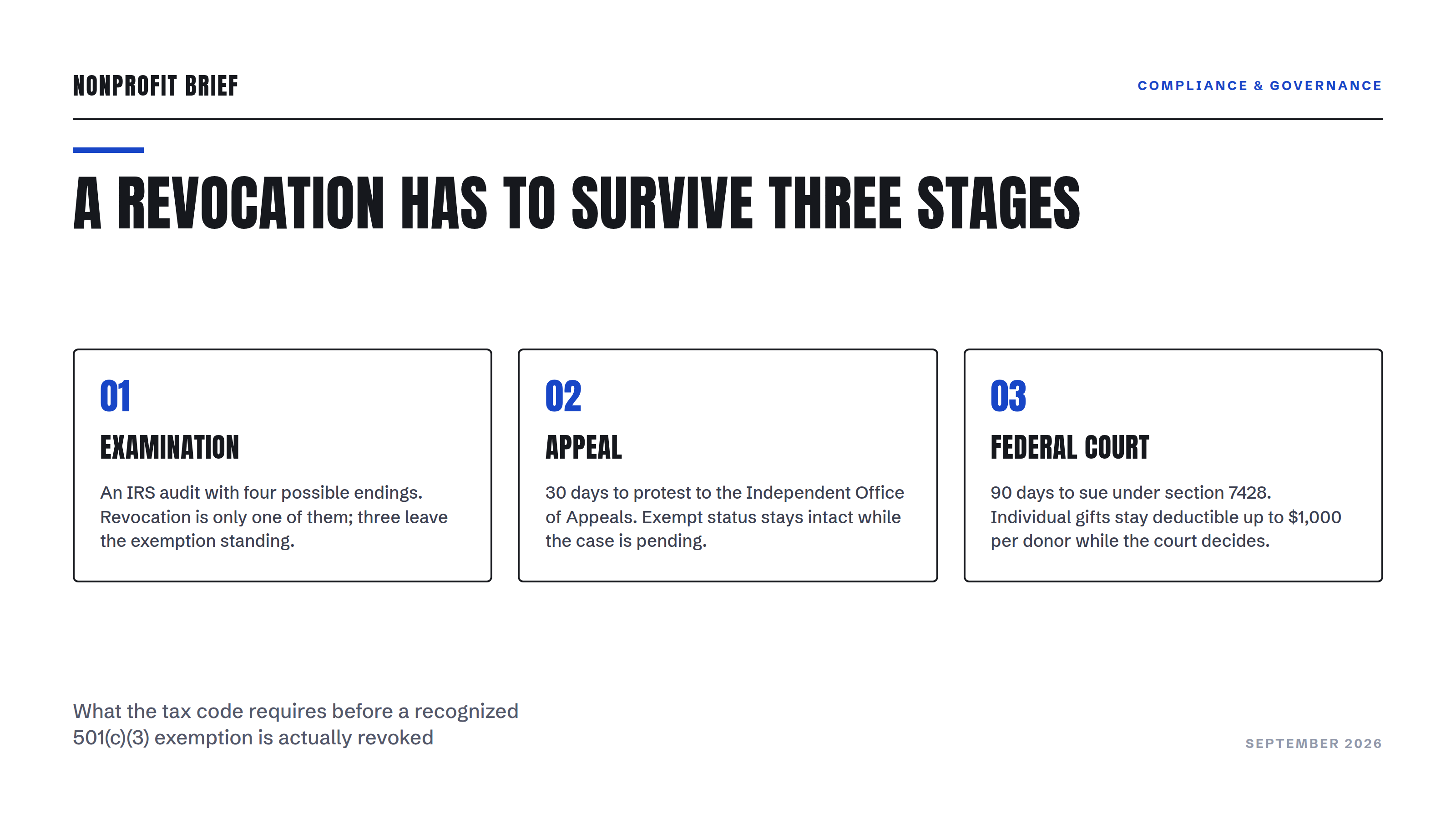
No official can revoke a 501(c)(3)'s status by press release, executive order, or memo. Under the IRS's own procedures, revocation of a recognized exemption comes out of an examination: the IRS audits the organization, usually starting from its Form 990, by mail or in the field. An examination has four possible endings, and revocation is only one of them. The others, laid out in a useful analysis by nonprofit lawyer Jeffrey Tenenbaum, are a no-change letter, a no-change letter with written advisories, and a negotiated closing agreement. Three of the four leave your exemption standing.
A proposed revocation opens a process; it does not end one
If an examination does end in a proposed revocation, you get a letter, not a verdict. Per IRS Publication 892, you have 30 days from the date of that letter to file a protest. The protest goes to the IRS Independent Office of Appeals, which operates separately from the examiners who proposed the revocation. (The same publication carves out an exception: in cases like fraud or jeopardy, where the IRS concludes delay would harm the government's interests, the appeal conference right does not apply.) Appeals officers have broad settlement authority, and while your case sits with them, your organization keeps its exempt status. Miss the 30-day window, though, and you lose your best forum: courts generally will not hear a declaratory judgment case unless you exhausted the IRS's administrative process first. If a 30-day letter ever arrives, calendar the deadline that day and get counsel moving. Outcomes here turn on your specific facts, and this is not legal advice for your situation.
Courts get the last word
If Appeals issues a final adverse determination, Congress gave exempt organizations a remedy most taxpayers do not have: a declaratory judgment suit under section 7428, filed within 90 days of the final determination letter, in the U.S. Tax Court, the U.S. Court of Federal Claims, or the U.S. District Court for the District of Columbia. While the case is pending, the law also shields your donors: under section 7428(c), individual gifts stay deductible up to $1,000 per donor in total (a married couple counts as one donor), from the public announcement of revocation until the court rules, though not for anyone responsible for the conduct that caused the revocation. And revocation is ordinarily prospective rather than retroactive: under the IRS's current determination procedures, retroactive revocation is reserved mainly for cases where the law changed, material information was omitted or misstated, or the organization operated in a way materially different from what it represented.
Federal law limits who can order an audit
The senators' letter leans on a statute worth knowing by name. Section 7217 of the tax code, passed in 1998, makes it a crime for the president, the vice president, their executive office staffs, or cabinet-level officials (the attorney general excepted, so the Justice Department can still refer tax cases) to ask the IRS, directly or indirectly, to start or stop an audit or investigation of a particular taxpayer. A willful violation carries up to a $5,000 fine and 5 years in prison. There are narrow exceptions, mainly for forwarding a taxpayer's own written request and for Treasury secretary requests about tax policy generally, not about particular taxpayers. One real carve-out from the ordinary process does exist: under section 501(p), an organization formally designated as supporting terrorism has its exemption suspended immediately, contributions to it stop being deductible for the duration, and the tax code bars a challenge to the suspension itself in tax proceedings; the underlying designation is contested under its own separate rules. That provision has reached roughly 10 organizations in two decades, per Tenenbaum's review.
The most common revocation is still self-inflicted
For all the attention on Washington, the way small nonprofits actually lose exempt status is automatic revocation: failing to file a Form 990-series return for 3 consecutive years. No examination, no Appeals conference, no lawsuit. It is also the one revocation entirely within your control, and the late-filing consequences stack up well before year 3. If political activity is what worries you, the actual rules for 501(c)(3)s in an election year are stricter and clearer than the current news cycle implies.
The takeaway
Short of a formal terrorism designation, nobody can take your exemption with a signature. A revocation has to survive an examination, an independent appeal, and, if you choose, federal court, with your status intact through the administrative stages and your donors partly protected after that. Your job this fall is not to panic-restructure. It is to keep filings current, document how your programs serve your exempt purpose, keep board minutes and conflict policies in order, and know the two deadlines that matter if a letter ever comes: 30 days to protest, 90 days to sue.