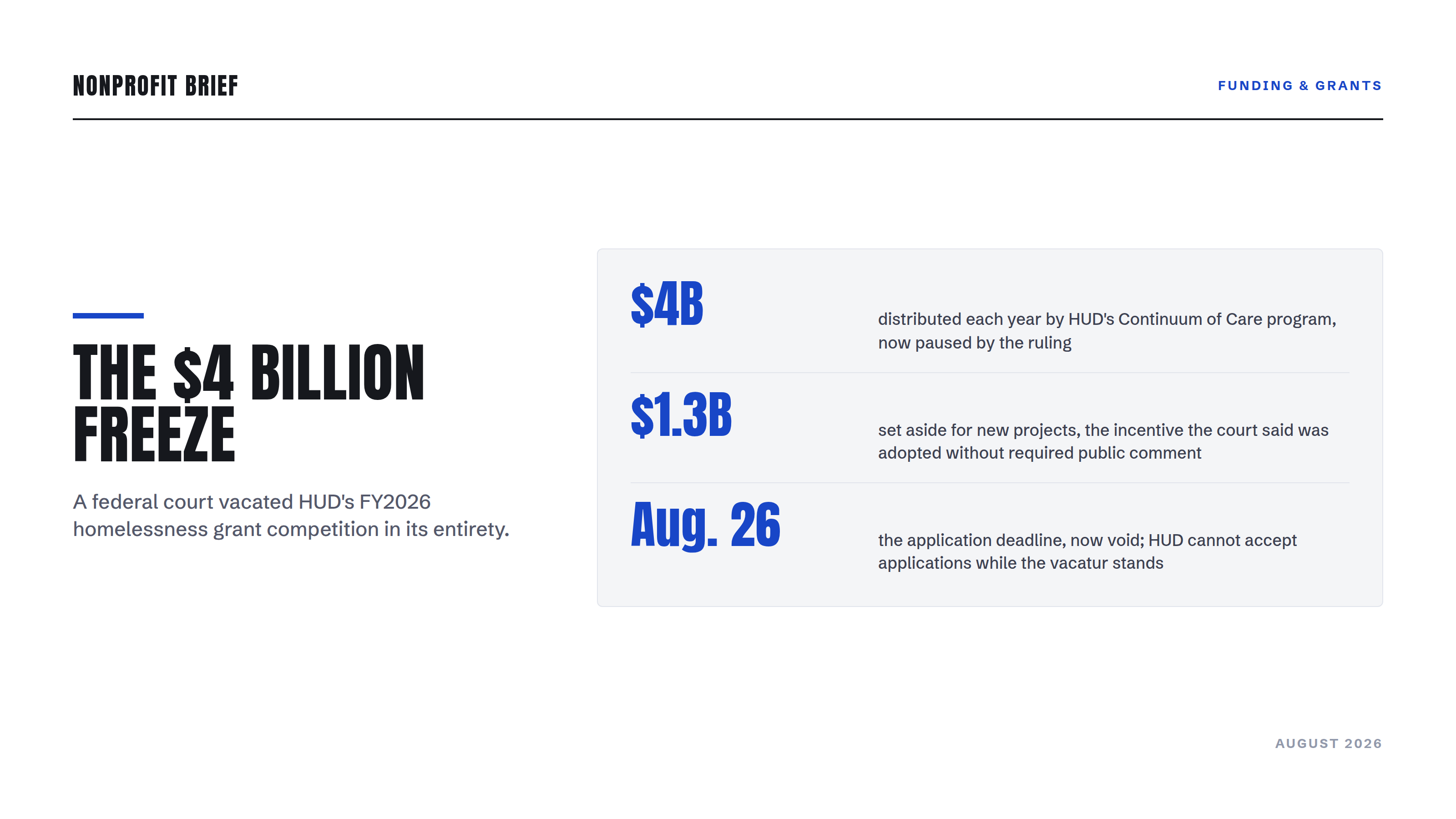
If your organization was pushing toward the August 26 deadline for HUD's Continuum of Care grant competition, put the application down. On August 7, a federal judge in Rhode Island set aside the FY2026 funding notice in its entirety, which means the competition that distributes roughly $4 billion a year for homelessness programs currently has no rulebook, no deadline, and no way to accept your application.
The Ruling Voids the Whole Competition, Not Just Parts of It
U.S. District Judge Mary McElroy ruled that HUD acted unlawfully in issuing the FY2026 Notice of Funding Opportunity, the annual document that sets the competition's rules. The McKinney-Vento Act, the statute behind the CoC program, requires HUD to take public notice and comment before it creates new funding incentives for anything other than permanent housing, and the court held that the notice's $1.3 billion set-aside was exactly such an incentive, adopted with no comment process at all. The remedy was not a trim. The court vacated the NOFO entirely, and HUD has told the field that the August 26 deadline is no longer in force and that the agency cannot accept applications at this time. Local planning bodies, including the King County Regional Homelessness Authority, are describing the competition as paused until HUD says otherwise.
Two sets of plaintiffs pushed the case. A coalition organized by Democracy Forward brought together the National Alliance to End Homelessness, the National Low Income Housing Coalition, service providers, and local governments including Santa Clara County, King County, Boston, and Nashville. Separately, 22 states and D.C. sued over the same notice in July.
What HUD Changed, and Why Courts Keep Balking
The vacated notice, issued June 1, would have redirected a large share of the program away from permanent housing. It reserved $1.3 billion for new projects, close to a third of available funds, favoring transitional housing and services-only models over the permanent supportive housing that renewals have historically funded. It also attached conditions drawn from executive orders on diversity programming, gender identity, and immigration enforcement cooperation. The states' complaint argued the structure amounted to a de facto cap on permanent housing funds and put existing renewal projects at risk.
This is the second year running that this playbook has failed in the same courtroom. HUD tried to redirect about 60 percent of the program away from permanent supportive housing in the FY2025 cycle, and McElroy struck those restrictions down in late June, calling the attempt the hallmark of unreasoned decision making. HUD asked the First Circuit to pause the earlier rulings while it appealed and was refused.
The Appeal Means the Pause Has No End Date Yet
HUD has appealed the August 7 ruling and asked the district court to put it on hold while the appeal runs. The court declined to stay the ruling, and observers expect HUD to ask the appeals court for the same relief. As of publication on August 23, the vacatur stands and the competition is frozen. Nobody, including HUD, has published a date for a reissued notice.
How long the freeze lasts is largely HUD's choice. The court declined to bar HUD from pursuing the same priorities through a lawful process, and nothing in the ruling dictates a reissue timeline. There is even a fast precedent: after losing in court last cycle, HUD withdrew the challenged notice in December and reissued a compliant one about five weeks later. A quick, clean reissue is possible. So is a long standoff while the appeal runs. Renewal-funded programs, which house people today, sit closest to whatever gap opens, since a competition that restarts late pushes award announcements and grant agreements late with it. This is the same pattern of funding whiplash that has defined a brutal year for federal grants, and litigation outcomes here will turn on filings and rulings still to come, so treat any specific date you hear as provisional.
What to Do While the Competition Is Frozen
First, stop polishing the dead application, but do not delete it. The project descriptions, budgets, and match documentation you built will carry into whatever notice comes next, whether that is a reissued FY2026 competition under the old rules or something else. Second, get on HUD's SNAPS competition listserv and stay close to your CoC lead agency, because that is where a restart will surface first. Third, plan cash flow for a late award year. If a renewal grant funds your program's payroll, model what a 3-to-6-month delay in grant agreements would do, and revisit how much operating reserve that implies. Boards would rather see that math in September than in a crisis in February.
The Takeaway
A federal court threw out the rulebook for the government's main homelessness grant program, the August 26 deadline is void, and HUD's appeal means the freeze has no announced end. The program itself is statutory, so money will eventually move, though last cycle it took an act of Congress directing noncompetitive renewals to fully close the loop. Prepare for both endings at once: keep application materials current in case HUD reissues quickly, and stress-test your budget against a late award year in case it does not.