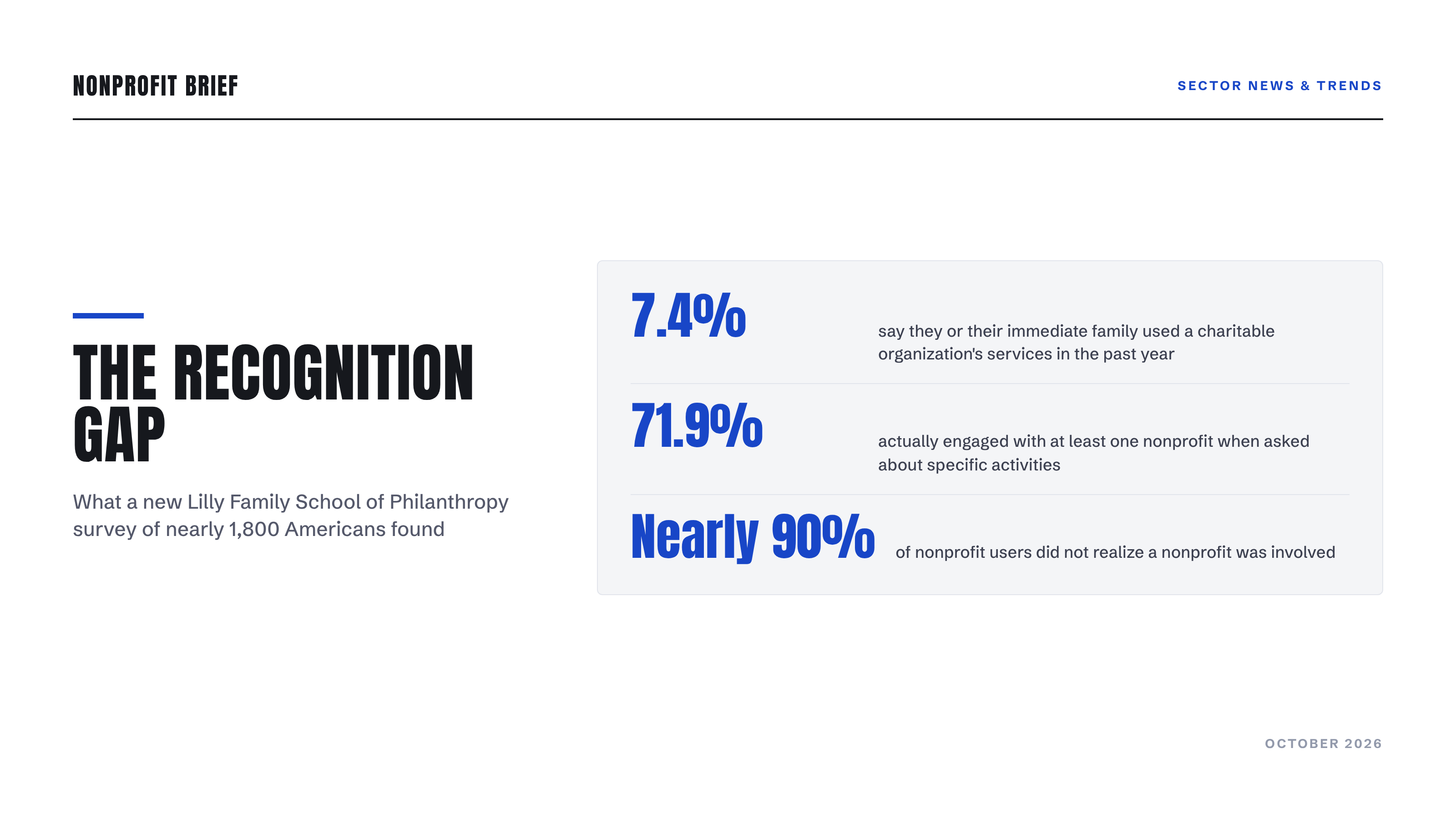
In March, survey firm Ipsos asked nearly 1,800 Americans whether they or their immediate family had received or used services from a charitable organization in the past year. Just 7.4% said yes. Then the survey asked about specific activities: attending religious services, visiting a museum, holding a scholarship. Measured that way, 71.9% had engaged with at least one nonprofit in the past year. Put those two numbers together and you get the headline finding of the Indiana University Lilly Family School of Philanthropy's new national survey: nearly 90% of the people your sector serves do not know a nonprofit was involved.
The Recognition Gap Is the Finding
The study, "What Americans Think About Nonprofits & Philanthropy 2026," was released September 25 and funded by the William and Flora Hewlett Foundation. It repeats a survey the school last fielded in 2023, which makes the trend lines as useful as the snapshots. The recognition gap barely moved: the share of Americans who identify themselves as nonprofit users rose only slightly in three years, from a very low base.
Jon Bergdoll, the school's interim director of data and research partnerships and the survey's lead analyst, told the Chronicle of Philanthropy the scale of the disconnect was striking. His sharper point, made in the school's announcement, was why it matters: the gap affects not just whether people donate, but how they react when policy hits the sector. Someone who does not know the food pantry, the after-school program, and the community clinic are nonprofits has no reason to object when nonprofit funding is cut.
Trust Is Decent, Shallow, and Movable
The confidence numbers look fine until you press on them. About 23.3% of respondents expressed high confidence in nonprofits' ability to solve societal problems, roughly even with religious institutions and well above Congress and corporations. Add the moderates and around 70% land at moderate-or-high confidence.
Three findings undercut the comfort. First, the share who say nonprofits are more effective than government at providing basic needs fell to 18.9%, from 24.6% in 2023. Second, 22.7% of respondents said their confidence in nonprofits would drop if a political figure they trust expressed a lack of confidence in the sector. That is a measure of how much of the sector's standing is borrowed rather than earned, and it points the same direction as the soft numbers in the trust data we covered in July. Third, asked whether the nonprofit sector is headed in the right direction, 53.5% said they did not know. The public is not hostile. It is unbriefed.
The Gap Shows Up in Giving, Too
A new deduction took effect this tax year for donors who take the standard deduction: up to $1,000 in cash gifts ($2,000 for joint filers), with gifts to donor-advised funds and most private foundations excluded. We walked through the details in our guide to the 2026 charitable deduction. The survey suggests the sector should not expect that incentive to sell itself: 19% of respondents said a universal charitable deduction would lead them to increase giving, down from 24.4% when the 2023 survey asked the same question hypothetically. A tax break does not advertise itself, and a deduction for gifts to a sector most people do not realize they use is not a growth strategy on its own. Somebody has to do the telling, and the funders and platforms with the biggest megaphones mostly talk to people already inside the room.
What to Do With a Finding Like This
You cannot close a national recognition gap from one organization. You can close yours. Three moves follow directly from the data.
Say the word. If your newsletter, your website, and your front desk never use the word "nonprofit," your community's mental model never updates. "We are a nonprofit; this program exists because people fund it" is one sentence, and it works in an email footer.
Count your users, not just your donors. The survey's method is replicable at your scale: people undercount their nonprofit contact until you name the specific service. An annual "you used us" number (meals, visits, seats, rides) gives your board and your local officials a figure they can repeat.
Brief before you need cover. The 22.7% whose confidence moves with political criticism is the case for building recognition in calm weather. An organization whose neighbors already know what it is and what it does is harder to caricature when the sector is under attack. That is not a comms luxury; in a year when federal funding has moved fast, it is operating insurance.
The Takeaway
The Lilly school's survey quantified something EDs feel constantly: the public likes you, vaguely, and knows almost nothing about you. The gap between 7.4% self-identified users and 71.9% actual users is the whole story. Trust built on that little recognition is cheap to attack and expensive to rebuild. The fix starts with the unglamorous habit of telling people, at the moment they use your services, that a nonprofit is what they are using.