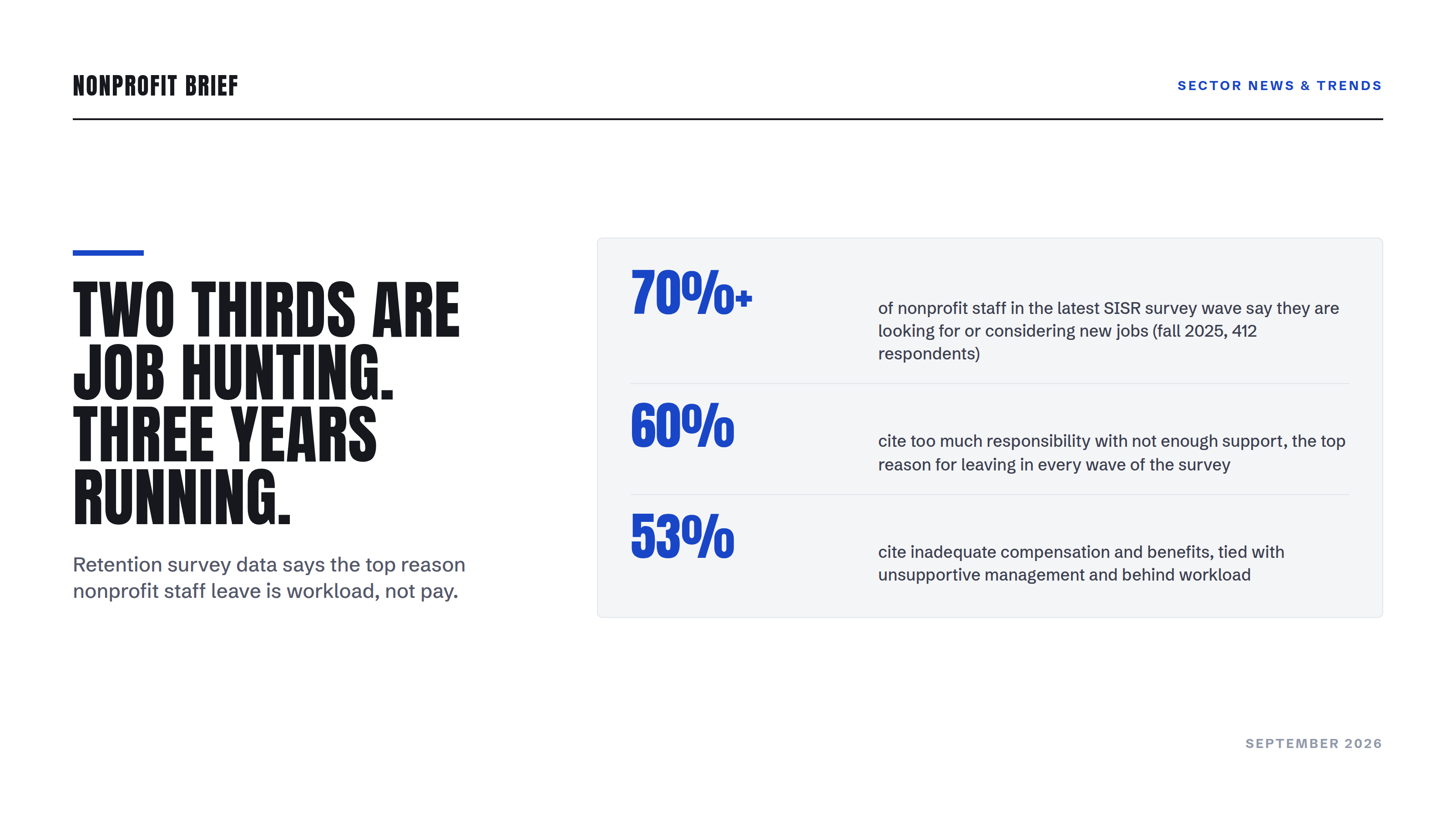
Just over 70% of nonprofit employees say they are looking for new jobs or considering it, according to the latest wave of the Social Impact Staff Retention survey, a practitioner-led annual survey of U.S. nonprofit workers. That makes three straight waves at two thirds or higher. The project's co-leads published a three-year retrospective through Candid on September 21, and its message is blunter than the turnover number itself: the things pushing people out are operational, and most of them are fixable.
Three Waves, One Direction
The current SISR report, released in February 2026 from data collected in fall 2025, surveyed a random sample of 412 nonprofit workers. Just over 70% said they are looking for or considering new jobs, and 22% said they are rarely or never fulfilled in their work. Only about one third of respondents (35%) say they plan to stay definitively in nonprofit work.
The trend line matters as much as the level. Earlier waves put job-hunting intent at 74.2% in the 2024 survey and 67.4% in 2025. The dip looked like progress. The rebound past 70% suggests it was a pause.
Who is looking has shifted, though. In the latest wave, health care workers lead at 77%, with social and human services close behind at 73%. Arts and culture, which topped the list at 93% and 92% in the two prior waves, dropped to 69%.
One caveat before you quote any of this at a board meeting. With 412 respondents, SISR is a modest survey, and its percentages are best read as directional, a consistent reading of sentiment rather than a census of the workforce. Three waves pointing the same way is the finding.
Leaders See the Same Problem From the Other Side
Employer-side data points the same way. In Wipfli's State of Nonprofit, Government and Education 2026 report, a survey of 299 executive-level leaders across those three sectors, 60% named attracting and retaining skilled people as one of their toughest challenges for 2026.
You might expect the year's federal funding disruptions to be the main driver. The staff data says otherwise. Among SISR respondents seeking new jobs, 35% cited concerns about the certainty of their current role given the political and funding landscape, and the report suggests those worries are more background context than decisive trigger, with the caution that it is too early to call that a trend. What actually moves people to leave is closer to home.
Workload Tops the Leave List Every Year
In the latest wave, the top reason for leaving is too much responsibility with not enough support, at 60%. It has led the list in every wave of the survey. Behind it, inadequate compensation and benefits and unsupportive management or leadership tie at 53%, with lacking growth opportunities at 46%.
Pay is real. It is also tied with management quality, and both trail workload. Two of the top three exit drivers, workload distribution and management practice, cost far less to address than an across-the-board raise. (For where sector pay actually sits, see our breakdown of nonprofit compensation data.)
The stay side tells the same story from the other direction. Respondents who plan to stay cite strong alignment with the mission (75%), hybrid or remote flexibility (72%), a good and encouraging work environment (66%), and supportive management or leadership (62%). Averaged across all three years, flexibility edges out mission as the single most cited reason to stay. Either way, the top of the list is not money.
Audit Workloads Before You Budget Raises
The survey's co-leads, Michelle Flores Vryn and Evan Wildstein, recommend starting with a workload audit, and they give a formula for it: utilization, meaning admin time plus assigned hours, divided by gross hours. In their experience, the optimal utilization rate is 80% to 85%. Above that range, someone is carrying more than a sustainable load, and the 60% who cite overloaded, undersupported roles suggest your staff already know who.
Three more moves follow directly from the stay-side data. Put your flexibility policy in writing; informal arrangements read as revocable, and flexibility sits at or near the top of the stay list in every wave. Build mission touchpoints into regular meetings, so the 75% who stay for the mission keep seeing it up close. And invest in manager skills: unsupportive management at 53% describes a practice problem, and practice is trainable.
None of this requires a consultant or a new budget line. It requires knowing who on your team is at 110% utilization while someone else is at 60%, and being willing to act on it.
If you want your organization's experience reflected in next year's numbers, the 2027 SISR survey is open for responses through October 31.
The takeaway
Retention is the sector's quiet crisis, and the data says the levers are closer than they look. What pushes people out most, overloaded roles and weak management, is operational, not financial. Run the utilization math before you conclude you cannot afford to keep people. Losing them costs more.