The federal fiscal year turns over on October 1, and two SNAP changes arrive with it, with a third already on the calendar for next October. One is routine. The other two move real money onto state budgets, and their effects will reach nonprofits far beyond the food pantry.
The Benefit Increase Is Routine, and Modest
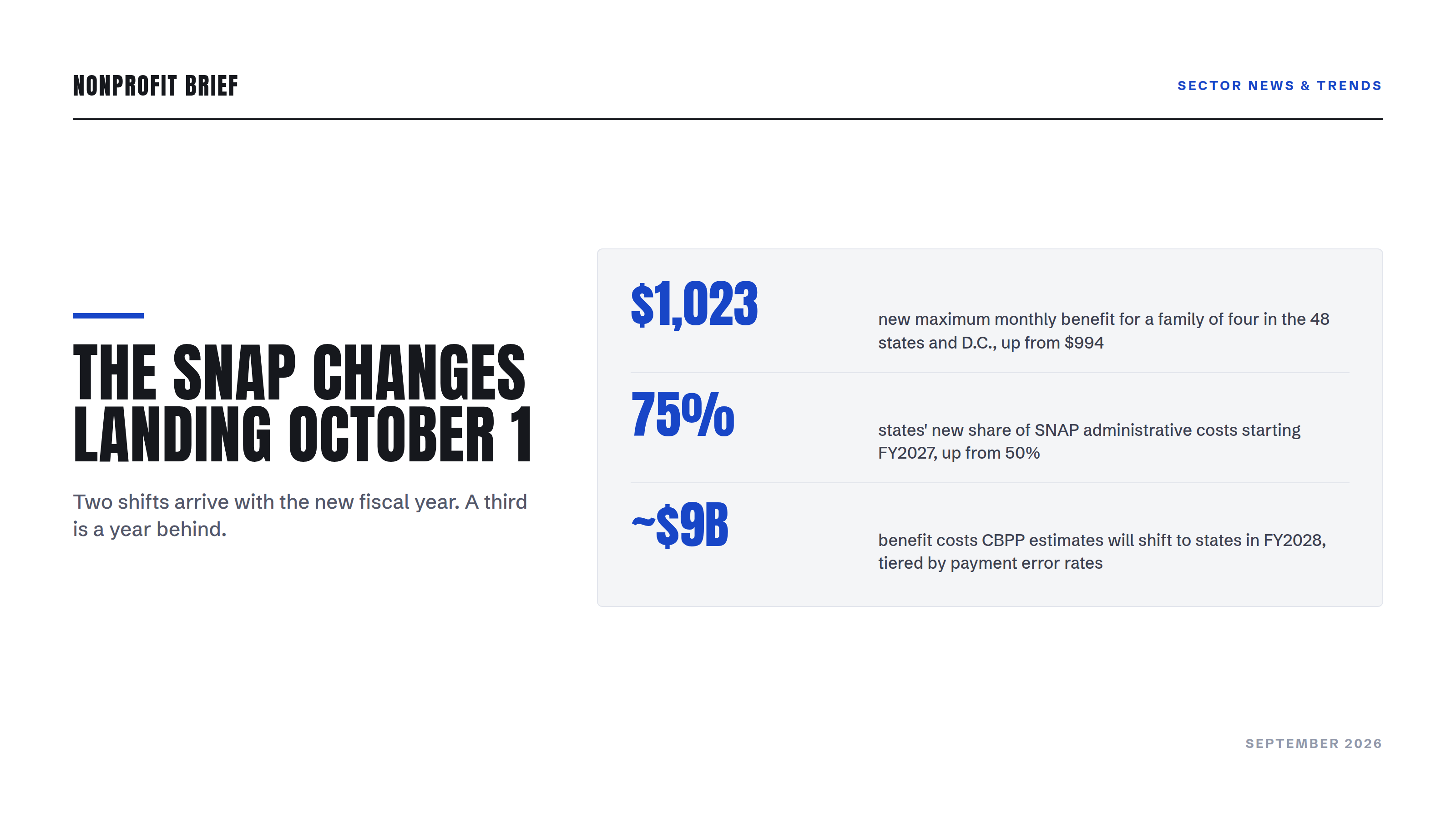
SNAP's annual cost-of-living adjustment takes effect October 1. The maximum monthly allotment for a family of four in the 48 contiguous states and D.C. rises to $1,023 a month, up from $994 in FY2026. A one-person household's maximum goes from $298 to $306, and the standard deduction for households of one to three rises from $209 to $217. Call it roughly a 3% bump. It is the one piece of October 1 news your clients will feel directly, and it is small.
States Will Pay Half Again More to Run SNAP
The bigger change is invisible to participants. For decades the federal government and states have split the cost of running SNAP, the caseworkers, eligibility systems, and call centers, roughly evenly. Section 10106 of last year's budget reconciliation law (Public Law 119-21, signed July 4, 2025) cuts the federal share of state administrative costs from 50% to 25% starting in fiscal year 2027, which begins October 1. States now carry 75%. USDA proposed the conforming rule in June, and the rule's own impact analysis estimates the change moves about $3.4 billion a year onto state budgets. Employment and training costs keep their 50% federal match, and tribal organizations administering the program keep 75%, but the core work of running SNAP just got half again as expensive for your state.
The Food Research & Action Center warns that the shift threatens the operations that keep the program running: staff capacity, timely eligibility processing, and customer service. For nonprofits whose clients depend on SNAP, that means longer certification waits and more procedural churn, people losing benefits over paperwork rather than eligibility.
The Bigger Bill Arrives in October 2027
For the first time in the program's history, states will also pay a share of SNAP benefit costs themselves, generally beginning in fiscal year 2028. The share depends on each state's payment error rate: nothing for states that keep errors under 6%, then 5%, 10%, or 15% of benefit costs as error rates climb, with the highest-error states allowed a delay of a year or two. The first-year tiers are set by error rates already on the books, from fiscal 2025 or 2026, so states can see their bill coming. The Center on Budget and Policy Priorities estimates roughly $9 billion shifts to states in fiscal year 2028 alone, including about $1.9 billion for California and $1.15 billion for New York. Legislatures are writing next year's budgets with those numbers in view, and nonprofit contracts and state grant lines compete for the same dollars.
Demand Is Already Up, and Charitable Food Cannot Cover It
The law's expanded work requirements took effect with its signing in July 2025, with states phasing in enforcement since. Most adults must now log 80 hours a month of work, training, or volunteering to keep benefits beyond 3 months in a 36-month period. The requirement now runs through age 64 instead of 54, the exception for parents covers only those with children under 14, and exemptions for veterans, homeless people, and former foster youth are gone. Exceptions remain for people medically certified as unfit for work and for pregnant women, and the law added new exemptions for certain American Indian populations. CBPP's participation tracker counts roughly 5 million fewer participants, a 12% drop, between July 2025 and May 2026, including about 1.2 million children across the 25 states with child-level data.
Those households do not stop eating. Many turn to charitable food, and the arithmetic there does not work: by Feeding America's count, SNAP provides nine meals for every one the food bank network provides. Federal SNAP-Ed nutrition education funding also ended after FY2025, taking with it a program many community organizations ran on contract.
What to Do Before the Year Turns
If you run food assistance, budget for the demand you are already seeing to continue through the giving season, and start documenting it now. Monthly service counts, wait times, and first-time-visitor numbers are the evidence funders and local reporters will ask for.
If your revenue includes state contracts or state grant lines, in any subsector, watch your statehouse the way you watched Washington this spring. States absorbing new SNAP costs on top of a shrinking federal grants picture will look for savings, and human-services contracts are a recurring target. This is a good month to check your operating reserves against a slow-pay scenario.
If your staff help clients with benefits, expect state agencies to get slower as their administrative funding thins, and plan for more application help, not less. One piece of calm in a busy fall: the federal grant-rule overhaul that would have added its own turbulence is frozen until December 11.
The takeaway
The dates matter. Benefits rise about 3% and the administrative cost shift lands on October 1, 2026. The benefit cost share follows in October 2027, and states are budgeting for it now. Demand for food assistance is up, state money is about to get tighter, and neither is temporary. Plan the fourth quarter, and next year's state budget season, with both in view.