Since July 4, any employer has been allowed to put money into a child's Trump account. On August 11, the IRS published proposed Section 128 regulations for doing it as a tax-free benefit. Nonprofits are covered on the same terms as every other employer, and the rules are usable now. The tax-free part depends on paperwork you have not written yet.
What a Trump Account Is, in One Paragraph
Trump accounts were created by the July 2025 budget law, which the IRS now brands the Working Families Tax Cuts. Each one is a special-purpose IRA for a child with a Social Security number, opened by a parent on Form 4547. Contributions opened on July 4, 2026 and are capped at $5,000 a year for 2026 and 2027, indexed after that. U.S.-citizen children born from 2025 through 2028 can also claim a one-time $1,000 federal deposit that sits outside the cap.
A parent who contributes gets no deduction. An employer that contributes under the new Section 128 of the tax code can put in up to $2,500 per employee per year (also indexed after 2027), and the employee owes no income tax on it. An employer program is the only way pre-tax dollars reach these accounts.
The $2,500 Is Per Employee, Not Per Child
The limit tracks the employee, not the account. A staff member with three kids can split the $2,500 across three accounts, but the calendar-year total stays at $2,500, even across two jobs. It also counts toward the child's $5,000 cap, so a family cannot put in the full $5,000 and take yours on top. Anything above $2,500, or outside a compliant program, is ordinary taxable wages.
The account must belong to the employee's dependent as the tax code defines one (a child claimed by an ex-spouse does not qualify), or to the employee if the employee is still a minor. Either way, employer money can only go in during the account's growth period, which ends December 31 of the year the beneficiary turns 17. Board members serving only as directors are not employees for this purpose.
The Written Plan Is Not Optional
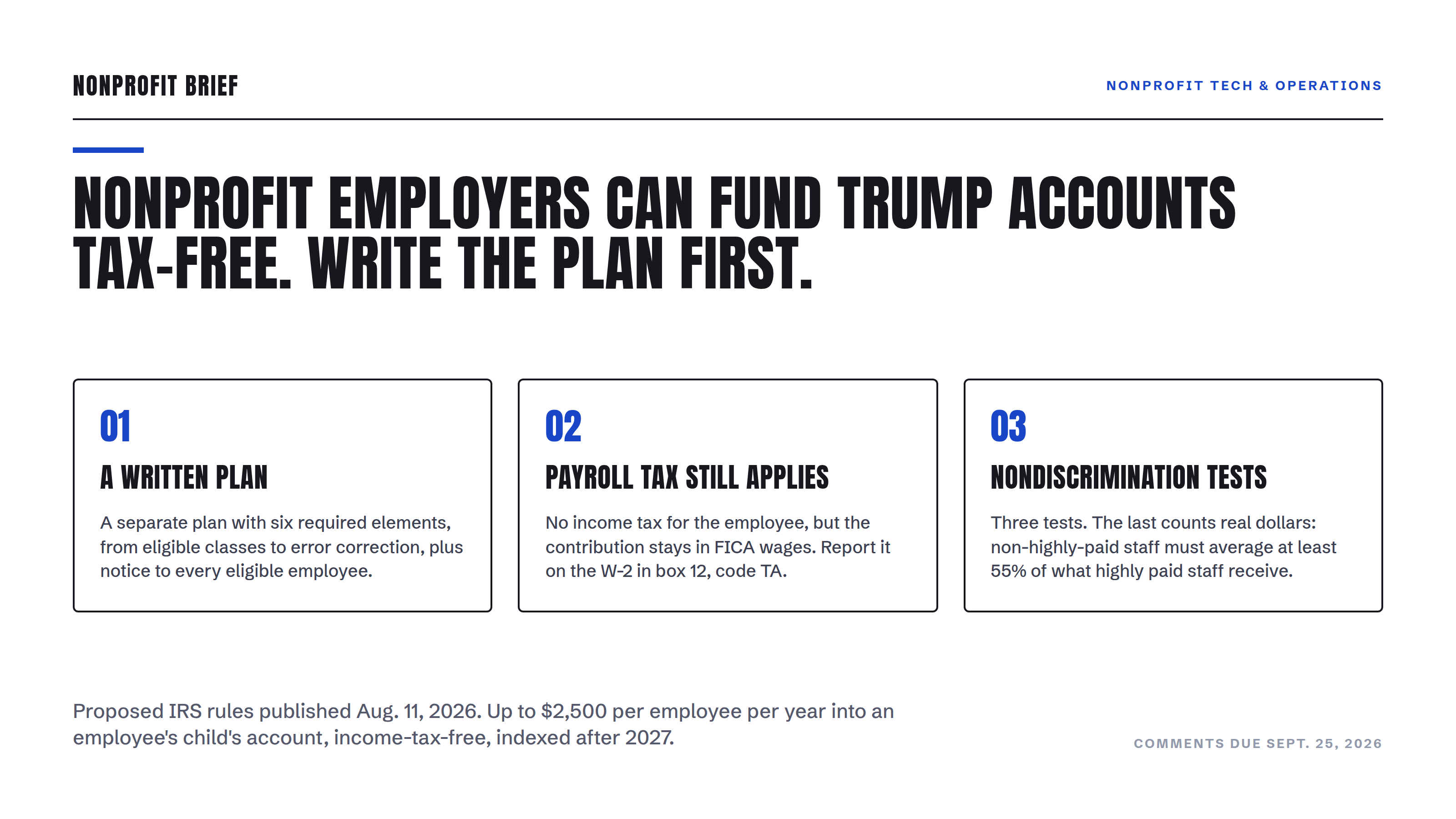
The plan document is the gatekeeper. Your program only counts if it is a separate written plan, for the exclusive benefit of employees, that spells out six things: which classes of employees are eligible; the contribution rules, including the amount and whether staff can add pre-tax salary deferrals; how an employee designates the target account; the certification, notice, and reporting procedures; the plan year; and how administrative failures get corrected. An arrangement is a program only if the employer actually follows those terms. Two conditions sit outside the list. Every eligible employee must get reasonable notice of the program and its terms. And you cannot restrict contributions to accounts held at one custodian you prefer; a program that does so is not a program at all.
The employer must use a method reasonably designed to confirm the money is going into a valid Trump account, using information from the trustee, payroll processor, or another service provider. For dependent status, it may rely on the employee's written certification (that the child is or is expected to be the employee's dependent that year, the child's date of birth, and that the employee knows of nothing making the child ineligible), unless it actually knows the certification is wrong. If you later find a contribution did not qualify, notify the trustee; the proposed rules treat 21 calendar days as a safe-harbor deadline for that notice.
Payroll Still Owes Social Security and Medicare on It
The exclusion is from income tax only. The employer's contribution stays in wages for FICA, so your organization pays its share and withholds the employee's, even though no federal income tax is withheld. On the year-end side, the 2026 Form W-2 instructions add box 12 code TA for these contributions, so brief your payroll provider before the first deposit, not at W-2 time.
Nondiscrimination Is Where a Small Shop Can Trip
A highly compensated employee, for this purpose, is anyone who earned more than the $160,000 compensation threshold in the prior year (the figure has held for 2025 and 2026). In many small nonprofits that is nobody, and the tests are trivial. Where it is somebody, usually the executive director, three tests apply. The program must offer contributions on the same terms to everyone eligible; uniform terms pass that one. Eligibility classes must be reasonable and cover enough non-highly-paid staff to pass a ratio test; a plan open to all employees passes the ratio test. And the average benefits test looks at actual dollars: the average contribution received by non-highly-compensated staff must be at least 55 percent of the average received by highly compensated staff, counting only people who received something.
That last test is the trap. If the only participant with a child's Trump account is the highly paid ED, uniform eligibility on paper does not rescue the numbers. Failing does not sink the whole program: the non-highly-paid keep their exclusion, and the employer can cure the year by adding the excess to the ED's taxable wages before the W-2 deadline. Employees who have not reached 21 and completed a year of service, and union employees whose benefits were bargained, are excluded from the math. There is also a safe harbor for a simple design: a match tied to the federal pilot deposit, offered to every non-excluded employee with a pilot-eligible child, is disregarded in two of the three tests. Outcomes turn on who is on your payroll and what they earn, and this is not tax advice for your organization; if your ED is above the threshold, run the design past a benefits advisor before the first contribution.
What to Do Before Year-End
The regulations are proposed, not final, but employers may rely on them now. Comments are due September 25, with a public hearing October 15. If you want to offer this in 2026, the order of operations is: decide the amount and who is eligible; adopt the written plan and notify staff; collect account designations and certifications; brief payroll on FICA and code TA; and calendar a nondiscrimination check before the plan year closes. For a board already studying compensation, whether because of what peers pay or because of the executive pay excise tax, a $2,500 benefit that lands tax-free for a parent is worth a conversation.
The Takeaway
Nonprofits can now put up to $2,500 a year, income-tax-free, into an employee's child's Trump account, and an employer program is the only pre-tax door into these accounts. The benefit is conditional: a separate written plan, notice to staff, a valid-account check, FICA on the amount, code TA on the W-2, and nondiscrimination tests that count actual dollars. Organizations with no highly paid staff can set this up cheaply. Those whose ED earns over $160,000 should design it with an advisor first.