A donor who wanted to compare food banks two years ago typed the question into Google and clicked through to three websites. Increasingly, that same person asks ChatGPT or reads Google's AI Overview, gets a synthesized answer naming two or three organizations, and never clicks anything. If your nonprofit is in that answer, you gained a donor you will struggle to trace. If it is not, you will never know the search happened.
The data behind that shift has been accumulating for a year, and this week it reached the sector's mainstream. An analysis published September 23 on Candid's blog argues that AI tools are now eating into the discovery channels nonprofits have relied on since the search engine era began. The numbers underneath it deserve a closer look, because they are less scary and more specific than the headline suggests.
The Click Is Disappearing Faster Than the Interest
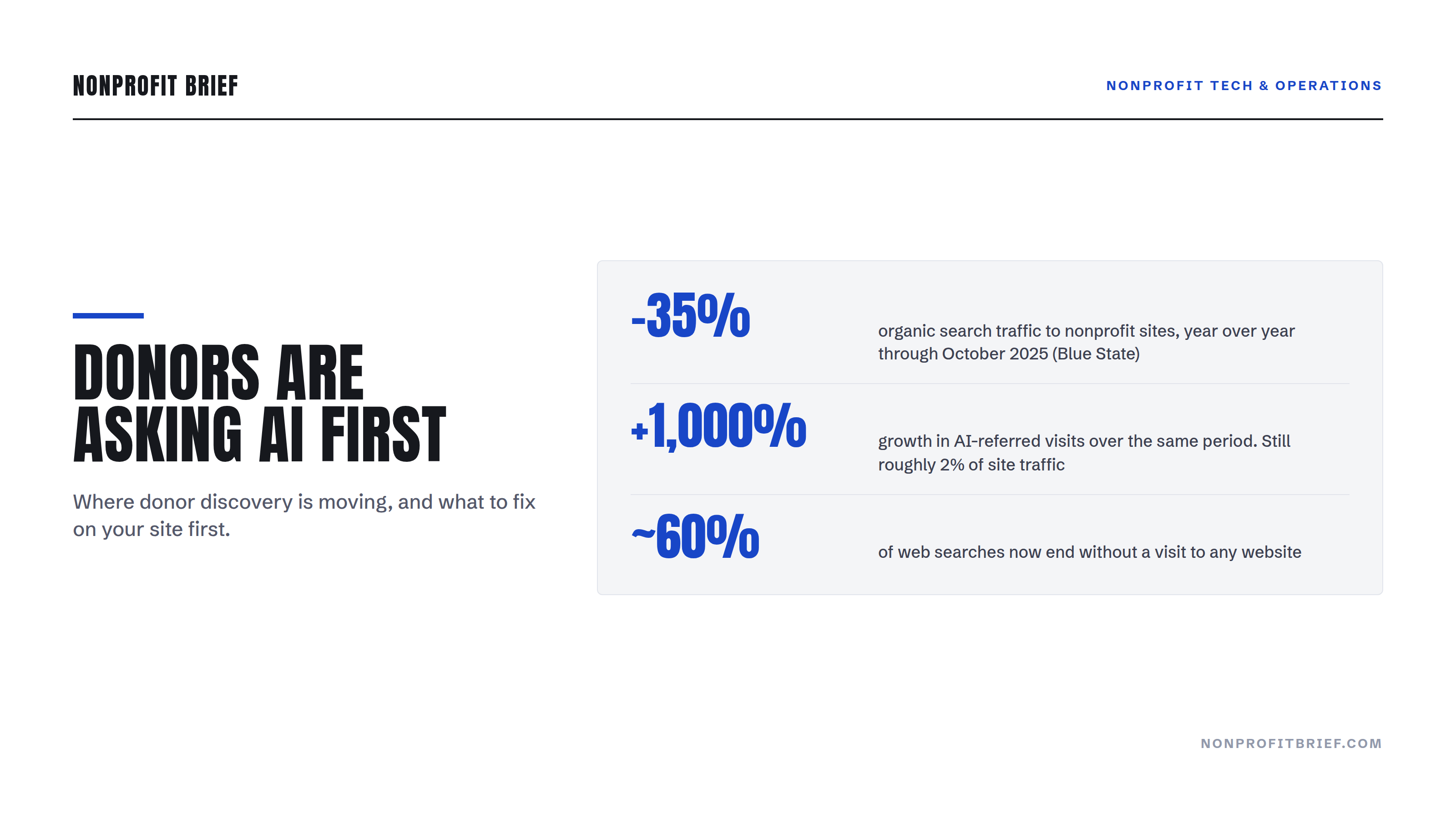
The load-bearing figures come from Blue State, a digital agency whose "Brand Discovery in the Age of AI" report analyzed years of traffic data from dozens of US-based causes. Its search and fundraising analysis found organic search traffic to nonprofit sites down 35% year over year through October 2025, while AI-referred traffic rose more than 1,000% over the same period. The firm also notes that nearly 60% of web searches now end without a visit to any website at all.
Those two growth rates need each other for context. A 1,000% increase sounds like a stampede, but it started from almost nothing: AI referrals still amounted to roughly 2% of nonprofit website traffic through October 2025, according to Candid's research roundup of the same report. Organic search, by contrast, was still driving more than a third of nonprofit website traffic, and nearly 30% of annual online revenue, as recently as December 2024. The story is not that AI referrals are replacing search visits one for one. It is that the search click is evaporating, and only a sliver of it is reappearing anywhere you can measure.
Donor behavior is starting to move the same direction. A Global Web Index survey of frequent donors fielded in July found nearly 6 million US donors now cite AI as a preferred tool for finding and learning about causes, according to the September Candid analysis. That is a small share of all donors. The direction is the point.
AI Visitors Research First and Give Later
The visitors who do arrive from an AI referral behave differently. Blue State's data, per Candid's roundup, shows they stay on nonprofit sites more than 70% longer than the average visitor but donate at roughly one eighth the average rate. When they do give, they give normally: about $250 on average, nearly identical to the $254 average for organic search visitors.
Read plainly, that is research traffic. Someone asked an AI assistant which organizations do credible work on a problem, got a short list, and came to inspect you. The gift, when it comes, often arrives later and through a different door: a branded search, a typed-in URL, an email signup that converts in December. Which means a last-click dashboard will systematically undercount what AI discovery is worth, and a board member reading one will conclude the channel is worthless. It is not. It is early, and it is bad at taking credit.
What to Check This Quarter
The fixes are unglamorous and mostly free, and they matter before year-end, when appeal season concentrates a year's worth of donor research into ten weeks.
Start with your robots.txt file, the plain-text file that tells crawlers what they may read. Plenty of organizations blocked AI crawlers wholesale in 2023 and 2024, when the only question on the table was model training. The bots have since split jobs: OpenAI's crawler documentation now distinguishes GPTBot, which gathers training data, from OAI-SearchBot, which decides whether ChatGPT's search answers can feature your site (opted-out sites can still surface as bare navigational links). A third agent, ChatGPT-User, fetches pages when a person directly asks about you, and robots.txt rules may not apply to it at all. Check what you are blocking, and make it a decision rather than a leftover.
Next, structure your site so a machine can quote it. AI assistants favor pages with claim-shaped headings, direct question-and-answer content, and text that lives in HTML rather than inside images or JavaScript. Google's structured data guide covers the markup that helps systems classify who you are, and a plain FAQ page about your programs, finances, and impact does more for AI visibility than any amount of homepage polish.
Third, tend the profiles you do not host. AI answers lean heavily on third-party sources: your Candid profile, your Charity Navigator listing, press coverage, and state registries. If those are stale or inconsistent with your website, the assistant inherits the confusion. This is the same lesson the sector keeps relearning about AI adoption generally: the tools moved in before the housekeeping was done.
Finally, measure what you can. Add chatgpt.com, perplexity.ai, and gemini.google.com as referrer segments in your analytics, and watch branded and direct traffic alongside them. And keep investing in the channel no algorithm sits between you and your donors: email you have authenticated still reaches the people who already said yes.
The Takeaway
Donor curiosity did not decline 35% last year. The click did. A growing set of donors now meets your organization inside an AI-generated answer, arrives informed, and gives later through channels your dashboard credits to something else. The response is not panic and it is not a consultant retainer. It is an afternoon of housekeeping: unblock the right crawlers, write pages a machine can quote, keep your third-party profiles current, and judge the channel by more than last-click revenue. The organizations in the answer box will be the ones that did the boring work first.